
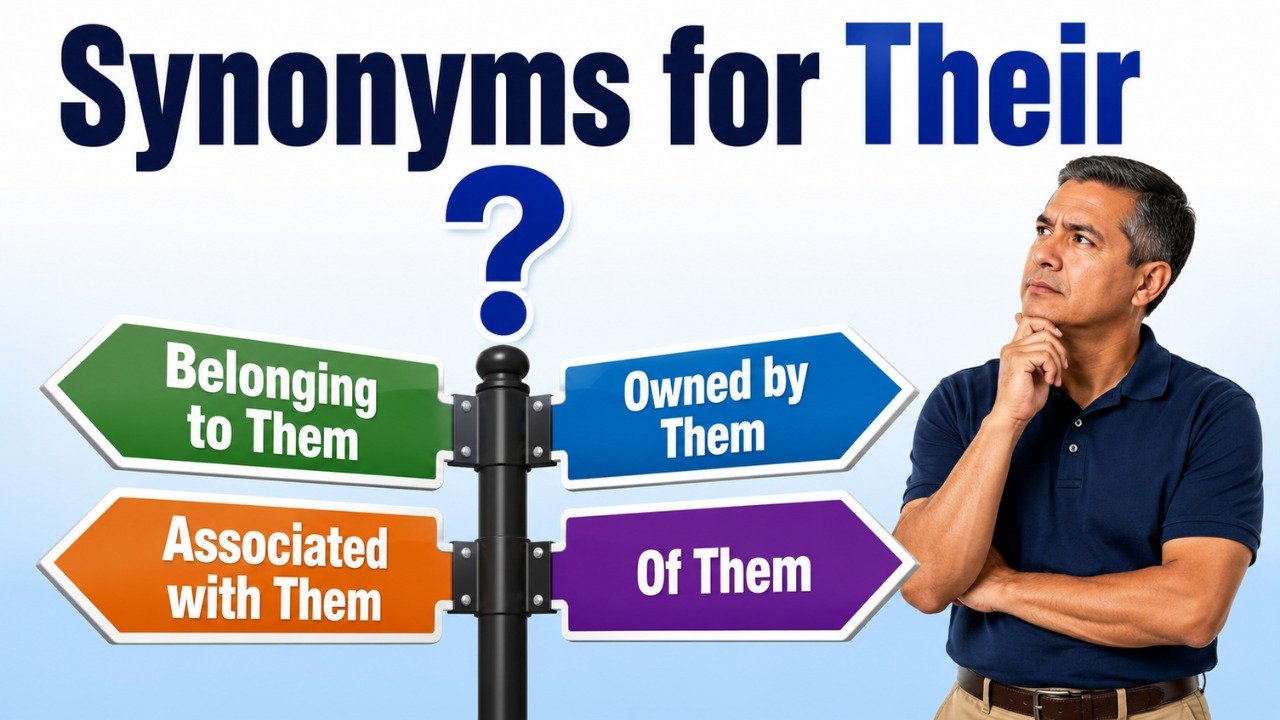
Quick Answer: Common synonyms for their include his or her, its, one’s, belonging to them, owned by them, of them, their own, belonging to the group, belonging to those people, and associated with them. However, their has no perfect synonym in every sentence because it is a possessive determiner. Use his or her when the owner is one unspecified person, its for a thing or organization, one’s in general formal statements, and belonging to them when possession needs to be explained explicitly.
Pronunciation and Word Details
Word: Their.
Pronunciation: /ðer/
Part of Speech: Possessive determiner.
Meaning: Belonging to, associated with, or relating to the people or person previously mentioned.
US Pronunciation:
UK Pronunciation:
What Does “Their” Mean?
Their means belonging to, associated with, or connected to certain people, a group, or sometimes one person whose gender is unknown or unimportant.
Their is normally placed before a noun.
For example, in the sentence “The students opened their books,” their shows that the books belong to the students.
The word can also refer to a singular person when the person’s gender is unknown, unspecified, or irrelevant.
For example, “Every applicant should bring their identification” uses their to refer naturally to each applicant.
Their is therefore an important possessive word in both plural and singular contexts.
Meaning, Tone, and Context of “Their”
Their has a neutral and natural tone. It appears in everyday conversation, academic writing, professional communication, instructions, stories, reports, essays, and formal documents.
Traditionally, their referred mainly to more than one person. Modern usage also commonly uses singular their when referring to a person whose gender is unknown, unspecified, or not relevant.
Their expresses possession or association without necessarily describing legal ownership.
For example, “their ideas” means ideas associated with or held by them, while “their house” normally means the house belonging to them.
Because their is a grammatical function word, replacing it usually requires changing the structure of the sentence rather than finding one exact synonym.
When and How to Use “Their”
For Plural Possession: Use their when something belongs to two or more people.
Example: The children packed their bags before leaving.
For Singular Reference: Use their when referring to one person whose gender is unknown or not important.
Example: Each student should submit their assignment by Friday.
For Groups: Use their when describing something associated with a team, family, organization, or community.
Example: The committee presented their recommendations.
For Ownership: Their can identify objects owned or controlled by certain people.
Example: They sold their old furniture before moving.
For Ideas and Opinions: Use their for thoughts, beliefs, decisions, or perspectives associated with people.
Example: The researchers explained their conclusions clearly.
For Experiences: Their can connect people with events, feelings, achievements, or difficulties.
Example: The athletes celebrated their victory.
Best Synonyms for Their
His or Her: Belonging to one unspecified male or female person.
Example: Every participant may bring his or her identification.
Its: Belonging to a thing, animal, institution, or organization treated grammatically as singular.
Example: The company updated its policy.
One’s: Belonging to an unspecified person in general statements.
Example: It is important to protect one’s privacy.
Belonging to Them: Owned or possessed by those people.
Example: The bicycles belonging to them were stored outside.
Owned by Them: Legally or personally possessed by those people.
Example: The property owned by them was recently renovated.
Of Them: Connected with or associated with those people in certain sentence structures.
Example: Several ideas of theirs were accepted.
Their Own: Belonging specifically to them rather than someone else.
Example: They wanted their own workspace.
Belonging to the Group: Possessed or associated with a particular group.
Example: The equipment belonging to the group was returned.
Belonging to Those People: Explicitly indicating possession by previously identified people.
Example: The bags belonging to those people were placed nearby.
Associated With Them: Connected with those people without necessarily indicating ownership.
Example: Several projects associated with them became successful.
50 Synonyms for Their with Short Meanings
- His or Her: Belonging to one unspecified person.
- Its: Belonging to a singular thing or organization.
- One’s: Belonging to an unspecified person generally.
- Belonging to Them: Possessed by those people.
- Owned by Them: Legally or personally possessed by them.
- Possessed by Them: Held or controlled by them.
- Of Them: Associated with those people.
- Their Own: Belonging specifically to them.
- Theirs: Something that belongs to them.
- Belonging to the Group: Possessed by a particular group.
- Owned by the Group: Belonging legally to a group.
- Possessed by the Group: Held or controlled by a group.
- Of the Group: Associated with a particular group.
- Belonging to Those People: Possessed by previously mentioned people.
- Owned by Those People: Held as property by those people.
- Associated With Them: Connected with those people.
- Connected With Them: Related to those people.
- Linked to Them: Having a connection with them.
- Related to Them: Associated with them in some way.
- Pertaining to Them: Formally relating to them.
- Attached to Them: Connected or assigned to them.
- Assigned to Them: Designated for their use or responsibility.
- Allocated to Them: Officially given for their use.
- Given to Them: Provided to them.
- Granted to Them: Formally provided or awarded to them.
- Provided to Them: Supplied for their use.
- Issued to Them: Officially supplied to them.
- Entrusted to Them: Placed under their care.
- Under Their Control: Managed or controlled by them.
- Under Their Ownership: Legally belonging to them.
- In Their Possession: Currently held by them.
- In Their Care: Being looked after by them.
- For Them: Intended for their use or benefit.
- Intended for Them: Specifically meant for those people.
- Reserved for Them: Kept specifically for their use.
- Designated for Them: Officially assigned to them.
- Available to Them: Accessible for their use.
- Used by Them: Employed or operated by those people.
- Managed by Them: Controlled or administered by them.
- Run by Them: Operated by those people.
- Created by Them: Produced by those people.
- Made by Them: Produced or prepared by those people.
- Chosen by Them: Selected by those people.
- Selected by Them: Picked by those people.
- Developed by Them: Created or improved by those people.
- Representing Them: Acting for or expressing those people.
- Concerning Them: Relating directly to those people.
- Regarding Them: Connected with those people as a subject.
- Personal to Them: Specifically belonging or relating to them.
- Particular to Them: Specifically associated with those people.
Read Also:
Synonyms for Custom
Synonyms for Their by Context
When Their Shows Ownership
When their indicates possession, useful alternatives include belonging to them, owned by them, possessed by them, under their ownership, and in their possession.
Example: Their house is near the park.
Alternative: The house belonging to them is near the park.
These alternatives are more explicit but usually longer than their.
When Their Refers to One Person
When their refers to a single unspecified person, alternatives may include his or her or one’s depending on sentence structure.
Example: Every employee should check their schedule.
Alternative: Every employee should check his or her schedule.
Their is usually more concise and natural when gender does not need to be specified.
When Their Refers to a Thing or Organization
If the owner is a singular thing, institution, or organization, its may be appropriate instead.
Example: The company changed their approach.
Alternative: The company changed its approach.
The correct choice may depend on whether the organization is treated grammatically as a single unit or as a group of people.
When Their Means Associated With Them
Sometimes their shows association rather than literal possession.
Example: Their opinion influenced the final decision.
Alternative: The opinion associated with them influenced the final decision.
Connected with them, related to them, and pertaining to them can also work in suitable contexts.
When Their Emphasizes Personal Ownership
Their own adds emphasis and makes personal possession clearer.
Example: They finally opened their business.
Alternative: They finally opened their own business.
Their own emphasizes that the business belongs specifically to them.
Another Word for Their
There is no single synonym that can replace their naturally in every sentence. The best alternative depends on the owner and the grammatical structure.
His or her can sometimes replace singular their. Its works when the possessor is a singular thing or organization. One’s is useful in formal general statements. Belonging to them is the clearest phrase when possession needs to be stated explicitly.
Original: Every student should bring their notebook.
Better Option: Every student should bring his or her notebook.
Original: The organization changed their policy.
Better Option: The organization changed its policy.
Original: It is important to understand their responsibilities.
Better Option: It is important to understand one’s responsibilities.
Original: Their bicycles were parked outside.
Better Option: The bicycles belonging to them were parked outside.
When Not to Use “Their”
Do not use their when the correct possessive form should be there or they’re. These words sound similar but have completely different meanings.
Weak: The books are over their.
Better: The books are over there.
Their may also be unnecessarily vague when readers cannot determine who the owner is.
Weak: They discussed the report with the managers before changing their decision.
Better: They discussed the report with the managers before changing the managers’ decision.
In formal sentences about singular organizations, its may sometimes provide greater grammatical clarity.
Weak: The company announced their new policy.
Better: The company announced its new policy.
However, avoid replacing singular their with awkward wording when their is already clear and natural.
Weak: Every visitor should leave his or her coat at the entrance.
Better: Every visitor should leave their coat at the entrance.
The best choice depends on style, clarity, sentence structure, and intended meaning.
Words Commonly Confused With Their
Their vs There: Their shows possession, while there refers to a place, position, existence, or situation.
Example With Their: Their car is parked outside.
Example With There: The car is parked over there.
Their vs They’re: Their is possessive, while they’re is the contraction of they are.
Example With Their: Their plans changed suddenly.
Example With They’re: They’re changing their plans.
Their vs Theirs: Their appears before a noun, while theirs normally stands alone.
Example With Their: That is their house.
Example With Theirs: That house is theirs.
Their vs Its: Their normally refers to people or plural possessors, while its usually refers to a singular thing, animal, institution, or organization.
Example With Their: The students completed their work.
Example With Its: The machine completed its cycle.
Their vs His or Her: Their can refer naturally to a person whose gender is unspecified. His or her explicitly mentions the traditional male and female alternatives.
Example With Their: Someone forgot their umbrella.
Example With His or Her: Each applicant must provide his or her address.
Their vs One’s: Their usually refers to a specific or previously mentioned person or people, while one’s is common in general formal statements.
Example With Their: Everyone should check their ticket.
Example With One’s: Protecting one’s privacy is important.
Which Synonym Should You Choose?
Choose their for natural possession involving multiple people.
Choose their for one person when gender is unknown, unspecified, or irrelevant.
Choose his or her when a formal style specifically requires that construction.
Choose its when a singular object, organization, institution, or other nonhuman entity is the possessor.
Choose one’s for general statements in formal writing.
Choose belonging to them when ownership must be explained explicitly.
Choose owned by them when legal or actual ownership is the main point.
Choose associated with them when the relationship is not literal ownership.
Choose their own when you want to emphasize personal possession or independence.
Choose theirs when the possessive word must stand alone rather than appear before a noun.
Real Life Examples of “Their” in Sentences
Original: The students placed their books on the table.
Better Option: The students placed the books belonging to them on the table.
Original: Everyone should check their email before the meeting.
Better Option: Everyone should check his or her email before the meeting.
Original: The organization updated their website.
Better Option: The organization updated its website.
Original: People should protect their personal information.
Better Option: People should protect information personal to them.
Original: The owners sold their property.
Better Option: The owners sold the property owned by them.
Original: Each applicant should review their form.
Better Option: Each applicant should review his or her form.
Original: The team celebrated their success.
Better Option: The team celebrated the success associated with them.
Original: They wanted their own office.
Better Option: They wanted an office of their own.
Original: The children collected their belongings.
Better Option: The children collected the belongings in their possession.
Original: The researchers published their findings.
Better Option: The researchers published the findings developed by them.
Synonym Groups and Usage Differences
Possession Group
Belonging to them, owned by them, possessed by them, under their ownership, and in their possession emphasize possession.
Use these phrases when ownership must be made especially clear.
Example: The property owned by them was sold last month.
Singular Reference Group
His or her, one’s, and singular their can refer to one unspecified person.
Their is usually the most concise option in ordinary modern writing.
Example: Every customer should keep their receipt.
Group Reference Group
Belonging to the group, owned by the group, of the group, and associated with the group work when possession relates to several people collectively.
Example: The equipment belonging to the group was returned.
Association Group
Associated with them, connected with them, related to them, linked to them, and pertaining to them indicate a relationship rather than strict ownership.
Example: Several projects associated with them received attention.
Assignment Group
Assigned to them, allocated to them, provided to them, issued to them, and entrusted to them describe something given for a particular purpose.
Example: The materials assigned to them were stored separately.
Antonyms of Their
Their does not have a simple direct antonym because it is a possessive determiner. Opposite ideas depend on who owns or does not own something.
My: Belonging to the speaker.
Your: Belonging to the person being addressed.
Our: Belonging to the speaker and others.
His: Belonging to a male person.
Her: Belonging to a female person.
Its: Belonging to a singular thing or entity.
Someone Else’s: Belonging to another person.
Not Theirs: Explicitly indicating that something does not belong to them.
Unowned: Having no owner.
Shared: Belonging collectively rather than exclusively to them.
Comparison: Their vs Related Words
Their vs There
Their expresses possession. There usually refers to a place or indicates existence.
Example With Their: Their apartment is nearby.
Example With There: Their apartment is over there.
Their vs They’re
Their is a possessive determiner. They’re means they are.
Example With Their: Their meeting begins soon.
Example With They’re: They’re preparing for the meeting.
Their vs Theirs
Their must normally be followed by a noun. Theirs can stand alone.
Example With Their: This is their table.
Example With Theirs: This table is theirs.
Their vs His or Her
Their can refer to an unspecified individual naturally and concisely. His or her is longer and explicitly refers to traditional gender alternatives.
Example With Their: Every student should bring their pen.
Example With His or Her: Every student should bring his or her pen.
Their vs Its
Their commonly refers to people, while its refers to a singular thing or organization when treated as one unit.
Example With Their: The players changed their strategy.
Example With Its: The organization changed its strategy.
Their vs One’s
Their generally refers to someone identifiable from context. One’s is more general and often more formal.
Example With Their: Everyone should respect their responsibilities.
Example With One’s: It is important to respect one’s responsibilities.
Common Phrases and Expressions With Their
Their Own: Belonging specifically to them.
Their Way: The method, direction, or preference associated with them.
Their Best: The greatest effort or performance they can provide.
Their Opinion: A view or belief held by them.
Their Choice: A decision or option selected by them.
Their Responsibility: A duty assigned to or belonging to them.
Their Decision: A choice made by them.
Their Home: The place where they live or which belongs to them.
Their Work: Work created, performed, or managed by them.
Their Future: Future circumstances or experiences connected with them.
Common Mistakes to Avoid
One of the most common mistakes is confusing their, there, and they’re. Their shows possession, there usually refers to location or existence, and they’re means they are.
Another mistake is confusing their with theirs. Their normally comes before a noun, while theirs stands independently.
Incorrect: The blue car is their.
Correct: The blue car is theirs.
Writers may also use their when the intended possessor is unclear. Make sure readers can easily identify who their refers to.
Do not assume singular their is automatically incorrect. It is widely used when referring to an individual whose gender is unknown, unspecified, or irrelevant.
Avoid replacing their with his or her repeatedly if the sentence becomes awkward. The best grammatical choice should preserve clarity and natural flow.
Finally, remember that most alternatives for their require restructuring the sentence because their performs a specific grammatical function.
Conclusion
Synonyms for their are usually grammatical alternatives or possessive phrases rather than perfect one word replacements. Useful options include his or her, its, one’s, theirs, belonging to them, owned by them, associated with them, and their own. Use their naturally for plural possession and for singular references when gender is unspecified. Choose its for singular things or organizations, one’s for general formal statements, and belonging to them when ownership needs explicit emphasis. The best alternative always depends on who possesses something and how the sentence is structured.
FAQs About Synonyms for Their
What Is the Best Synonym for Their?
There is no universal synonym. His or her, its, one’s, theirs, or belonging to them may work depending on sentence structure and meaning.
What Is Another Word for Their in Formal Writing?
One’s, his or her, its, belonging to them, and associated with them may work in formal contexts depending on the intended possessor.
Can Their Refer to One Person?
Yes. Their can refer to a single person when gender is unknown, unspecified, or irrelevant.
What Is the Difference Between Their and Theirs?
Their appears before a noun, as in “their house.” Theirs stands alone, as in “the house is theirs.”
What Is the Difference Between Their and There?
Their indicates possession. There usually refers to a location or indicates that something exists.
What Is the Difference Between Their and They’re?
Their is possessive, while they’re is a contraction meaning they are.
Can Its Replace Their?
Only in certain contexts. Its is appropriate when the possessor is a singular thing, institution, organization, or other entity treated grammatically as one unit.
