
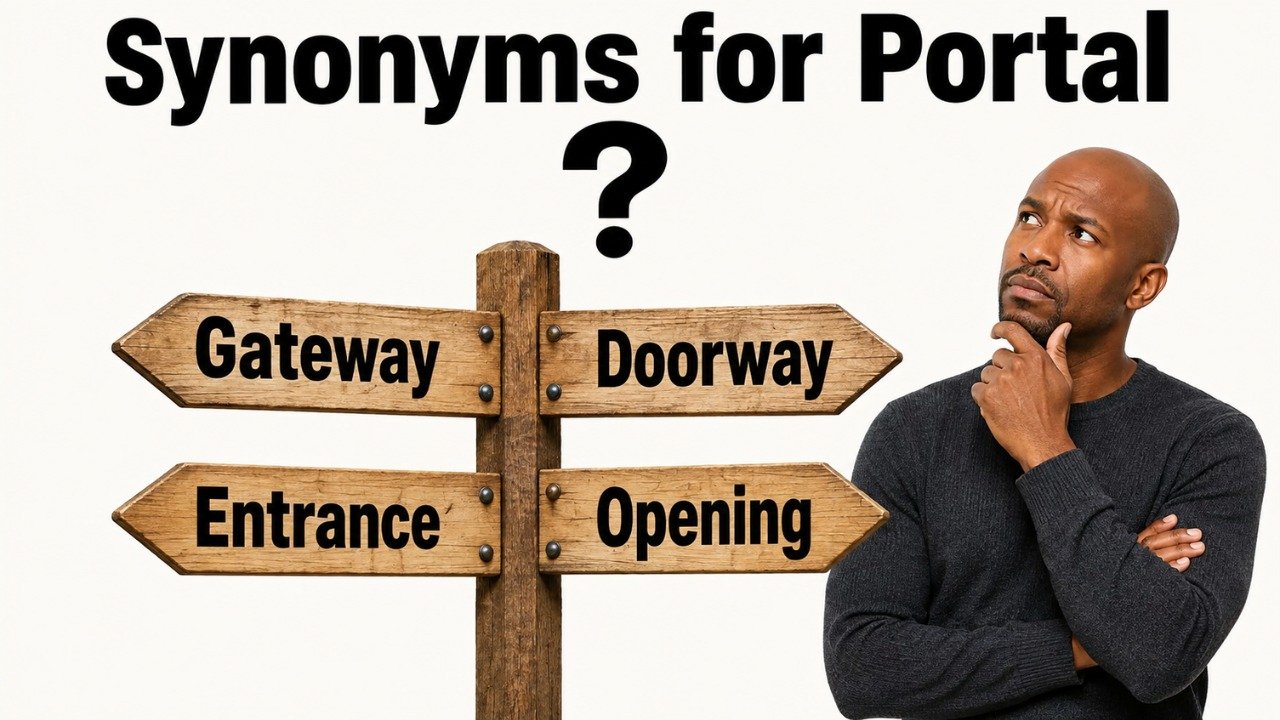
Quick Answer: Common synonyms for portal include gateway, entrance, doorway, entryway, opening, access point, hub, platform, dashboard, and website. Use gateway for a grand or symbolic entrance, doorway for an opening in a wall, and entryway for the area through which people enter. In digital contexts, use website for a collection of online pages, dashboard for a control screen, hub for a central source of information, and access point for a place that connects users to a system.
Pronunciation and Word Details
Word: Portal.
Pronunciation: /ˈpɔːrtəl/
Part of Speech: Noun.
Meaning: An entrance, gateway, or digital access point that leads into a place, system, or collection of information.
US Pronunciation:
UK Pronunciation:
What Does “Portal” Mean?
Portal means an entrance or access point that leads into another place, space, system, or source of information.
As a noun, portal can describe a large or impressive doorway, especially at the entrance to an important building. It can also describe a website, dashboard, or online system through which users access information, services, documents, or tools.
The word often suggests more than an ordinary door. A physical portal may sound grand, decorative, mysterious, symbolic, or ceremonial. A digital portal usually provides organized access to several resources from one location.
Architectural Context: Visitors entered through the stone portal.
Digital Context: Employees can view their schedules through the staff portal.
Educational Context: Students submit assignments through the learning portal.
Business Context: Customers can manage their accounts through the online portal.
Imaginative Context: The mirror became a portal to another world.
Portal can therefore refer to a real entrance, a figurative gateway, or a digital point of access.
Meaning, Tone, and Context of “Portal”
Portal has a neutral to formal tone, depending on the context.
In architecture, portal often sounds formal, historical, descriptive, or grand. It may refer to an elaborate doorway, arch, gate, or entrance to a building.
In technology and business, portal is a common technical term. It describes a central online location where users can sign in, find information, complete tasks, or access services.
In fantasy, storytelling, and imaginative writing, portal can sound mysterious or dramatic. It may describe a magical opening that connects two worlds, times, or dimensions.
Formal Tone: The main portal features carved stone columns.
Technical Tone: Users must sign in through the secure portal.
Business Tone: The customer portal displays invoices and account details.
Academic Tone: The research portal provides access to archived materials.
Imaginative Tone: The glowing portal opened into an unknown realm.
Symbolic Tone: Education can be a portal to greater opportunity.
Portal is useful when the idea of access, transition, connection, or entry is important. A more specific synonym may be better when the sentence refers only to an ordinary door, website, dashboard, or sign in page.
When and How to Use “Portal”
For Building Entrances
Use portal when describing a large, important, decorated, or impressive entrance to a building.
Example: The cathedral portal was covered with detailed carvings.
For Ordinary Openings
Use portal when the entrance has a formal, architectural, or symbolic quality. For a normal entrance, doorway or entrance may sound more natural.
Example: The ancient portal led into a quiet courtyard.
For Online Services
Use portal for a website or system that provides access to several services, records, or tools.
Example: Customers can update their details through the online portal.
For Employee Access
Use portal when workers access schedules, benefits, documents, or company information from one central system.
Example: Staff members can download forms from the employee portal.
For Student Access
Use portal for systems that allow students to view courses, submit work, check results, or contact instructors.
Example: The student portal displays grades and course announcements.
For Customer Accounts
Use portal when users can sign in to manage personal information, orders, payments, or requests.
Example: The customer portal allows users to view previous transactions.
For Central Information
Use portal when one digital location connects users to many related resources.
Example: The health portal contains appointments, reports, and account information.
For Figurative Entry
Use portal to describe something that creates access to knowledge, opportunity, experience, or change.
Example: Reading can be a portal to new ideas.
For Fantasy and Fiction
Use portal for a magical, scientific, or imaginary opening between locations, worlds, or periods.
Example: The characters discovered a portal beneath the abandoned tower.
Best Synonyms for Portal
Gateway
Synonym: Gateway means an entrance or access point that leads into a place, system, or opportunity.
Example: The archway formed a gateway to the palace garden.
Entrance
Synonym: Entrance means the place through which someone enters a building, room, or area.
Example: The main entrance is located beside the courtyard.
Doorway
Synonym: Doorway means the opening in a wall where a door is placed.
Example: She stood in the doorway and waited.
Entryway
Synonym: Entryway means an entrance or the space immediately inside it.
Example: The entryway was decorated with plants and framed pictures.
Opening
Synonym: Opening means a gap or space through which someone or something can pass.
Example: Light entered through the narrow opening.
Access Point
Synonym: Access point means a place or system through which entry or connection is provided.
Example: The page serves as the main access point for account services.
Hub
Synonym: Hub means a central place where information, services, people, or activities are gathered.
Example: The website is a useful hub for training materials.
Platform
Synonym: Platform means a digital system that supports communication, services, tools, or activities.
Example: The learning platform contains lessons and assessments.
Dashboard
Synonym: Dashboard means a screen that displays important information, controls, or account details.
Example: The dashboard shows recent activity and upcoming deadlines.
Website
Synonym: Website means a collection of connected online pages available through one address.
Example: The organization publishes updates on its website.
50 Synonyms for Portal with Short Meanings
- Gateway: An entrance or point of access.
- Entrance: A place through which people enter.
- Doorway: An opening in a wall for a door.
- Entryway: An entrance or the area beside it.
- Opening: A gap that allows entry or passage.
- Access Point: A place that provides entry or connection.
- Entry Point: A location where access begins.
- Way In: A route or opening used to enter.
- Door: A movable barrier covering an entrance.
- Gate: A movable entrance in a wall or fence.
- Archway: An entrance or passage with a curved top.
- Passage: A route connecting one place with another.
- Passageway: A path or corridor used for movement.
- Threshold: The point or boundary at an entrance.
- Vestibule: A small entrance area inside a building.
- Foyer: An entrance hall in a building.
- Lobby: A public entrance area inside a building.
- Hallway: A passage connecting rooms or areas.
- Corridor: A long passage within a building.
- Ingress: A formal word for entry or access.
- Access: The means or permission to enter.
- Entry: The act or place of going inside.
- Openingway: A passage or opening that allows entry.
- Accessway: A path or route providing access.
- Approach: A route leading toward an entrance.
- Interface: A point where a user interacts with a system.
- Website: A collection of connected online pages.
- Webpage: A single page available online.
- Homepage: The main page of a website.
- Dashboard: A screen displaying key information and controls.
- Platform: A digital environment offering tools or services.
- Hub: A central source of information or activity.
- System: An organized digital service or structure.
- Network: A connected system of people, devices, or resources.
- Site: An online location containing information or services.
- Online Center: A central digital location for resources.
- Resource Center: A place where useful materials are collected.
- Information Center: A central source of organized information.
- Service Center: A location that provides related services.
- Control Panel: A screen used to manage settings or functions.
- User Interface: The visible system through which users interact.
- Login Page: A page where users enter account details.
- Sign In Page: A page used to access a personal account.
- Account Center: A digital area for managing account information.
- Workspace: A digital area where users complete tasks.
- Console: A control area used to manage a system.
- Directory: An organized list of links, services, or information.
- Landing Page: A page designed as an entry point for visitors.
- Bridge: Something that connects two places or systems.
- Channel: A route through which information or access is provided.
Read Also:
Synonyms for Plants

Synonyms for Portal by Context
When Portal Means a Building Entrance
Entrance, doorway, entryway, gateway, archway, gate, threshold, and vestibule are useful when portal refers to a physical entrance.
Example With Portal: The visitors gathered outside the main portal.
Example With Entrance: The visitors gathered outside the main entrance.
Entrance is the clearest general alternative. Doorway refers specifically to the opening where a door is placed. Gateway is stronger when the entrance is large, formal, symbolic, or connected to an enclosed area.
Archway is appropriate when the entrance has a curved structure. Threshold refers to the exact boundary between outside and inside.
When Portal Means an Interior Entrance Area
Foyer, lobby, vestibule, entryway, and hall are suitable when portal refers to the space around an entrance.
Example With Portal: Guests waited inside the portal before the event began.
Example With Foyer: Guests waited inside the foyer before the event began.
Foyer and lobby describe areas inside a building. Vestibule usually refers to a smaller enclosed space near the main entrance.
Entryway can refer to either the entrance itself or the area immediately inside it.
When Portal Means a Route of Access
Access point, entry point, accessway, passageway, approach, and way in describe a route through which entry becomes possible.
Example With Portal: The bridge is the only portal to the island.
Example With Access Point: The bridge is the only access point to the island.
Access point is clear and practical. Entry point is common when discussing security, travel, buildings, systems, or processes.
Passageway suggests a physical route connecting two spaces.
When Portal Means a Website
Website, site, homepage, webpage, online center, and landing page may replace portal in general digital contexts.
Example With Portal: Visit the portal for updated information.
Example With Website: Visit the website for updated information.
Website is the best broad alternative when the digital service consists of connected pages. Homepage refers only to the main page.
Landing page is more specific and describes a page where users first arrive or complete a particular action.
When Portal Means a Central Digital Resource
Hub, resource center, information center, online center, directory, and platform work when a portal collects several resources in one place.
Example With Portal: The portal contains guides, forms, and training materials.
Example With Resource Center: The resource center contains guides, forms, and training materials.
Hub suggests a central location connecting many resources. Resource center emphasizes helpful materials. Directory emphasizes organized links or listings.
When Portal Means an Account Management System
Dashboard, account center, control panel, workspace, console, and user interface are useful when users manage information or complete tasks.
Example With Portal: Users can view payments through the portal.
Example With Dashboard: Users can view payments through the dashboard.
Dashboard is best when the screen displays summaries, activity, controls, or account details. Account center is better when users mainly update personal information or preferences.
Control panel and console are more technical and often describe settings or administrative functions.
When Portal Means a Digital Service Environment
Platform, system, interface, network, and workspace work when the portal supports several activities or tools.
Example With Portal: The portal allows teams to communicate and share documents.
Example With Platform: The platform allows teams to communicate and share documents.
Platform is suitable when users actively work, communicate, learn, buy, sell, or manage services. System is broader and may include both visible and hidden technical parts.
Interface focuses on the part users see and interact with.
When Portal Means a Figurative Gateway
Gateway, bridge, channel, path, access point, and doorway are useful in figurative language.
Example With Portal: Education can be a portal to opportunity.
Example With Gateway: Education can be a gateway to opportunity.
Gateway is the strongest general replacement in figurative writing. Bridge emphasizes connection between two groups, ideas, or conditions.
Channel describes a route through which information, communication, or opportunity moves.
When Portal Means a Magical Opening
Gateway, doorway, opening, passage, threshold, and bridge can describe a fictional entrance to another world or dimension.
Example With Portal: The glowing portal led to another realm.
Example With Gateway: The glowing gateway led to another realm.
Gateway sounds dramatic and natural in fantasy. Doorway emphasizes the idea of passing from one space into another.
Threshold works well when the focus is the boundary between two worlds or stages.
Another Word for Portal
Gateway is often the best single replacement for portal because it works in physical, digital, symbolic, and imaginative contexts. However, entrance is clearer for buildings, website is better for general online content, and dashboard is more precise for an account management screen.
Original: The stone portal led into the castle.
Better Option: The stone gateway led into the castle.
Original: Users can submit requests through the portal.
Better Option: Users can submit requests through the online platform.
Original: The portal displays account activity.
Better Option: The dashboard displays account activity.
Original: Reading is a portal to greater understanding.
Better Option: Reading is a gateway to greater understanding.
When Not to Use “Portal”
Portal may sound too formal, technical, grand, or vague when a simpler word would communicate the meaning more clearly.
When You Mean an Ordinary Door
Use door or doorway when describing a normal household opening.
Weak: She walked through the kitchen portal.
Better: She walked through the kitchen doorway.
When You Mean a Building Entrance
Use entrance when the location is ordinary and does not have a grand architectural quality.
Weak: Please wait beside the supermarket portal.
Better: Please wait beside the supermarket entrance.
When You Mean a Basic Website
Portal may sound unnecessarily technical when the page is simply a general website.
Weak: Visit our information portal to read the article.
Better: Visit the website to read the article.
When You Mean a Login Page
Portal can be too broad when the sentence refers only to the page where users enter account details.
Weak: Enter your password on the portal.
Better: Enter your password on the sign in page.
When You Mean a Dashboard
Use dashboard when the page shows account information, summaries, charts, settings, or controls.
Weak: The portal shows your recent activity and balances.
Better: The dashboard shows your recent activity and balances.
When You Mean a Complete Digital Platform
Portal may understate the range of functions provided by a complex system.
Weak: The portal allows users to create projects, communicate, and manage files.
Better: The platform allows users to create projects, communicate, and manage files.
When the Meaning Is Unclear
Explain whether the portal is a website, dashboard, entrance, or gateway.
Weak: Open the portal and continue.
Better: Open the customer dashboard and select the payment section.
When Portal Is Repeated Too Often
Use precise alternatives to improve clarity and rhythm.
Weak: The portal gives users access to the portal settings, portal documents, and portal services.
Better: The platform gives users access to account settings, documents, and online services.
Words Commonly Confused With Portal
Portal vs Gateway: Portal and gateway can both describe an entrance or point of access. Portal often sounds more formal, technical, or imaginative, while gateway is more flexible and natural in figurative language.
Portal vs Entrance: Portal may suggest a grand, decorated, or important entrance. Entrance is the broad everyday word for any place used to enter.
Portal vs Doorway: Portal can refer to a physical or digital access point. Doorway refers specifically to an opening in a wall where a door is placed.
Portal vs Website: Portal usually provides organized access to multiple services, records, tools, or accounts. Website is a broader term for any collection of connected online pages.
Portal vs Platform: Portal mainly provides access to information or services. Platform often supports active tasks, communication, transactions, creation, or collaboration.
Portal vs Dashboard: Portal refers to the wider access system. Dashboard refers to the screen that displays summaries, controls, and account information.
Portal vs Homepage: Portal may include many pages and functions. Homepage is only the main introductory page of a website.
Portal vs Interface: Portal is the access location or system. Interface is the visible structure through which a user interacts with that system.
Portal vs Hub: Portal emphasizes entry and access. Hub emphasizes centralization and connection.
Portal vs Login Page: Portal may contain many services after a user signs in. A login page only collects account credentials.
Which Synonym Should You Choose?
Choose gateway when describing a grand entrance, symbolic opening, or path to opportunity.
Choose entrance when referring to the general place through which people enter.
Choose doorway when referring to an opening in a wall.
Choose entryway when describing an entrance or the area immediately inside it.
Choose archway when the entrance has a curved upper structure.
Choose threshold when emphasizing the boundary between two spaces or stages.
Choose access point when describing a practical place or system through which entry is provided.
Choose entry point when focusing on where a journey, process, or system begins.
Choose website when referring to a general collection of online pages.
Choose homepage when referring only to the main page of a website.
Choose platform when the digital service supports several activities, tools, or interactions.
Choose dashboard when users view account information, summaries, controls, or reports.
Choose hub when a digital location connects several resources or services.
Choose resource center when the main purpose is to provide guides, documents, or educational materials.
Choose account center when users manage personal details, settings, payments, or preferences.
Choose control panel when users change technical or administrative settings.
Choose interface when describing the visible part of a system that users interact with.
Choose workspace when users create, organize, or complete tasks online.
Choose bridge when something connects different people, places, systems, or ideas.
Choose portal when the idea of entry, connection, transition, or centralized access is important.
Real Life Examples of “Portal” in Sentences
Original: Visitors entered the building through the eastern portal.
Better Option: Visitors entered the building through the eastern entrance.
Original: The stone portal was decorated with carved figures.
Better Option: The stone gateway was decorated with carved figures.
Original: Students can view their results through the portal.
Better Option: Students can view their results through the online dashboard.
Original: The portal contains forms, guides, and announcements.
Better Option: The resource center contains forms, guides, and announcements.
Original: Employees use the portal to manage their schedules.
Better Option: Employees use the platform to manage their schedules.
Original: The portal asks users to enter their passwords.
Better Option: The sign in page asks users to enter their passwords.
Original: The glowing portal led into another world.
Better Option: The glowing gateway led into another world.
Original: Education is a portal to better opportunities.
Better Option: Education is a gateway to better opportunities.
Original: The customer portal displays recent payments.
Better Option: The customer dashboard displays recent payments.
Original: The portal connects users with several support services.
Better Option: The online hub connects users with several support services.
Synonym Groups and Usage Differences
Entrance Group
Entrance, doorway, entryway, gate, archway, opening, and threshold describe physical places used for entry.
Entrance is the broadest term. Doorway refers to the opening where a door is placed. Entryway may include the space immediately inside the entrance.
Example: The main entrance opens into a spacious hall.
Passage Group
Passage, passageway, corridor, hallway, accessway, and approach describe routes that lead through or toward a place.
Passageway and corridor usually connect different areas. Approach refers to the route leading toward an entrance.
Example: A narrow passageway connected the two buildings.
Formal Access Group
Ingress, access, entry point, access point, and way in describe entry in formal, technical, or practical contexts.
Ingress is highly formal and often appears in technical, legal, architectural, or planning contexts. Access point is clear and widely useful.
Example: The rear gate is the main access point for deliveries.
Website Group
Website, webpage, homepage, site, and landing page refer to online locations.
Website describes the complete collection of pages. Webpage describes one page. Homepage is the main page, while a landing page is designed for a specific visitor action.
Example: The website contains information about every available service.
Platform Group
Platform, system, network, workspace, and interface describe digital environments that support activity or interaction.
Platform emphasizes tools and activities. System is broader and can include technical processes. Workspace focuses on tasks and productivity.
Example: The platform allows users to share files and manage projects.
Dashboard Group
Dashboard, control panel, console, account center, and user interface describe screens used to view or manage information.
Dashboard presents summaries and controls. Control panel emphasizes settings. Console often has a more technical or administrative meaning.
Example: The dashboard displays recent transactions and account notices.
Information Group
Hub, information center, resource center, directory, online center, and service center describe central locations for organized information.
Hub emphasizes connection. Resource center emphasizes useful materials. Directory emphasizes organized listings.
Example: The online hub brings all training resources together.
Figurative Access Group
Gateway, bridge, doorway, channel, threshold, and path describe access to opportunities, ideas, knowledge, or change.
Gateway emphasizes opportunity. Bridge emphasizes connection. Threshold suggests the beginning of a new stage.
Example: The internship became a gateway to a successful career.
Antonyms of Portal
The opposite of portal depends on whether the word refers to an entrance, digital access point, or route of connection.
Barrier: Something that prevents access or movement.
Wall: A structure that blocks entry or passage.
Blockade: Something placed to stop movement or access.
Obstruction: An object or condition that blocks a route.
Closure: The act or state of preventing entry.
Exit: A place used to leave rather than enter.
Dead End: A route that does not continue.
Restriction: A rule or condition that limits access.
Denial: A refusal to provide entry or permission.
Lockout: A situation in which access to a system is prevented.
Disconnection: A break in access or communication.
Isolation: Separation from other people, places, or systems.
Boundary: A line that separates areas and may prevent passage.
Seal: A closure that blocks an opening.
Exclusion: The act of keeping someone or something out.
Comparison: Portal vs Related Words
Portal vs Gateway
Portal often suggests a formal, impressive, technical, or imaginative entrance. Gateway is more natural in general and figurative writing.
Example With Portal: The ancient portal was covered with symbols.
Example With Gateway: The course became a gateway to new career opportunities.
Portal vs Entrance
Portal may sound grand or architectural. Entrance is the normal word for the place through which someone enters.
Example With Portal: The palace portal featured carved stone figures.
Example With Entrance: Please meet me at the main entrance.
Portal vs Doorway
Portal can refer to physical, digital, or imaginary access. Doorway refers specifically to a physical opening for a door.
Example With Portal: The portal connected the two virtual environments.
Example With Doorway: She left the package beside the doorway.
Portal vs Website
Portal usually organizes access to several services, accounts, or resources. Website is the broad term for connected online pages.
Example With Portal: Customers can manage invoices through the portal.
Example With Website: The website contains information about the organization.
Portal vs Platform
Portal primarily gives access. Platform usually allows users to perform several activities or interact with tools and other users.
Example With Portal: The portal provides access to account documents.
Example With Platform: The platform supports communication and project management.
Portal vs Dashboard
Portal refers to the wider digital entry system. Dashboard is the screen that presents important data, summaries, and controls.
Example With Portal: Sign in through the employee portal.
Example With Dashboard: Check the dashboard for your weekly schedule.
Portal vs Hub
Portal emphasizes entry into a system. Hub emphasizes a central place connecting several resources or activities.
Example With Portal: The portal requires account verification.
Example With Hub: The learning hub contains videos, guides, and exercises.
Portal vs Interface
Portal is an access point or digital location. Interface is the visible arrangement through which users interact with a system.
Example With Portal: The portal connects users to several services.
Example With Interface: The interface uses simple menus and clear buttons.
Portal vs Login Page
Portal is the complete access environment. Login page is only the screen where users enter their credentials.
Example With Portal: The portal contains account records and support tools.
Example With Login Page: The login page asks for an email address and password.
Portal vs Access Point
Portal can sound formal, digital, or imaginative. Access point is more direct and practical.
Example With Portal: The portal leads into the main hall.
Example With Access Point: The side gate is the only access point after sunset.
Common Phrases and Expressions With “Portal”
Online Portal: A digital location that provides access to services or information.
Customer Portal: A secure system where customers manage accounts or requests.
Employee Portal: An online system containing workplace information and tools.
Student Portal: A digital system for courses, grades, schedules, and assignments.
Patient Portal: A secure system for appointments, records, and account information.
Payment Portal: An online system used to make or manage payments.
Learning Portal: A digital location containing lessons, resources, and assessments.
Service Portal: A system that gives users access to support or services.
Secure Portal: A protected digital system requiring identity verification.
Web Portal: A website that organizes links, services, or information in one place.
Main Portal: The primary or most important entrance.
Stone Portal: A doorway or entrance constructed from stone.
Magical Portal: An imaginary opening to another world or place.
Portal to Opportunity: A figurative gateway to progress or success.
Portal of Entry: A formal phrase describing a place through which entry occurs.
Common Mistakes to Avoid
Using Portal for Every Website
Not every website is a portal. Portal usually suggests access to several organized resources, services, or account functions.
Incorrect: I read one article on the news portal page.
Better: I read the article on the website.
Using Portal Instead of Dashboard
Use dashboard when referring to a screen that displays data, summaries, or controls.
Unclear: The portal shows your monthly activity.
Clearer: The dashboard shows your monthly activity.
Using Portal for an Ordinary Door
Portal can sound too grand or dramatic in a simple domestic context.
Unnatural: He opened the bedroom portal.
Better: He opened the bedroom door.
Confusing Portal With Platform
A portal mainly provides access. A platform usually supports multiple activities, tools, or interactions.
Unclear: The portal lets users design projects and work together.
Clearer: The platform lets users design projects and work together.
Confusing Homepage With Portal
A homepage is only one page. A portal may include many pages, services, tools, and account areas.
Incorrect: Enter your account details on the homepage portal.
Better: Enter your account details on the sign in page.
Using Gateway in Every Digital Context
Gateway can work figuratively, but portal, platform, dashboard, or access point may be more precise in technical writing.
Vague: Open the payment gateway to view your account history.
Better: Open the payment portal to view your account history.
Repeating Portal Too Often
Replace repeated uses with precise terms that match each function.
Repetitive: The portal contains a portal dashboard, portal settings, and portal resources.
Improved: The platform contains a dashboard, account settings, and a resource center.
Failing to Explain the Portal’s Purpose
Readers should know what they can access or do.
Vague: Visit the portal for more.
Clearer: Visit the customer portal to view invoices and update payment details.
Using Physical Synonyms in Digital Contexts
Doorway, archway, and vestibule usually sound unnatural when describing online systems.
Incorrect: Open the account vestibule to change your password.
Correct: Open the account center to change your password.
Using Digital Synonyms for Physical Entrances
Dashboard, website, and interface cannot replace portal when describing a building entrance.
Incorrect: Visitors entered through the stone dashboard.
Correct: Visitors entered through the stone gateway.
Conclusion
Synonyms for portal include gateway, entrance, doorway, entryway, access point, website, platform, hub, and dashboard. Gateway works well for grand, symbolic, or imaginative entrances, while entrance and doorway suit physical locations. In digital writing, use website for general online content, dashboard for account information, platform for interactive tools, and hub for centralized resources. Choosing the most precise alternative helps readers understand whether the portal is a building entrance, online service, account area, or figurative path to opportunity.
FAQs About Synonyms for Portal
What is the best synonym for portal?
Gateway is the best general synonym because it can describe a physical entrance, digital access point, or figurative path to opportunity.
What is another word for an online portal?
Website, platform, dashboard, hub, account center, resource center, and online system are useful alternatives.
What is another word for a building portal?
Entrance, gateway, doorway, entryway, archway, and opening are natural choices.
Is a portal the same as a website?
Not always. A website is any collection of online pages, while a portal usually provides organized access to several services, tools, records, or resources.
What is the difference between a portal and a dashboard?
A portal is the wider system or access point. A dashboard is a screen within that system that displays information, summaries, and controls.
What is a formal synonym for portal?
Gateway, ingress, access point, entry point, interface, and information center can work as formal alternatives.
What is a synonym for portal in fantasy writing?
Gateway, doorway, opening, passage, threshold, and dimensional gate are suitable choices for fantasy or imaginative writing.
