
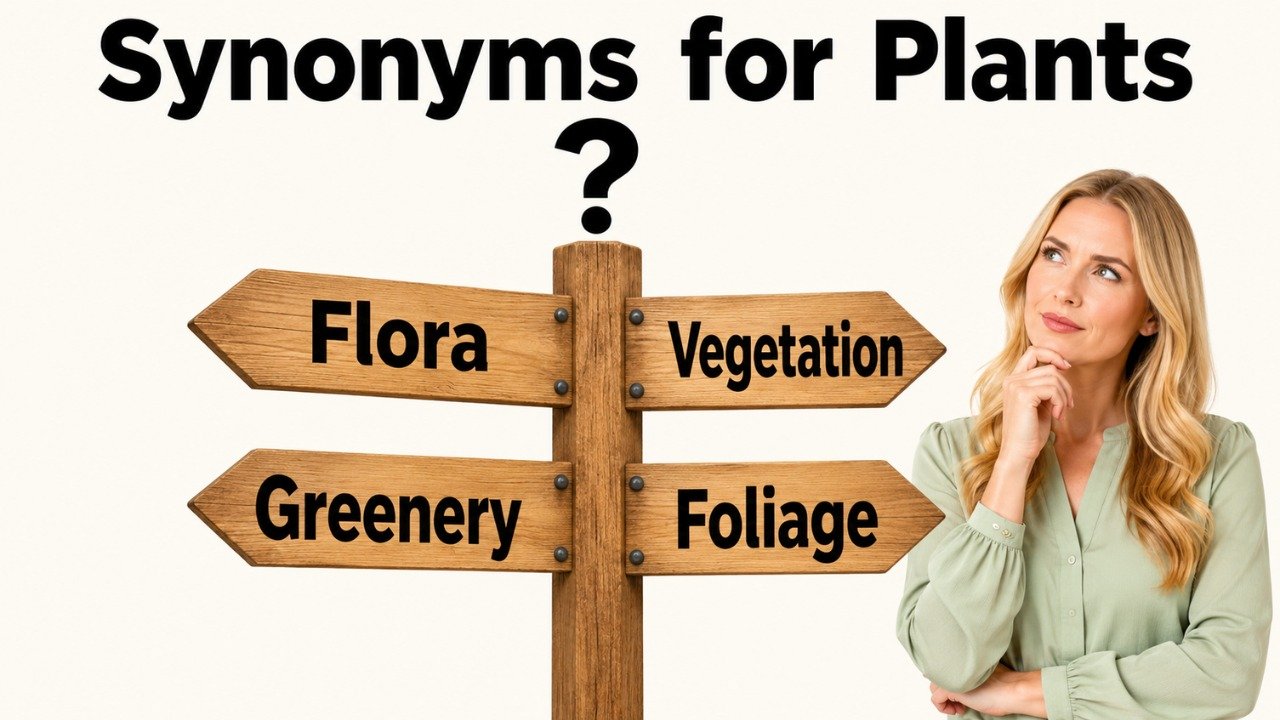
Quick Answer: The best synonyms for plants include flora, vegetation, greenery, plant life, botanicals, foliage, crops, houseplants, factories, and facilities. Use flora in scientific, environmental, or formal writing. Choose vegetation for plants growing across an area, greenery for attractive green growth, crops for cultivated food plants, and houseplants for plants grown indoors. When plants refers to industrial buildings, factories, works, facilities, or manufacturing sites are clearer alternatives.
Pronunciation and Word Details
Word: Plants
Pronunciation: /plænts/
Part of Speech: Plural noun and third person singular verb
Meaning: Living organisms that usually grow in soil, or industrial locations where products, energy, or materials are produced.
US Pronunciation:
UK Pronunciation:
What Does “Plants” Mean?
Plants are living organisms such as trees, flowers, grasses, shrubs, herbs, and ferns that usually grow by using sunlight, water, air, and nutrients.
As a plural noun, plants commonly refers to botanical life. The word can describe small flowers in a garden, large trees in a forest, crops in a field, or indoor plants kept for decoration.
Example: The garden contains several flowering plants.
Plants can also mean industrial buildings or sites where goods, energy, chemicals, or materials are produced or processed.
Example: The company operates two manufacturing plants.
As a verb, plants means places something firmly in a position, puts seeds into the ground, secretly leaves an object somewhere, or establishes an idea in someone’s mind.
Example: She plants vegetable seeds every spring.
The correct synonym depends on whether plants refers to botanical organisms, industrial facilities, or the action of placing or growing something.
Meaning, Tone, and Context of “Plants”
Plants is a common, neutral, and widely understood word. It appears in everyday speech, gardening, agriculture, biology, environmental writing, industry, manufacturing, and technical communication.
In casual conversation, plants usually refers to flowers, houseplants, garden plants, or other forms of greenery.
Example: I bought several plants for the living room.
In scientific and environmental writing, terms such as flora, vegetation, plant life, species, or botanical life may sound more precise.
Example: The region supports a wide variety of native flora.
In agriculture, plants may refer to crops, seedlings, cultivars, or edible vegetation.
Example: Farmers protected the young crops from heavy rain.
In industrial writing, plants often refers to factories, refineries, processing facilities, power stations, or manufacturing sites.
Example: The new processing facility will handle locally produced materials.
The word is usually neutral, but certain synonyms create different tones. Greenery sounds visual and pleasant. Flora sounds formal or scientific. Crops suggests agriculture. Factories and facilities suggest industry.
When and How to Use “Plants”
For General Botanical Life
Use plants when referring broadly to living botanical organisms without identifying a particular type.
Example: Plants need suitable amounts of water, light, and nutrients.
For Gardening
Use plants for flowers, shrubs, herbs, and other varieties grown in a garden.
Example: These plants grow well in shaded areas.
For Indoor Decoration
Use plants when referring to greenery kept inside homes, offices, or other buildings.
Example: Indoor plants can make a room feel fresher and more welcoming.
For Agriculture
Use plants when discussing crops, seedlings, or cultivated vegetation.
Example: The farmers inspected the plants for signs of disease.
For Scientific Writing
Use plants when discussing organisms belonging to the plant kingdom in a general way.
Example: Plants use light to produce the energy needed for growth.
For Environmental Description
Use plants when describing natural growth in forests, wetlands, grasslands, or other habitats.
Example: Native plants provide shelter and food for local wildlife.
For Industrial Facilities
Use plants when referring to locations where goods, materials, or energy are produced.
Example: The manufacturing plants operate throughout the week.
For the Action of Growing Seeds
Use plants as a verb when someone places seeds or young growth in soil.
Example: She plants herbs near the kitchen window.
For Placing Something Firmly
Use plants as a verb when someone places an object or body part firmly in a position.
Example: He plants his feet firmly before lifting the box.
Best Synonyms for Plants
Flora
Synonym: The plants growing naturally in a particular place or period.
Example: The island is known for its unusual native flora.
Vegetation
Synonym: Plant growth covering a particular area.
Example: Thick vegetation surrounded the walking path.
Greenery
Synonym: Green plants and leaves, especially when they create an attractive appearance.
Example: The balcony was filled with fresh greenery.
Plant Life
Synonym: Plants considered collectively within an environment.
Example: The wetland supports diverse plant life.
Botanicals
Synonym: Plants or plant materials, especially those used for practical, decorative, or scientific purposes.
Example: The garden contains several unusual botanicals.
Foliage
Synonym: The leaves of plants, trees, and shrubs.
Example: The bright foliage added color to the landscape.
Crops
Synonym: Plants cultivated for food, materials, or commercial use.
Example: The farmers harvested their crops before the storm arrived.
Houseplants
Synonym: Plants grown indoors for decoration or personal enjoyment.
Example: She placed several houseplants near the sunny window.
Factories
Synonym: Industrial buildings where products are manufactured.
Example: The factories produce equipment for local businesses.
Facilities
Synonym: Buildings or sites designed for production, processing, or another specific purpose.
Example: The new facilities will process agricultural materials.
50 Synonyms for Plants With Short Meanings
- Flora: Plant life found in a particular place or period.
- Vegetation: Plants growing collectively across an area.
- Greenery: Attractive green plants, leaves, and growth.
- Plant Life: Plants considered together in an environment.
- Botanical Life: Living organisms belonging to the plant kingdom.
- Botanicals: Plants or plant materials used for specific purposes.
- Foliage: The leaves of plants, shrubs, and trees.
- Crops: Plants cultivated for food, materials, or profit.
- Herbs: Small plants used for food, medicine, or fragrance.
- Shrubs: Short woody plants with several stems.
- Bushes: Low woody plants with spreading branches.
- Trees: Tall woody plants with trunks and branches.
- Flowers: Blooming plants valued for color, scent, or beauty.
- Grasses: Narrow leaved plants commonly found in fields and lawns.
- Vines: Plants with long stems that climb or spread.
- Ferns: Leafy plants that reproduce through spores.
- Mosses: Small soft plants that grow in damp places.
- Succulents: Plants that store water in thick leaves or stems.
- Cacti: Succulent plants adapted to dry environments.
- Seedlings: Young plants recently grown from seeds.
- Saplings: Young trees that have not reached full size.
- Houseplants: Plants grown inside buildings.
- Ornamentals: Plants cultivated mainly for decorative value.
- Perennials: Plants that live and grow for several years.
- Annuals: Plants that complete their life cycle within one year.
- Biennials: Plants that complete their life cycle in two years.
- Cultivars: Plant varieties developed for selected characteristics.
- Varieties: Distinct forms of a particular plant species.
- Species: Groups of plants sharing common biological features.
- Specimens: Individual plants studied, displayed, or collected.
- Groundcover: Low growing plants that spread across soil.
- Undergrowth: Dense plants growing beneath trees or larger vegetation.
- Wildflowers: Flowers growing naturally without cultivation.
- Native Vegetation: Plants naturally occurring in a particular region.
- Garden Growth: Plants cultivated together in a garden.
- Nursery Stock: Young plants prepared for sale or transplanting.
- Aquatic Vegetation: Plants growing in or near water.
- Factories: Buildings where goods are manufactured.
- Works: Industrial sites where materials or products are made.
- Mills: Facilities that process raw materials.
- Facilities: Buildings designed for production or processing.
- Manufacturing Sites: Locations where products are created.
- Production Sites: Places used to manufacture goods or materials.
- Processing Facilities: Locations where materials are treated or prepared.
- Industrial Sites: Areas used for industrial operations.
- Refineries: Facilities where raw substances are purified or processed.
- Foundries: Industrial sites where metal is melted and shaped.
- Complexes: Groups of connected industrial buildings.
- Installations: Sites containing specialized industrial equipment.
- Premises: Buildings and land used for business or industrial activity.
Read Also:
Synonyms for Version

Synonyms for Plants by Context
When Plants Means Living Botanical Organisms
Flora, vegetation, plant life, botanical life, and botanicals are useful when discussing plants collectively.
Flora: Best for formal, scientific, geographic, or environmental writing.
Example: The valley contains rare alpine flora.
Vegetation: Best for describing plant growth covering an area.
Example: Dense vegetation blocked the view of the river.
Plant Life: Best for general descriptions of plants in an ecosystem.
Example: The lake supports abundant plant life.
Botanical Life: Best for scientific or educational explanations.
Example: The reserve protects diverse botanical life.
When Plants Means Attractive Green Growth
Greenery, foliage, ornamentals, garden growth, and houseplants work well when visual appearance is important.
Greenery: Emphasizes fresh green color and natural decoration.
Example: Greenery softened the appearance of the stone wall.
Foliage: Refers mainly to leaves rather than complete plants.
Example: The autumn foliage changed from green to red.
Ornamentals: Refers to plants grown mainly for beauty.
Example: The entrance was surrounded by colorful ornamentals.
Houseplants: Refers specifically to plants grown indoors.
Example: Her houseplants received plenty of indirect light.
When Plants Means Agricultural Growth
Crops, seedlings, cultivars, nursery stock, and edible plants are suitable for farming and cultivation.
Crops: Best for plants grown for food or commercial value.
Example: The dry weather damaged several crops.
Seedlings: Best for very young plants grown from seeds.
Example: The seedlings were moved into larger containers.
Cultivars: Best for varieties developed for selected qualities.
Example: These cultivars were chosen for their resistance to disease.
Nursery Stock: Best for young plants prepared for sale or transplanting.
Example: The nursery stock arrived in healthy condition.
When Plants Means Trees, Flowers, or Shrubs
Use specific category words when the type of plant is known.
Trees: Tall woody plants with a main trunk.
Example: Mature trees shaded the garden.
Shrubs: Shorter woody plants with several stems.
Example: Flowering shrubs lined the walkway.
Flowers: Plants known mainly for their blossoms.
Example: Bright flowers attracted bees to the garden.
Herbs: Small useful plants grown for flavor, scent, or traditional purposes.
Example: She grows fresh herbs in small containers.
When Plants Means Industrial Facilities
Factories, works, mills, facilities, manufacturing sites, and processing facilities are clearer when discussing industry.
Factories: Best for buildings where products are made.
Example: Several factories produce furniture in the region.
Works: A traditional term for a large industrial site.
Example: The steel works employs hundreds of skilled workers.
Mills: Best for facilities that grind, cut, or process raw materials.
Example: The paper mills process wood into usable products.
Facilities: A broad formal term for specialized industrial locations.
Example: The production facilities were recently expanded.
Refineries: Best for plants that purify or process raw materials.
Example: The refineries convert crude materials into usable products.
Another Word for Plants
Vegetation is the best general replacement when plants refers to natural growth across an area. Flora is more suitable in scientific or formal writing, while greenery works well for attractive green growth. When plants refers to industrial locations, factories or facilities are usually clearer.
Original: The region contains many unusual plants.
Better Option: The region contains unusual native flora.
Original: Thick plants covered the hillside.
Better Option: Thick vegetation covered the hillside.
Original: She decorated the room with plants.
Better Option: She decorated the room with fresh greenery.
Original: The business operates several plants.
Better Option: The business operates several manufacturing facilities.
When Not to Use “Plants”
Avoid plants when a more specific category would help the reader understand the subject.
Weak: The garden contains several plants.
Better: The garden contains roses, herbs, shrubs, and flowering vines.
Do not use plants when referring only to leaves. Foliage is more accurate in that context.
Weak: The trees developed colorful plants in autumn.
Better: The trees developed colorful foliage in autumn.
Avoid plants in formal environmental writing when describing all vegetation within a region. Flora or plant life may sound more precise.
Weak: The study examined the plants of the coastal region.
Better: The study examined the coastal region’s native flora.
Do not use plants for industrial locations when the meaning could be confused with botanical life.
Weak: New plants will open near the town.
Better: New manufacturing facilities will open near the town.
Avoid crops when referring to wild vegetation because crops are deliberately cultivated.
Weak: Wild crops covered the mountainside.
Better: Wild vegetation covered the mountainside.
Do not use greenery when discussing dead, dry, or colorless plant material because the word usually suggests fresh green growth.
Weak: The desert was covered with dry greenery.
Better: The desert was covered with dry vegetation.
Words Commonly Confused With Plants
Plants vs Flora: Plants is a general everyday term. Flora refers collectively to the plant life of a region, habitat, or historical period.
Plants vs Vegetation: Plants can refer to individual organisms. Vegetation describes plant growth collectively across an area.
Plants vs Foliage: Plants includes entire organisms, while foliage refers mainly to their leaves.
Plants vs Crops: Plants is a broad category. Crops are plants deliberately cultivated for food, materials, or commercial purposes.
Plants vs Flowers: All flowers come from plants, but not all plants are grown or recognized for flowers.
Plants vs Trees: Trees are one category of plants distinguished by woody trunks and long term growth.
Plants vs Botanicals: Plants is a general word, while botanicals often refers to plants or plant materials used for decoration, study, fragrance, food, or other purposes.
Plants vs Factories: Plants may mean industrial production sites, but factories is clearer when manufacturing is the intended meaning.
Which Synonym Should You Choose?
Choose flora for scientific, environmental, geographic, or formal writing about the plants of a region.
Choose vegetation when describing plant growth covering land, forests, hillsides, wetlands, or other areas.
Choose greenery when emphasizing beauty, freshness, decoration, or green color.
Choose plant life when discussing plants collectively within an ecosystem or habitat.
Choose botanicals when referring to plants or plant materials used for decoration, study, food, fragrance, or practical purposes.
Choose foliage when discussing leaves rather than complete plants.
Choose crops when writing about agriculture, farming, food production, or cultivated fields.
Choose houseplants when referring specifically to plants grown indoors.
Choose ornamentals when discussing plants cultivated mainly for beauty.
Choose seedlings for young plants recently grown from seeds.
Choose cultivars when discussing developed plant varieties with selected qualities.
Choose factories when plants refers to places where goods are manufactured.
Choose facilities for formal reports about industrial buildings or production locations.
Choose mills when raw materials are ground, cut, or processed.
Choose refineries when raw substances are purified or converted into usable products.
Real Life Examples of “Plants” in Sentences
Original: The forest contains many rare plants.
Better Option: The forest contains many examples of rare native flora.
Original: Thick plants grew along the riverbank.
Better Option: Thick vegetation grew along the riverbank.
Original: She added plants to the empty balcony.
Better Option: She added fresh greenery to the empty balcony.
Original: The gardener selected plants for their colorful leaves.
Better Option: The gardener selected ornamentals for their colorful foliage.
Original: The farmer examined the plants after the storm.
Better Option: The farmer examined the crops after the storm.
Original: The young plants were ready for larger containers.
Better Option: The seedlings were ready for larger containers.
Original: Several plants grow naturally in the wetland.
Better Option: Diverse plant life grows naturally in the wetland.
Original: She keeps tropical plants near the window.
Better Option: She keeps tropical houseplants near the window.
Original: The company built two new plants.
Better Option: The company built two new manufacturing facilities.
Original: The plants process raw materials before shipment.
Better Option: The processing facilities prepare raw materials before shipment.
Synonym Groups and Usage Differences
General Botanical Group
This group includes flora, vegetation, plant life, botanical life, and botanicals. These alternatives describe plants collectively, but their tones differ.
Flora is formal and geographic. Vegetation focuses on physical growth across an area. Plant life is broad and accessible. Botanical life sounds scientific.
Example: The protected valley contains diverse native flora.
Green Appearance Group
This group includes greenery, foliage, garden growth, ornamentals, and groundcover. These words are useful when appearance, landscaping, or decoration matters.
Greenery emphasizes freshness and color. Foliage refers to leaves. Ornamentals are cultivated mainly for beauty.
Example: Decorative greenery surrounded the entrance.
Agricultural Group
This group includes crops, cultivars, seedlings, nursery stock, herbs, and varieties. These terms fit farming, gardening, and commercial cultivation.
Crops emphasizes production. Cultivars refers to developed varieties. Seedlings identifies an early growth stage.
Example: Farmers selected cultivars that performed well in dry conditions.
Plant Type Group
This group includes trees, shrubs, bushes, flowers, grasses, vines, ferns, mosses, succulents, and cacti. These words identify specific kinds of plants.
Example: Ferns and mosses covered the shaded forest floor.
Growth Stage Group
This group includes seedlings, saplings, mature plants, and nursery stock. These alternatives help describe age, development, or readiness for transplanting.
Example: The saplings were protected from strong winds.
Indoor and Decorative Group
This group includes houseplants, ornamentals, botanicals, and greenery. These terms are useful for interior decoration and cultivated displays.
Example: Houseplants brought natural color into the room.
Industrial Group
This group includes factories, works, mills, facilities, industrial sites, refineries, foundries, and production sites. These words replace plants when referring to industrial operations.
Example: The manufacturing facilities produce building materials.
Antonyms of Plants
Plants does not have one direct opposite in every context. The most useful antonyms depend on the intended meaning.
Animals: Living organisms that belong to the animal kingdom rather than the plant kingdom.
Fungi: Organisms such as mushrooms and molds that are biologically separate from plants.
Barren Land: Ground where little or no vegetation grows.
Bare Ground: Land without plants, grass, or other growth.
Desert: A dry area with very limited vegetation.
Cleared Land: An area from which trees, shrubs, or other plants have been removed.
Artificial Objects: Manufactured items rather than living botanical organisms.
Empty Site: Land without an industrial plant or facility.
Demolished Facility: An industrial building that has been removed or destroyed.
Wilderness: An opposite only when plants means industrial sites, since wilderness lacks factories and developed facilities.
Comparison: Plants vs Related Words
Plants vs Flora
Plants is the everyday general word. Flora is more formal and refers collectively to plants in a particular location, environment, or period.
Example With Plants: The garden contains several unusual plants.
Example With Flora: The island has unusually diverse flora.
Plants vs Vegetation
Plants can refer to individual living organisms. Vegetation describes a mass or covering of plant growth.
Example With Plants: These plants produce small white flowers.
Example With Vegetation: Dense vegetation covered the abandoned path.
Plants vs Greenery
Plants is neutral and broad. Greenery emphasizes attractive green leaves and natural decoration.
Example With Plants: She placed several plants near the entrance.
Example With Greenery: Fresh greenery made the entrance feel welcoming.
Plants vs Foliage
Plants refers to complete organisms. Foliage refers mainly to leaves.
Example With Plants: The plants grew rapidly during spring.
Example With Foliage: The foliage became brighter after the rain.
Plants vs Crops
Plants includes wild and cultivated growth. Crops are deliberately cultivated for food, materials, or commercial value.
Example With Plants: Wild plants grew beside the field.
Example With Crops: The farmers protected their crops from frost.
Plants vs Botanicals
Plants is common and general. Botanicals often suggests plants selected for decorative, scientific, fragrant, culinary, or practical use.
Example With Plants: The room contained several tropical plants.
Example With Botanicals: The display featured rare tropical botanicals.
Plants vs Factories
Plants can refer to industrial locations, but factories clearly indicates manufacturing.
Example With Plants: The company operates three plants.
Example With Factories: The company operates three factories that produce household goods.
Plants vs Facilities
Plants usually suggests production or processing. Facilities is broader and can include laboratories, warehouses, offices, and specialized buildings.
Example With Plants: The plants process agricultural materials.
Example With Facilities: The facilities include laboratories, storage areas, and production rooms.
Common Phrases and Expressions With “Plants”
Indoor Plants: Plants grown inside homes or other buildings.
Outdoor Plants: Plants cultivated or growing outside.
Native Plants: Plants that occur naturally in a particular region.
Flowering Plants: Plants that produce flowers.
Medicinal Plants: Plants traditionally used for health related purposes.
Edible Plants: Plants or plant parts that can be eaten.
Garden Plants: Plants selected and cultivated in gardens.
Power Plants: Industrial facilities that produce electrical energy.
Manufacturing Plants: Industrial sites where goods are produced.
Processing Plants: Facilities where raw materials are treated or prepared.
Common Mistakes to Avoid
Treating Plants and Flowers as Identical
Flowers are only one category of plants. Trees, grasses, ferns, mosses, and shrubs are also plants.
Incorrect: Every plant produces a colorful flower.
Correct: Some plants produce colorful flowers, while others do not.
Using Plants When Vegetation Is More Natural
Use vegetation when describing plant growth covering a large area.
Weak: Thick plants covered the valley.
Better: Thick vegetation covered the valley.
Using Flora for One Individual Plant
Flora usually describes plant life collectively rather than one individual specimen.
Incorrect: This rose is a beautiful flora.
Correct: This rose is a beautiful plant.
Confusing Foliage With Complete Plants
Foliage refers mainly to leaves, not roots, stems, flowers, and complete organisms.
Incorrect: The foliage was planted in a deep container.
Correct: The plant was placed in a deep container.
Calling Wild Plants Crops
Crops are deliberately cultivated. Wild plants should normally be called vegetation, flora, or plant life.
Incorrect: Wild crops covered the forest floor.
Correct: Wild plants covered the forest floor.
Creating Industrial Ambiguity
Plants can mean botanical organisms or industrial sites. Use factories or facilities when the sentence could be misunderstood.
Unclear: The area contains several new plants.
Clearer: The area contains several new manufacturing facilities.
Using the Wrong Verb Form
Plants agrees with a singular third person subject. Plant agrees with plural subjects and the pronouns I, you, we, and they.
Incorrect: They plants vegetables every spring.
Correct: They plant vegetables every spring.
Correct: She plants vegetables every spring.
Using a Broad Word When Specificity Is Needed
Replace plants with trees, shrubs, crops, herbs, seedlings, or another precise category when the type matters.
Vague: The gardener added several plants.
Clearer: The gardener added lavender shrubs and flowering vines.
Conclusion
The most useful synonyms for plants depend on the intended meaning. Flora and plant life work well in formal or environmental writing, while vegetation describes growth covering an area. Greenery emphasizes beauty, foliage refers to leaves, and crops suits agriculture. Houseplants and ornamentals are better for indoor or decorative contexts. When plants means industrial locations, choose factories, facilities, mills, or manufacturing sites. Selecting a precise alternative makes every sentence clearer, more natural, and easier for readers to understand.
FAQs About Synonyms for Plants
What Is the Best General Synonym for Plants?
Vegetation is a strong general alternative when referring to plant growth collectively. Flora is better for scientific or formal contexts.
What Is a Formal Synonym for Plants?
Flora, botanical life, vegetation, and plant life are suitable formal alternatives.
What Is Another Word for Green Plants?
Greenery is the best choice when emphasizing fresh green color or decorative growth.
Is Foliage a Synonym for Plants?
Foliage is a related word, but it refers mainly to leaves rather than complete plants.
What Is Another Word for Plants in a Garden?
Garden growth, ornamentals, flowers, shrubs, herbs, and houseplants may work, depending on the exact type.
What Is Another Word for Industrial Plants?
Factories, facilities, manufacturing sites, production sites, works, mills, and processing facilities are useful alternatives.
What Is the Difference Between Flora and Vegetation?
Flora refers to the plant life of a place or period. Vegetation emphasizes the plants physically growing across an area.
