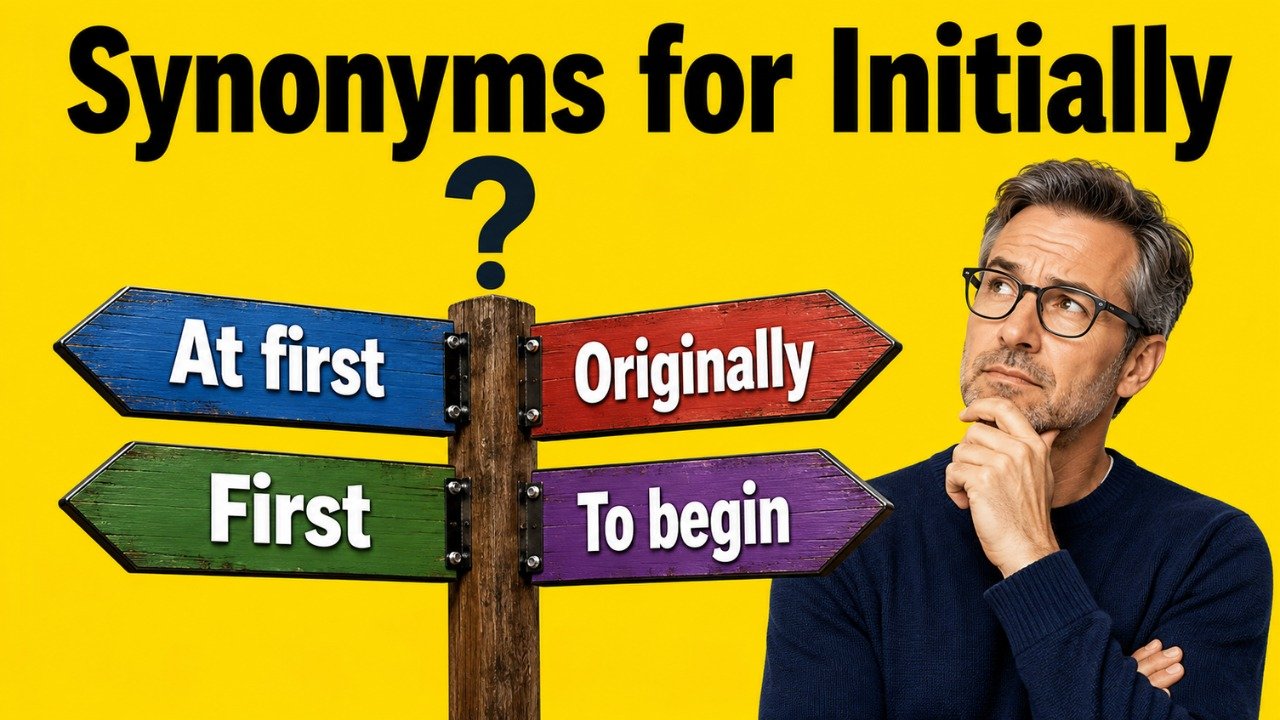
Quick Answer: The best synonyms for initially include at first, originally, in the beginning, at the outset, to begin with, first, at the start, from the beginning, early on, and in the first instance. Use at first for a situation that later changed, originally for an earlier plan or condition, and at the outset for formal writing. First works well for instructions and ordered steps, while early on describes something that happened during the beginning stage of a process, relationship, project, or event.
Pronunciation and Word Details
Word: Initially.
Pronunciation: /ɪˈnɪʃəli/
Part of Speech: Adverb.
Meaning: At the beginning of a period, process, situation, or series of events.
US Pronunciation:
UK Pronunciation:
What Does “Initially” Mean?
Initially means at the beginning of a situation, process, period, or sequence.
It is an adverb used to explain what happened, existed, was planned, or was believed at an early stage. It often suggests that something changed later.
Example: The proposal was initially rejected but later approved.
In this sentence, initially shows that rejection was the first response and that a different decision followed.
Initially can describe an original plan.
Example: We initially planned to hold the meeting on Monday.
It can describe a first impression or belief.
Example: She initially believed the task would be simple.
It can also introduce the first stage of a process.
Example: The medicine was initially tested on a small group of volunteers.
The word is common in formal writing, reports, essays, news writing, research, workplace communication, and everyday conversation.
Meaning, Tone, and Context of “Initially”
Initially usually has a neutral and slightly formal tone. It is appropriate in both professional and conversational writing, although at first often sounds more natural in casual speech.
Formal Context: Initially is commonly used in reports, essays, research, official explanations, and business communication.
Example: The project was initially expected to require six months.
Conversational Context: In everyday speech, at first and to begin with may sound more relaxed.
Example: At first, I did not understand the instructions.
Sequence Context: Initially identifies the first stage before later events or changes.
Example: The team initially focused on improving product quality.
Original Plan Context: It can describe what was first intended before a plan was revised.
Example: The building was initially designed as a public library.
First Impression Context: Initially can introduce an opinion or reaction that later changed.
Example: I initially thought the film would be boring.
Historical Context: It can describe the original purpose, form, location, or condition of something.
Example: The organization was initially established to provide educational support.
Initially often prepares the reader for a contrast. Words such as but, however, later, eventually, and subsequently commonly appear in the same sentence or nearby.
When and How to Use “Initially”
For an Original Plan: Use initially to explain what was planned before a change occurred.
Example: The event was initially scheduled for Friday.
For a First Reaction: Use it to introduce someone’s earliest emotional or intellectual response.
Example: She was initially surprised by the decision.
For an Early Belief: Use initially when a person’s first opinion later changes.
Example: Investigators initially believed the fire had started accidentally.
For the Beginning of a Process: Use it to describe the first stage of an activity, study, project, or development.
Example: The program was initially offered to a limited number of students.
For an Original Purpose: Use initially to explain why something was first created or introduced.
Example: The software was initially developed for internal use.
For Early Results: Use it when reporting findings that may later be revised.
Example: The treatment initially produced encouraging results.
For Ordered Instructions: Initially can introduce the first action, although first is usually clearer in simple directions.
Example: Initially, gather all the required documents.
For a Situation That Changed: Use it when the beginning differed from the final outcome.
Example: The negotiations were initially difficult but became more productive.
Best Synonyms for Initially
At First: During the beginning stage, especially before a later change.
Example: At first, the new system seemed difficult to use.
Originally: In the first form, plan, purpose, or condition.
Example: The room was originally intended to be an office.
In the Beginning: During the earliest part of a situation or process.
Example: In the beginning, the business had only three employees.
At the Outset: At the beginning, especially in formal writing.
Example: The responsibilities were clearly explained at the outset.
To Begin With: At the start or as the first point in a discussion.
Example: To begin with, we need to identify the main problem.
First: Before any other action, event, or stage.
Example: First, review the instructions carefully.
At the Start: At the beginning of a period, activity, or event.
Example: Attendance was low at the start of the course.
From the Beginning: Starting at the earliest point and often continuing afterward.
Example: She supported the proposal from the beginning.
Early On: During an early part of a situation or process.
Example: The team identified several risks early on.
In the First Instance: As the first action, decision, or stage.
Example: Complaints should be directed to the department manager in the first instance.
50 Synonyms for Initially with Short Meanings
- At First: During the beginning stage before something changed.
- Originally: In the earliest form, plan, or condition.
- In the Beginning: During the first part of a situation.
- At the Beginning: At the point when something starts.
- At the Outset: At the beginning of an activity or process.
- At the Start: During the opening part of something.
- To Begin With: At the start or as a first consideration.
- First: Before anything else in a sequence.
- First of All: Before discussing or doing other things.
- From the Outset: Starting from the earliest stage.
- From the Start: Beginning at the first point.
- From the Beginning: Starting at the earliest moment.
- Early On: During an early part of a process.
- In the Early Stages: During the first period of development.
- In the Opening Stages: During the earliest part of an activity.
- In the First Stage: During the beginning phase of a process.
- During the First Stage: While the earliest phase is taking place.
- At an Early Stage: Near the beginning of a process.
- At the Initial Stage: During the first phase or period.
- In the Initial Phase: During the earliest period of development.
- In the Opening Phase: During the beginning part of a process.
- At the Opening Stage: At the first stage of an activity.
- In the Beginning Stages: During the earliest stages of development.
- At the Very Beginning: At the earliest possible point.
- At the Earliest Point: At the first identifiable moment.
- In the First Instance: As the first step or action.
- In the First Place: At the beginning or before other considerations.
- At Inception: At the time something is created or established.
- From Inception: Beginning from the time of creation.
- At Commencement: At the time an activity formally begins.
- At the Commencement: During the opening of an event or process.
- Upon Commencement: As soon as something formally begins.
- At the Onset: At the beginning of a condition or event.
- At the Preliminary Stage: During an early preparatory period.
- Preliminarily: As an early or preparatory action.
- At the Introductory Stage: During the opening stage of a subject or process.
- At the Opening: At the beginning of an event or activity.
- At the First Step: During the earliest action in a process.
- As a First Step: As the action that should happen before others.
- Before Anything Else: Prior to all other actions or considerations.
- At an Earlier Point: During a previous and early stage.
- In Its Original Form: In the form something had at the beginning.
- In Its Earliest Form: In the first version or condition.
- In the Early Days: During the beginning period of an organization or activity.
- To Start With: At the beginning or as a first point.
- At First Glance: Based on the earliest visual impression.
- At First Sight: When something is first seen.
- On First Impression: Based on an immediate initial opinion.
- At First Blush: According to an early impression before closer examination.
- At the Point of Origin: At the place or moment where something began.
Read Also:
Synonyms for Ultimately in an Essay

Synonyms for Initially by Context
When Initially Means At First
At first, in the beginning, at the beginning, and to start with are useful when describing an early situation that later changed.
At First: The most natural general replacement when a contrast follows.
Example: At first, the instructions appeared confusing.
In the Beginning: Emphasizes the earliest period of a longer situation.
Example: In the beginning, the team struggled to meet its deadlines.
At the Beginning: Refers to a clear starting point.
Example: The audience was quiet at the beginning of the performance.
To Start With: Sounds conversational and often introduces an early condition or opinion.
Example: To start with, we had very little information.
When Initially Means Originally
Originally, in its original form, at inception, and from inception are best when discussing an original purpose, design, condition, or plan.
Originally: The strongest replacement when describing what something was first intended to be.
Example: The building was originally designed as a railway station.
In Its Original Form: Refers to the first version of a product, document, idea, or system.
Example: In its original form, the proposal contained only three recommendations.
At Inception: Describes the moment an organization, plan, or project was created.
Example: At inception, the program served fewer than one hundred students.
From Inception: Emphasizes a condition that existed from the time something began.
Example: The organization promoted equal access from inception.
When Initially Means During an Early Stage
Early on, in the early stages, at an early stage, and in the initial phase describe the early development of a process.
Early On: Natural in both formal and conversational writing.
Example: Several technical problems were discovered early on.
In the Early Stages: Useful for projects, relationships, illnesses, investigations, and development.
Example: The research remains in the early stages.
At an Early Stage: Emphasizes that something happened before much progress had been made.
Example: The mistake was identified at an early stage.
In the Initial Phase: Suitable for formal reports and project descriptions.
Example: Training will be provided during the initial phase.
When Initially Introduces a First Impression
At first glance, at first sight, on first impression, and at first blush describe an immediate reaction before closer consideration.
At First Glance: Used for an early visual or intellectual impression.
Example: At first glance, the two designs appear identical.
At First Sight: Focuses on the first moment something is seen.
Example: At first sight, the damage seemed minor.
On First Impression: Describes an early opinion about a person, place, or situation.
Example: On first impression, the candidate appeared highly confident.
At First Blush: A less common expression meaning before detailed examination.
Example: At first blush, the proposal seems reasonable.
When Initially Introduces the First Action
First, first of all, as a first step, and before anything else are useful in instructions and explanations.
First: The clearest choice for a simple sequence.
Example: First, turn off the power supply.
First of All: Introduces the first point in a discussion or argument.
Example: First of all, we need to understand why the error occurred.
As a First Step: Emphasizes the beginning action in a longer process.
Example: As a first step, the committee will review the available evidence.
Before Anything Else: Gives the first action special importance.
Example: Before anything else, confirm that the information is accurate.
Another Word for Initially
At first is usually the best single replacement for initially when describing a situation that later changed. Originally is more precise when referring to a first plan, purpose, design, or condition.
The best alternative depends on whether the sentence concerns sequence, timing, original intention, an early stage, or a first impression.
Original: I initially found the software difficult to use.
Better Option: At first, I found the software difficult to use.
Original: The house was initially built as a school.
Better Option: The house was originally built as a school.
Original: The team initially experienced several technical problems.
Better Option: The team experienced several technical problems early on.
Original: Initially, submit the completed form to your manager.
Better Option: First, submit the completed form to your manager.
When Not to Use “Initially”
Do not use initially when a simpler word such as first, early, or originally would communicate the meaning more clearly.
Initially may sound unnecessarily formal in casual conversation. At first often sounds more natural when describing an ordinary personal experience.
Weak: I initially did not like the new restaurant.
Better: At first, I did not like the new restaurant.
Do not use initially when you specifically mean that something had a different original purpose or form. Originally is more precise in that context.
Weak: The building was initially a private residence.
Better: The building was originally a private residence.
Avoid initially when writing simple instructions. First is shorter and clearer.
Weak: Initially, open the settings menu.
Better: First, open the settings menu.
Do not combine initially with at first because the two expressions repeat the same idea.
Weak: Initially, at first, the plan appeared successful.
Better: Initially, the plan appeared successful.
Do not use initially when referring to something that happened before another unrelated past event. Previously or earlier may be more suitable.
Weak: She initially worked at another company five years ago.
Better: She previously worked at another company.
Do not use initially if there was no later change, development, or sequence and the time distinction adds no useful meaning.
Weak: He initially entered the room and sat down.
Better: He entered the room and sat down.
Words Commonly Confused With Initially
Initially vs Originally: Initially describes what happened at the beginning of a process or period. Originally describes the first form, purpose, plan, or condition of something.
Example With Initially: The audience initially reacted with confusion.
Example With Originally: The event was originally planned for Saturday.
Initially vs First: Initially describes an early condition or stage. First identifies the earliest action or item in a sequence.
Example With Initially: The treatment initially appeared effective.
Example With First: First, wash your hands thoroughly.
Initially vs Early: Initially means at the beginning. Early means before the expected, usual, or later time.
Example With Initially: She initially opposed the proposal.
Example With Early: She arrived early for the meeting.
Initially vs Previously: Initially refers to the beginning of the current process or situation. Previously means at an earlier time before the event being discussed.
Example With Initially: The company initially employed ten people.
Example With Previously: She previously worked in the finance department.
Initially vs Formerly: Initially describes an early stage. Formerly describes a previous identity, title, role, or condition that no longer exists.
Example With Initially: The service was initially available in two cities.
Example With Formerly: The building was formerly a courthouse.
Initially vs Eventually: Initially refers to the beginning, while eventually refers to the final result after time or difficulty.
Example With Initially: The team initially rejected the proposal.
Example With Eventually: The team eventually approved the proposal.
Initially vs Primarily: Initially means at the beginning. Primarily means mainly or for the most important part.
Example With Initially: The program was initially tested in schools.
Example With Primarily: The program is primarily intended for young students.
Which Synonym Should You Choose?
Choose at first when describing a beginning condition, opinion, or reaction that later changed.
Choose originally when discussing an original design, purpose, intention, location, or plan.
Choose at the outset in formal essays, reports, agreements, and professional explanations.
Choose first for instructions, numbered steps, and clear sequences.
Choose first of all when introducing the first point in an argument, speech, email, or discussion.
Choose in the beginning when describing the earliest period of a long experience, relationship, organization, or story.
Choose early on when referring to something that happened during an early stage without identifying an exact starting moment.
Choose in the early stages for projects, investigations, research, illnesses, relationships, or developing situations.
Choose at inception when discussing the formal creation of a company, organization, program, or policy.
Choose at the onset when describing the beginning of a condition, event, conflict, illness, or noticeable change.
Choose at first glance when describing an immediate visual or intellectual impression.
Choose on first impression when discussing an early opinion about a person, place, proposal, or experience.
Choose as a first step when explaining the first action in a larger plan.
Choose initially when a neutral and slightly formal word is appropriate and the context suggests that later circumstances were different.
Real Life Examples of “Initially” in Sentences
Original: The manager initially rejected the request.
Better Option: At first, the manager rejected the request.
Original: The room was initially designed as a library.
Better Option: The room was originally designed as a library.
Original: The project initially faced several financial problems.
Better Option: The project faced several financial problems early on.
Original: Initially, check that all the documents are complete.
Better Option: First, check that all the documents are complete.
Original: The company initially offered the service in one city.
Better Option: At the outset, the company offered the service in one city.
Original: She initially thought the assignment would be easy.
Better Option: At first, she thought the assignment would be easy.
Original: The treatment was initially tested on a small group.
Better Option: The treatment was tested on a small group during the first stage.
Original: The organization initially focused on providing food assistance.
Better Option: In its early days, the organization focused on providing food assistance.
Original: The damage initially appeared to be minor.
Better Option: At first glance, the damage appeared to be minor.
Original: The researchers initially collected information from local hospitals.
Better Option: As a first step, the researchers collected information from local hospitals.
Synonym Groups and Usage Differences
Beginning and Sequence Group
At first, first, first of all, at the beginning, and to begin with identify the earliest point or action.
At first commonly introduces a situation that later changed. First gives a clear order, while first of all introduces the opening point in an explanation or argument.
Example: First, identify the cause of the problem.
Original Purpose and Form Group
Originally, in its original form, in its earliest form, at inception, and from inception describe how something first existed or was intended.
Originally is the most flexible choice. At inception sounds formal and is commonly used for organizations, projects, and policies.
Example: The product was originally developed for professional photographers.
Early Development Group
Early on, in the early stages, at an early stage, in the initial phase, and in the opening stages describe an activity that has begun but has not progressed far.
Early on sounds natural in most contexts. In the initial phase is more suitable for formal reports and project plans.
Example: Several risks were identified during the initial phase.
Formal Beginning Group
At the outset, from the outset, at commencement, and upon commencement are formal alternatives.
At the outset is common in professional and academic writing. At commencement and upon commencement are more appropriate for formal procedures, contracts, and official events.
Example: The expectations were clearly communicated at the outset.
First Impression Group
At first glance, at first sight, on first impression, and at first blush describe an immediate judgment.
These expressions often suggest that closer examination may produce a different conclusion.
Example: At first glance, the problem seemed easy to solve.
Instruction and Action Group
First, as a first step, before anything else, and in the first instance introduce the earliest required action.
First is direct and simple. In the first instance is more formal and often appears in procedures or complaint policies.
Example: In the first instance, contact the customer service department.
Antonyms of Initially
The opposite of initially usually refers to a later stage, final result, or concluding action.
Finally: At the last stage or after everything else.
Eventually: After a period of time or several developments.
Ultimately: In the end or as the final result.
Later: At a time after the beginning.
Subsequently: After a particular event or stage.
Afterward: At a later time following an event.
Lastly: As the final item in a sequence.
At the End: During the concluding part of something.
In the Final Stage: During the last phase of a process.
In Conclusion: At the end of an explanation or argument.
At Last: After waiting, delay, or difficulty.
Thereafter: After the event or time already mentioned.
In the Long Run: After a long period and all developments are considered.
In the End: At the final point or result.
Finally Established: Confirmed or created after earlier uncertainty.
Comparison of Initially and Related Words
Initially vs At First
Initially and at first both refer to the beginning. Initially sounds slightly more formal, while at first is more common in everyday speech.
Example With Initially: The new employee initially required additional guidance.
Example With At First: At first, the new employee required additional guidance.
Initially vs Originally
Initially describes an early stage or reaction. Originally describes the first purpose, form, intention, or condition.
Example With Initially: The audience initially disliked the performance.
Example With Originally: The performance was originally scheduled for June.
Initially vs First
Initially often describes a condition that later changed. First places actions or ideas in a clear order.
Example With Initially: The task initially appeared impossible.
Example With First: First, divide the task into smaller parts.
Initially vs Early On
Initially refers closely to the beginning. Early on refers more generally to an early period.
Example With Initially: The company initially sold only one product.
Example With Early On: The company encountered supply problems early on.
Initially vs At the Outset
Both expressions refer to the beginning, but at the outset is more formal and often emphasizes that something was established or understood from the start.
Example With Initially: The plan was initially supported by most members.
Example With At the Outset: The project goals were defined at the outset.
Initially vs Previously
Initially refers to the beginning of the situation being discussed. Previously refers to any earlier time before a particular event.
Example With Initially: She initially worked in the marketing department.
Example With Previously: She had previously worked for a smaller organization.
Initially vs Eventually
Initially identifies the beginning, while eventually introduces what happened after time, effort, or change.
Example With Initially: The committee initially opposed the recommendation.
Example With Eventually: The committee eventually accepted the recommendation.
Common Phrases and Expressions With “Initially”
Initially Planned: Intended at the beginning before possible changes.
Initially Intended: First meant or designed for a particular purpose.
Initially Believed: Accepted as true during the beginning stage.
Initially Expected: Predicted or considered likely at first.
Initially Proposed: Presented as an idea or plan at the beginning.
Initially Designed: Created at first for a particular use.
Initially Reported: Described in the earliest available report.
Initially Estimated: Calculated approximately during an early stage.
Initially Rejected: Refused or disapproved at first.
Initially Available: Offered or accessible during the beginning period.
Common Mistakes to Avoid
Confusing Initially With Originally: Use initially for an early stage or reaction. Use originally for a first purpose, design, intention, or form.
Incorrect: The building was initially intended to be a museum.
Better: The building was originally intended to be a museum.
Using Initially and At First Together: These expressions communicate the same basic idea, so combining them creates repetition.
Incorrect: Initially, at first, we expected the project to be simple.
Correct: Initially, we expected the project to be simple.
Overusing Initially: Repeating initially several times in one paragraph makes the writing sound mechanical. Use at first, originally, early on, or at the outset where appropriate.
Using Initially Instead of First: In simple directions, first is usually clearer and more direct.
Weak: Initially, press the power button.
Better: First, press the power button.
Confusing Initially With Primarily: Initially relates to time or sequence. Primarily means mainly.
Incorrect: The service is initially used by students.
Correct: The service is primarily used by students.
Using Initially Without a Meaningful Contrast: Initially often suggests that a later change occurred. Do not add it when the timing does not matter.
Weak: She initially opened the door.
Better: She opened the door.
Placing Initially Unnaturally: Initially can appear at the start of a sentence, before the main verb, or after a form of be.
Natural: Initially, the plan seemed effective.
Natural: The committee initially supported the plan.
Natural: The plan was initially successful.
Using Initially for an Earlier Unrelated Event: Use previously, formerly, or earlier when referring to a separate past situation rather than the beginning of the current one.
Weak: He initially worked for another company ten years ago.
Better: He previously worked for another company.
Conclusion
Synonyms for initially help describe beginnings, original plans, early stages, and first impressions more precisely. At first is the best general alternative when a situation later changes, while originally suits an earlier purpose or design. Use first for instructions, at the outset for formal writing, and early on for developing situations. At first glance works for immediate impressions. Selecting the right alternative makes timing, sequence, and changes easier for readers to understand.
FAQs About Synonyms for Initially
What Is the Best Synonym for Initially?
At first is the best general synonym for initially. Originally is more suitable when discussing a first plan, purpose, or form.
What Is a Formal Synonym for Initially?
At the outset, from the outset, at inception, and in the first instance are formal alternatives. The best choice depends on the sentence.
Is Originally a Synonym for Initially?
Originally can replace initially when discussing an earlier plan, purpose, design, or condition. It is not always suitable for reactions or process stages.
What Is a Casual Synonym for Initially?
At first, to start with, and in the beginning are natural conversational alternatives.
What Is the Difference Between Initially and First?
Initially describes the beginning stage of a situation, while first identifies the earliest item or action in an ordered sequence.
Can Early On Replace Initially?
Yes. Early on works well when something happened during an early stage rather than at the exact starting point.
What Is the Opposite of Initially?
Common opposites include finally, eventually, ultimately, subsequently, and in the end.
