
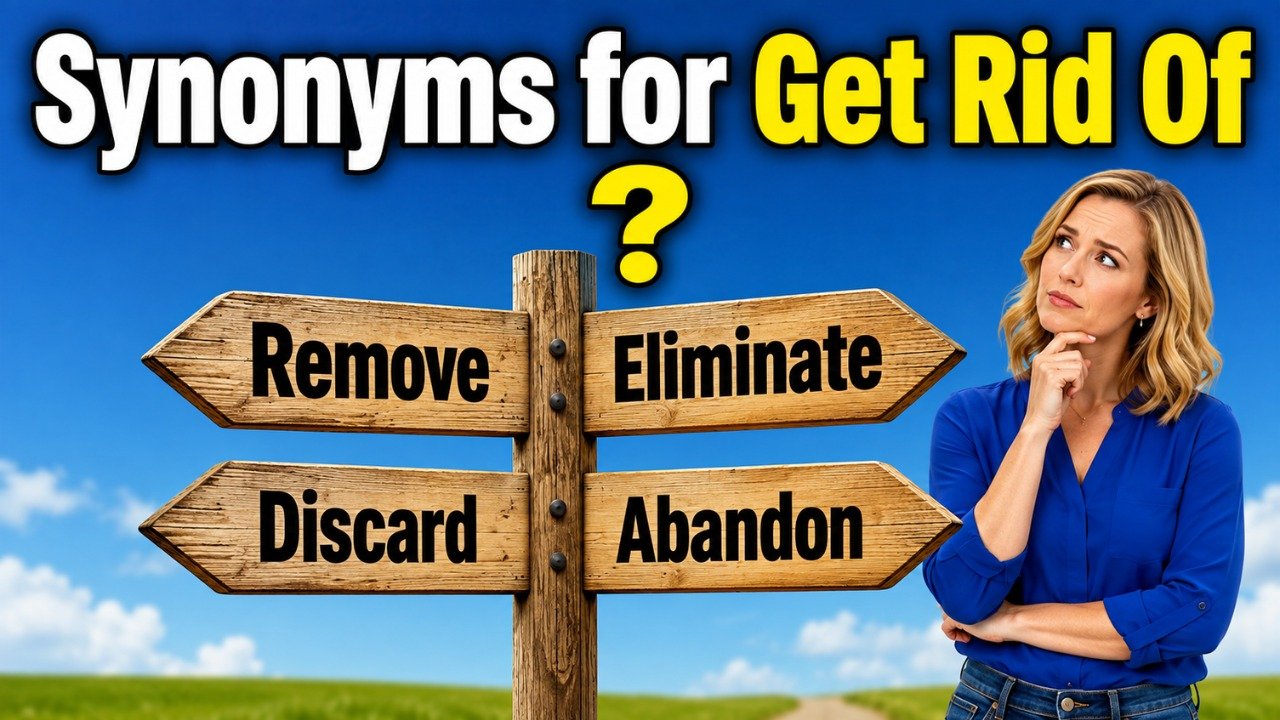
Quick Answer: The best synonyms for get rid of include remove, eliminate, discard, dispose of, clear away, throw away, erase, abolish, resolve, and overcome. Use remove for taking something away, eliminate for ending a problem completely, and discard for unwanted objects. Dispose of works well for waste or possessions, while clear away suits clutter. Use erase for marks or information, abolish for rules or systems, resolve for difficulties, and overcome for challenges, fears, or obstacles.
Pronunciation and Word Details
Word: Get rid of.
Pronunciation: /ɡet rɪd əv/.
Part of Speech: Phrasal verb.
Meaning: To remove, discard, eliminate, or free yourself from something unwanted.
US Pronunciation:
UK Pronunciation:
What Does “Get Rid Of” Mean?
Get rid of means to remove something unwanted, dispose of something unnecessary, or end a difficult situation. It is a common phrasal verb used in both everyday speech and informal writing.
The phrase can refer to physical objects, personal habits, problems, emotions, stains, debts, illnesses, rules, or responsibilities. Its exact meaning depends on the object that follows it.
Physical Removal: She got rid of the broken chair.
Problem Solving: The update helped get rid of the technical error.
Ending a Habit: He is trying to get rid of his habit of arriving late.
Removing a Mark: This cleaner can get rid of the stain.
Overcoming an Emotion: She practiced speaking to get rid of her fear.
In formal writing, a more precise synonym such as remove, eliminate, resolve, abolish, or overcome may communicate the intended meaning more clearly.
Meaning, Tone, and Context of “Get Rid Of”
Get rid of has a neutral to casual tone. It is common in conversation, instructions, personal writing, and practical advice.
The phrase can sometimes sound direct or negative because it suggests that something is unwanted. When referring to a person, it may sound rude, hostile, or insensitive. More respectful wording should be used in professional or polite communication.
Casual Context: Get rid of is natural when discussing clutter, old belongings, stains, or simple problems.
Neutral Context: It can describe removing unnecessary items or ending an unwanted condition.
Formal Context: Remove, eliminate, resolve, and discontinue are often better in reports, essays, policies, and professional messages.
Emotional Context: Overcome, release, or let go of may sound more thoughtful when discussing fear, anger, guilt, or painful memories.
Technical Context: Delete, uninstall, erase, clear, or deactivate may be more accurate for files, data, applications, and settings.
Medical Context: Treat, relieve, reduce, or cure may be more precise when discussing symptoms or health conditions.
When and How to Use “Get Rid Of”
For Removing Unwanted Objects
Use get rid of when you no longer want to keep an object.
Example: We need to get rid of the damaged furniture before moving.
For Throwing Away Waste
The phrase can describe placing rubbish or unwanted materials in the proper place.
Example: Please get rid of the empty containers after lunch.
For Clearing Clutter
Use it when removing unnecessary items from a room, desk, storage area, or digital space.
Example: She got rid of the clutter in her home office.
For Ending a Problem
Get rid of can describe solving or eliminating an issue.
Example: The new process helped the team get rid of repeated delays.
For Removing Stains or Marks
Use it when cleaning an unwanted substance, spot, smell, or mark.
Example: This method may get rid of the ink stain.
For Ending an Unwanted Habit
The phrase can describe stopping a repeated behavior.
Example: He wants to get rid of his habit of checking his phone during meals.
For Overcoming Fear or Stress
Use it informally when discussing an emotion that someone wants to overcome.
Example: Regular practice helped her get rid of her fear of public speaking.
For Clearing Digital Content
Get rid of may refer to deleting files, messages, applications, or saved data.
Example: I got rid of several unused files to create more storage space.
For Ending Rules or Systems
In informal language, the phrase can describe abolishing a rule, policy, or practice.
Example: The committee voted to get rid of the outdated requirement.
Best Synonyms for Get Rid Of
Remove
Synonym: To take something away from its position or place.
Example: Please remove the empty boxes from the hallway.
Eliminate
Synonym: To end or remove something completely.
Example: The company introduced new checks to eliminate avoidable errors.
Discard
Synonym: To throw away or stop keeping something unwanted.
Example: Discard any documents that are no longer needed.
Dispose Of
Synonym: To remove or throw away something in an appropriate manner.
Example: Dispose of damaged batteries according to the safety instructions.
Clear Away
Synonym: To remove objects from an area and make it tidy.
Example: We cleared away the dishes after dinner.
Throw Away
Synonym: To place something unwanted in the rubbish.
Example: Do not throw away the receipt until the refund is completed.
Erase
Synonym: To remove writing, marks, recordings, or information.
Example: She erased the incorrect answer and wrote a new one.
Abolish
Synonym: To officially end a law, rule, custom, or system.
Example: The organization voted to abolish the outdated policy.
Resolve
Synonym: To find a solution to a problem or disagreement.
Example: The support team resolved the issue within one day.
Overcome
Synonym: To successfully control or defeat a challenge, fear, or difficulty.
Example: She overcame her fear through preparation and practice.
50 Synonyms for Get Rid Of with Short Meanings
- Remove: Take something away from a place.
- Eliminate: End or remove something completely.
- Discard: Stop keeping something unwanted.
- Dispose Of: Remove something in a suitable way.
- Throw Away: Put something unwanted in the rubbish.
- Clear Away: Remove objects from an area.
- Clear Out: Empty a place by removing its contents.
- Clear: Remove unwanted material or obstructions.
- Erase: Remove writing, marks, or information.
- Delete: Remove digital information or content.
- Wipe Out: Destroy or remove something completely.
- Expel: Force something or someone to leave.
- Eject: Push or send something out.
- Extract: Remove something from inside another thing.
- Withdraw: Remove something from use or availability.
- Detach: Separate something from another object.
- Dislodge: Force something out of its position.
- Purge: Remove unwanted or harmful elements.
- Cleanse: Make something clean by removing impurities.
- Clean Out: Remove unwanted contents from a place.
- Empty: Remove everything from a container or space.
- Unload: Remove goods, burdens, or unwanted items.
- Shed: Let go of something unnecessary.
- Drop: Stop using, keeping, or discussing something.
- Abandon: Leave something behind permanently.
- Renounce: Formally give up a claim, belief, or practice.
- Relinquish: Voluntarily give up possession or control.
- Release: Free yourself from a burden or feeling.
- Let Go Of: Stop holding, keeping, or emotionally carrying something.
- Ditch: Informally abandon or discard something.
- Dump: Informally throw away or leave something unwanted.
- Scrap: Discard something because it is no longer useful.
- Jettison: Deliberately discard something unnecessary.
- Exterminate: Completely destroy harmful insects or pests.
- Eradicate: Remove something harmful completely.
- Abolish: Officially end a rule or system.
- End: Bring something to a conclusion.
- Stop: Cause an activity or condition to finish.
- Terminate: Formally bring something to an end.
- Discontinue: Stop providing, producing, or using something.
- Cancel: Decide that an arrangement will not continue.
- Resolve: Find a solution to a problem.
- Fix: Correct a problem or fault.
- Solve: Find the answer to a difficulty.
- Overcome: Successfully deal with a challenge.
- Cure: Remove an illness or harmful condition.
- Relieve: Reduce pain, pressure, or discomfort.
- Free Yourself From: Escape an unwanted burden or condition.
- Rid Yourself Of: Remove something unwanted from your life.
- Do Away With: End, remove, or stop using something.
Read Also:
Synonyms for Prepared

Synonyms for Get Rid Of by Context
When Get Rid Of Means Remove
Use remove, extract, detach, dislodge, eject, or withdraw when something is taken away from a particular place.
Example: The dentist removed the damaged tooth.
Example: Carefully detach the label from the package.
Example: The mechanic dislodged the object from the engine.
Remove is the most flexible choice. Extract suggests taking something out from inside another object. Detach means separating connected parts.
When Get Rid Of Means Throw Away
Use discard, dispose of, throw away, dump, scrap, or jettison when an unwanted object will no longer be kept.
Example: Discard any food that has passed its safe use period.
Example: The workers disposed of the waste responsibly.
Example: They scrapped the damaged equipment.
Discard is neutral and suitable for written instructions. Throw away is common in conversation. Dispose of is more formal and often suggests responsible handling.
When Get Rid Of Means Clear a Space
Use clear away, clear out, clean out, empty, or unload when removing items from a room, container, desk, or storage area.
Example: We cleared out the garage before the renovation.
Example: She emptied the drawer and organized its contents.
Example: Please clear away the plates after the meal.
Clear out often suggests removing many items. Clear away usually refers to tidying a visible area.
When Get Rid Of Means Eliminate a Problem
Use eliminate, eradicate, resolve, fix, solve, or wipe out when ending a difficulty, fault, or harmful condition.
Example: The new software eliminated several common errors.
Example: The technicians resolved the connection problem.
Example: Better planning solved the scheduling conflict.
Eliminate means removing the problem itself. Resolve and solve focus on finding an effective answer.
When Get Rid Of Means End a Rule or Practice
Use abolish, terminate, discontinue, cancel, end, or do away with when a rule, system, service, or practice will no longer continue.
Example: The school abolished the unnecessary requirement.
Example: The manufacturer discontinued the older model.
Example: The committee decided to do away with the outdated procedure.
Abolish is formal and often refers to laws, systems, or established practices. Discontinue is useful for products, services, and regular activities.
When Get Rid Of Means Overcome a Feeling
Use overcome, release, let go of, shed, or free yourself from when discussing fear, guilt, anger, stress, or emotional burdens.
Example: She overcame her anxiety through gradual practice.
Example: He learned to let go of unnecessary guilt.
Example: The conversation helped her release years of frustration.
Overcome suggests successfully gaining control. Let go of sounds more reflective and emotional.
When Get Rid Of Means Delete Digital Content
Use delete, erase, clear, uninstall, or remove when dealing with files, applications, records, or stored information.
Example: Delete the duplicate files from the folder.
Example: Clear the saved history from the device.
Example: Remove the unused application to create more space.
Delete is best for digital files and messages. Erase may refer to data, recordings, or stored information.
When Get Rid Of Means Reduce a Symptom
Use relieve, treat, cure, ease, or reduce when discussing pain, illness, discomfort, or symptoms.
Example: The treatment helped relieve the discomfort.
Example: Rest may ease the pressure in the injured area.
Example: The medicine reduced the swelling.
Cure suggests completely ending an illness. Relieve and ease usually mean making symptoms less severe.
Another Word for Get Rid Of
The best general replacement for get rid of is remove. It works well for objects, marks, barriers, unnecessary information, and unwanted materials.
However, the strongest alternative depends on what is being removed. Use discard for unwanted objects, eliminate for problems, resolve for difficulties, abolish for rules, delete for digital content, and overcome for fears or emotional challenges.
Original: We need to get rid of the old equipment.
Better Option: We need to remove the old equipment.
Original: The team must get rid of the repeated errors.
Better Option: The team must eliminate the repeated errors.
Original: She wants to get rid of her fear of driving.
Better Option: She wants to overcome her fear of driving.
Original: Please get rid of the unused files.
Better Option: Please delete the unused files.
When Not to Use “Get Rid Of”
When the Sentence Requires Formal Language
Get rid of may sound too conversational in reports, policies, academic writing, or formal instructions.
Weak: The company plans to get rid of unnecessary expenses.
Better: The company plans to eliminate unnecessary expenses.
When the Intended Meaning Is Unclear
The phrase can refer to throwing away, removing, solving, ending, or overcoming something. Choose a precise verb when readers need exact information.
Weak: We need to get rid of the issue.
Better: We need to resolve the issue.
When Referring to a Person
Get rid of can sound disrespectful or threatening when used about a person.
Weak: The manager wants to get rid of two employees.
Better: The manager plans to reassign two employees.
When Discussing Emotional Recovery
The phrase may sound dismissive when referring to grief, anxiety, guilt, or trauma.
Weak: She needs to get rid of her sadness.
Better: She needs time and support to work through her sadness.
When Discussing Illness
Get rid of is often too vague for medical information. Use treat, relieve, reduce, or cure according to the intended meaning.
Weak: This medicine will get rid of the pain.
Better: This medicine may relieve the pain.
When Responsible Disposal Matters
Throw away or get rid of may not explain how an item should be handled.
Weak: Get rid of the used batteries.
Better: Dispose of the used batteries at an approved collection point.
When Something Is Only Being Reduced
Do not use eliminate or get rid of when a problem will become smaller but will not disappear completely.
Weak: The changes will get rid of all delays.
Better: The changes will reduce delays.
Words Commonly Confused With Get Rid Of
Get Rid Of vs Remove: Get rid of is broad and conversational. Remove is more precise and suitable for both formal and informal contexts.
Get Rid Of vs Eliminate: Get rid of can mean removing or discarding something. Eliminate suggests ending something completely.
Get Rid Of vs Discard: Get rid of can apply to objects, habits, problems, and feelings. Discard usually refers to unwanted objects, materials, ideas, or options.
Get Rid Of vs Dispose Of: Dispose of means removing something appropriately, especially waste or unwanted materials. Get rid of does not explain the disposal method.
Get Rid Of vs Delete: Get rid of is general. Delete specifically refers to removing digital content, written entries, or stored information.
Get Rid Of vs Resolve: Get rid of may suggest ending a problem. Resolve means dealing with the problem successfully through a solution.
Get Rid Of vs Abolish: Abolish is used for officially ending a law, system, policy, or established practice.
Get Rid Of vs Overcome: Get rid of is informal and broad. Overcome is more suitable for fears, obstacles, challenges, and personal difficulties.
Get Rid Of vs Reduce: Get rid of suggests complete removal. Reduce means making something smaller, weaker, or less frequent.
Which Synonym Should You Choose?
Choose remove when taking an object, mark, barrier, or unwanted element away.
Choose eliminate when a problem, error, risk, or unnecessary step must disappear completely.
Choose discard when you decide that an object, idea, document, or option is no longer useful.
Choose dispose of when waste, chemicals, batteries, or unwanted materials must be handled appropriately.
Choose clear away when tidying dishes, clutter, rubbish, or objects from a visible area.
Choose clear out when emptying a room, drawer, cupboard, or storage space.
Choose delete when removing digital files, messages, records, or information.
Choose erase when removing writing, marks, memories, recordings, or stored data.
Choose resolve when finding an answer to a disagreement, technical issue, or practical problem.
Choose abolish when officially ending a law, rule, system, or long established practice.
Choose discontinue when a company or organization stops producing, offering, or using something.
Choose overcome when dealing successfully with fear, anxiety, weakness, or a difficult obstacle.
Choose relieve when reducing pain, discomfort, pressure, or emotional distress.
Choose let go of when discussing emotional release, painful memories, guilt, or resentment.
Real Life Examples of “Get Rid Of” in Sentences
Original: We need to get rid of these empty boxes.
Better Option: We need to remove these empty boxes.
Original: She got rid of several clothes she no longer wore.
Better Option: She discarded several clothes she no longer wore.
Original: The update got rid of the repeated error.
Better Option: The update eliminated the repeated error.
Original: Please get rid of the garden waste responsibly.
Better Option: Please dispose of the garden waste responsibly.
Original: He wants to get rid of his fear of speaking in public.
Better Option: He wants to overcome his fear of speaking in public.
Original: The committee decided to get rid of the old rule.
Better Option: The committee decided to abolish the old rule.
Original: I got rid of the duplicate photographs on my computer.
Better Option: I deleted the duplicate photographs on my computer.
Original: We must get rid of the disagreement before signing the contract.
Better Option: We must resolve the disagreement before signing the contract.
Original: This cleaner should get rid of the mark.
Better Option: This cleaner should remove the mark.
Original: She is trying to get rid of unnecessary guilt.
Better Option: She is trying to let go of unnecessary guilt.
Synonym Groups and Usage Differences
Physical Removal Group
Remove, extract, detach, dislodge, eject, and clear describe taking something away from a particular position.
Remove is the broadest choice. Extract means taking something from inside, while detach means separating connected parts.
Example: The technician removed the damaged component from the machine.
Disposal Group
Discard, dispose of, throw away, dump, scrap, and jettison describe no longer keeping something.
Discard is neutral. Dispose of emphasizes suitable handling. Dump can sound careless or informal.
Example: Dispose of unwanted materials according to local safety instructions.
Cleaning Group
Clear away, clear out, clean out, empty, purge, and cleanse describe removing clutter, dirt, impurities, or unwanted contents.
Clear away suits visible objects. Clean out suggests removing everything unwanted from an enclosed space.
Example: They cleaned out the storage room before moving new supplies inside.
Problem Solving Group
Eliminate, resolve, solve, fix, eradicate, and wipe out describe ending a problem or harmful condition.
Resolve and solve focus on finding an answer. Eliminate and eradicate emphasize complete removal.
Example: The revised process resolved the reporting issue.
Ending Group
Abolish, terminate, discontinue, cancel, stop, and end describe bringing an activity, system, agreement, or practice to a conclusion.
Abolish is formal and institutional. Discontinue is common for products and services.
Example: The provider discontinued the outdated service.
Emotional Release Group
Overcome, release, shed, let go of, and free yourself from describe moving beyond an emotional burden.
Overcome emphasizes control and success. Let go of sounds gentle and reflective.
Example: She gradually overcame her fear of making mistakes.
Digital Removal Group
Delete, erase, clear, remove, and uninstall refer to digital content, software, records, or stored information.
Delete works for files and messages. Uninstall specifically means removing an application or program.
Example: Delete the duplicate document before sharing the folder.
Antonyms of Get Rid Of
The opposite of get rid of depends on whether the phrase refers to keeping, adding, continuing, or accepting something.
Keep: Continue to possess something.
Retain: Continue to hold or preserve something.
Preserve: Protect something from loss or damage.
Save: Keep something for future use.
Store: Place something somewhere for later use.
Collect: Bring items together and keep them.
Acquire: Obtain or gain possession of something.
Add: Put something extra into a group or place.
Include: Make something part of a whole.
Accept: Agree to receive or take something.
Maintain: Keep something in its present condition.
Continue: Allow an action or situation to remain active.
Adopt: Begin using an idea, method, or practice.
Restore: Bring something back into use or existence.
Reintroduce: Bring something back after it was removed.
Comparison of Get Rid Of and Related Words
Get Rid Of vs Remove
Get rid of is casual and can have several meanings. Remove is clearer and more suitable for formal writing.
Example With Get Rid Of: Please get rid of the damaged boxes.
Example With Remove: Please remove the damaged boxes.
Get Rid Of vs Eliminate
Get rid of may mean discarding or removing. Eliminate usually suggests complete removal of a problem, risk, or unwanted element.
Example With Get Rid Of: We need to get rid of unnecessary delays.
Example With Eliminate: We need to eliminate unnecessary delays.
Get Rid Of vs Discard
Get rid of works with objects, problems, habits, and emotions. Discard usually describes rejecting or throwing away something no longer useful.
Example With Get Rid Of: She got rid of her old notes.
Example With Discard: She discarded her old notes.
Get Rid Of vs Dispose Of
Get rid of focuses on no longer having something. Dispose of focuses on the way it is removed.
Example With Get Rid Of: We need to get rid of the waste.
Example With Dispose Of: We need to dispose of the waste safely.
Get Rid Of vs Resolve
Get rid of suggests ending a problem. Resolve emphasizes finding a solution.
Example With Get Rid Of: The team got rid of the scheduling problem.
Example With Resolve: The team resolved the scheduling problem.
Get Rid Of vs Abolish
Get rid of is informal. Abolish is formal and relates to officially ending a rule, law, custom, or system.
Example With Get Rid Of: The council wants to get rid of the old regulation.
Example With Abolish: The council wants to abolish the old regulation.
Get Rid Of vs Overcome
Get rid of can describe no longer experiencing fear or difficulty. Overcome emphasizes personal effort and success.
Example With Get Rid Of: She got rid of her fear of water.
Example With Overcome: She overcame her fear of water.
Get Rid Of vs Reduce
Get rid of suggests complete removal. Reduce means making something less severe, frequent, or large.
Example With Get Rid Of: The plan aims to get rid of waste.
Example With Reduce: The plan aims to reduce waste.
Common Phrases and Expressions With Get Rid Of
Get Rid of Clutter: Remove unnecessary objects from a space.
Get Rid of Waste: Dispose of unwanted materials.
Get Rid of a Stain: Remove an unwanted mark from a surface.
Get Rid of a Smell: Eliminate an unpleasant odor.
Get Rid of a Habit: Stop a repeated behavior.
Get Rid of a Problem: Eliminate or resolve a difficulty.
Get Rid of Stress: Reduce or release mental pressure.
Get Rid of Fear: Overcome an anxious feeling.
Get Rid of Old Files: Delete unnecessary digital documents.
Get Rid of Unwanted Items: Discard possessions that are no longer needed.
Get Rid of an Error: Correct or eliminate a mistake.
Get Rid of a Rule: Abolish or discontinue a requirement.
Common Mistakes to Avoid
Using Get Rid Of in Formal Writing
The phrase may sound too casual in reports, essays, policies, and professional communication. Replace it with remove, eliminate, resolve, or discontinue.
Weak: The policy will get rid of unnecessary steps.
Better: The policy will eliminate unnecessary steps.
Choosing an Inaccurate Synonym
Discard is suitable for objects and ideas, but it does not naturally describe solving a technical problem.
Incorrect: The technician discarded the error.
Correct: The technician resolved the error.
Suggesting Complete Removal When Only Reduction Is Possible
Get rid of and eliminate imply that something disappears completely. Use reduce, ease, or limit when the effect is partial.
Weak: The new schedule will get rid of stress.
Better: The new schedule may reduce stress.
Using Rude Language About People
Avoid phrases that treat people as unwanted objects.
Weak: The department wants to get rid of several workers.
Better: The department is reviewing several roles and assignments.
Confusing Throw Away With Dispose Of
Throw away is general, while dispose of may involve specific environmental or safety requirements.
Weak: Throw away the chemical container anywhere.
Better: Dispose of the chemical container according to the safety guidance.
Using Cure for Temporary Relief
Cure means ending an illness or condition. Relieve means reducing symptoms.
Weak: The medicine cured the headache for two hours.
Better: The medicine relieved the headache for two hours.
Repeating the Phrase Too Often
Repeated use of get rid of can make writing sound vague. Select specific alternatives based on the intended action.
Repetitive: Get rid of the files, get rid of the boxes, and get rid of the errors.
Better: Delete the files, remove the boxes, and correct the errors.
Conclusion
Synonyms for get rid of should be chosen according to what is being removed or ended. Remove suits physical objects, discard and dispose of work for unwanted items, and eliminate describes complete removal. Resolve is best for problems, abolish suits rules, and delete applies to digital content. Use overcome or let go of for fears and emotional burdens. Choosing a precise alternative improves clarity, creates a more natural tone, and helps readers understand whether something is being removed, solved, reduced, or permanently ended.
FAQs About Synonyms for Get Rid Of
What Is the Best Synonym for Get Rid Of?
Remove is the best general synonym. Eliminate, discard, resolve, and dispose of may be more precise in specific contexts.
What Is a Formal Synonym for Get Rid Of?
Eliminate, remove, resolve, abolish, discontinue, and dispose of are suitable formal alternatives.
What Is Another Word for Getting Rid of Unwanted Items?
Discarding, disposing of, clearing out, and throwing away are useful alternatives for unwanted items.
What Is a Synonym for Get Rid Of a Problem?
Resolve, solve, fix, eliminate, and overcome can replace get rid of when referring to a problem.
Can Eliminate Always Replace Get Rid Of?
No. Eliminate works for problems, risks, errors, and unwanted elements, but it may sound unnatural when referring to ordinary household objects.
Is Dispose Of the Same as Get Rid Of?
They are similar, but dispose of often emphasizes removing something correctly or responsibly.
What Is a Better Way to Say Get Rid Of Fear?
Overcome fear, release fear, move beyond fear, and free yourself from fear are clearer and more thoughtful alternatives.
