
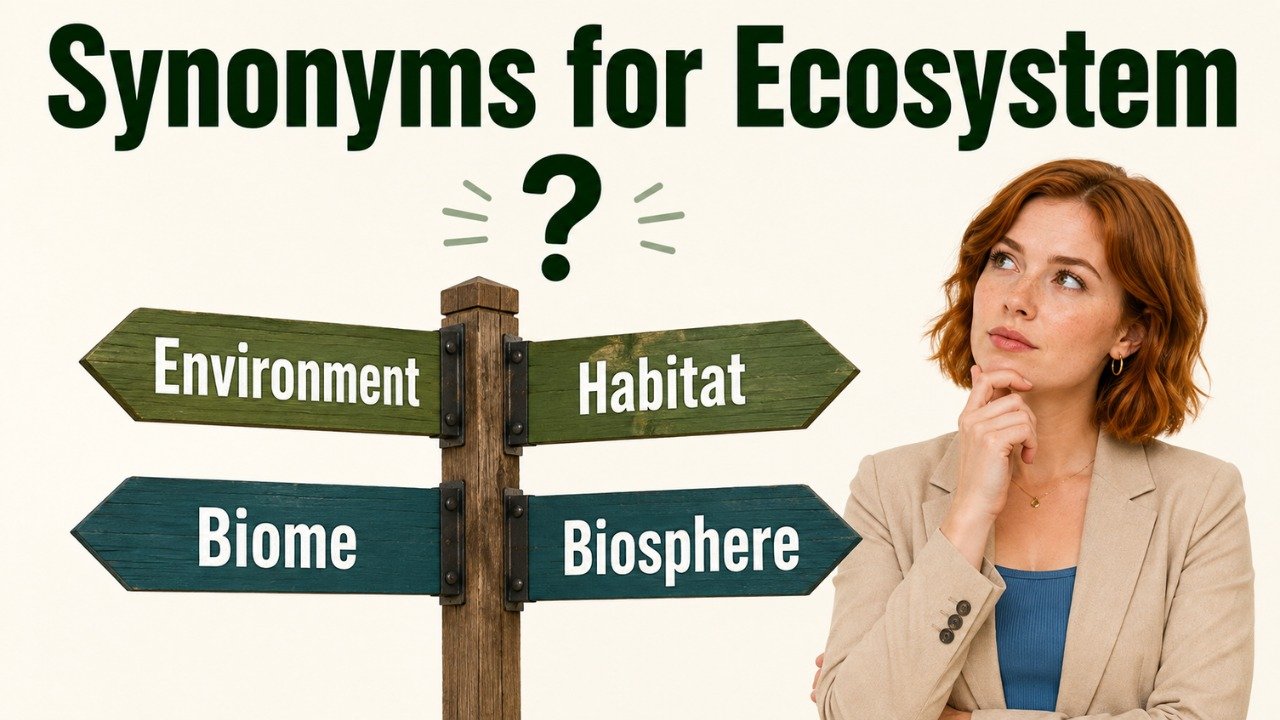
Quick Answer: Synonyms for ecosystem include ecological system, environment, habitat, biome, biosphere, ecological community, living system, natural network, interconnected system, and biological community. Use ecological system in scientific writing, environment for general surroundings, habitat for the place where a species lives, and biome for a large climate based region. In business or technology, network, platform, community, infrastructure, or interconnected system may be more accurate.
Pronunciation and Word Details
Word: Ecosystem.
Pronunciation: /ˈiː.koʊˌsɪs.təm/
Part of Speech: Noun.
Meaning: A connected system in which living organisms, physical surroundings, resources, and processes interact with one another.
US Pronunciation:
UK Pronunciation:
What Does “Ecosystem” Mean?
Ecosystem means a connected system formed by living organisms and the environment in which they interact.
In environmental science, an ecosystem includes plants, animals, microorganisms, soil, water, air, sunlight, climate, and the relationships among them. A forest, pond, desert, coral reef, or grassland can function as an ecosystem.
Example: The lake ecosystem supports fish, insects, plants, and birds.
Ecosystem is a noun. Its plural form is ecosystems.
The word is also used outside environmental science. It can describe any complex network of connected people, organizations, technologies, services, or resources.
Business Context: Small companies depend on a wider business ecosystem.
Technology Context: The application belongs to a connected digital ecosystem.
Education Context: Schools, families, libraries, and local organizations form a learning ecosystem.
Creative Context: Writers, publishers, editors, and readers are part of a literary ecosystem.
In every context, the central idea is connection. An ecosystem contains several parts that affect, support, compete with, or depend on one another.
Meaning, Tone, and Context of “Ecosystem”
Ecosystem has a neutral, academic, scientific, professional, and technical tone.
In environmental writing, it is a precise scientific term. It describes relationships between organisms and physical conditions rather than merely naming a location.
Scientific Context: Rising temperatures can disrupt a coastal ecosystem.
In business, technology, education, health, and media, ecosystem is often used metaphorically. It describes a network in which many participants, tools, and resources work together.
Professional Context: The company is building an ecosystem of products and services.
Technical Context: The software ecosystem includes developers, users, tools, and integrations.
Social Context: Community groups form a support ecosystem for local families.
The word can sound broad or abstract when the relationship between the parts is not explained. In simple writing, environment, network, community, system, or industry may communicate the meaning more clearly.
Ecosystem is generally neutral, but it can carry positive or negative associations.
Positive Tone: A healthy ecosystem supports diversity and resilience.
Negative Tone: Pollution has damaged the surrounding ecosystem.
Analytical Tone: The report examines changes across the regional business ecosystem.
When and How to Use “Ecosystem”
For Natural Environments
Use ecosystem when describing organisms and the physical conditions that support them.
Example: The wetland ecosystem provides food and shelter for many species.
Alternative: The wetland ecological system provides food and shelter for many species.
For Interdependent Species
Use ecosystem when plants, animals, microorganisms, and natural resources depend on one another.
Example: Every species plays a role in the forest ecosystem.
Alternative: Every species plays a role in the forest biological community.
For Environmental Change
Use ecosystem when explaining how pollution, climate, development, or natural events affect a connected natural system.
Example: The oil spill caused lasting damage to the marine ecosystem.
Alternative: The oil spill caused lasting damage to the marine environment.
For Business Networks
Use ecosystem when companies, suppliers, customers, investors, and service providers operate within a connected commercial system.
Example: New businesses are strengthening the local startup ecosystem.
Alternative: New businesses are strengthening the local innovation network.
For Technology Systems
Use ecosystem when devices, programs, platforms, developers, and users interact.
Example: The tool works well within the existing software ecosystem.
Alternative: The tool works well within the existing software environment.
For Education and Learning
Use ecosystem when schools, teachers, families, technology, and community organizations support learning together.
Example: Libraries are an important part of the local learning ecosystem.
Alternative: Libraries are an important part of the local learning network.
For Health and Support Services
Use ecosystem when several services, professionals, institutions, and communities contribute to health or care.
Example: The patient depends on a broad healthcare ecosystem.
Alternative: The patient depends on a broad healthcare network.
For Creative Industries
Use ecosystem when creators, audiences, tools, institutions, and distributors form an interconnected field.
Example: Independent artists contribute to the cultural ecosystem.
Alternative: Independent artists contribute to the cultural community.
Best Synonyms for Ecosystem
Ecological System
Synonym: A scientific term for organisms and physical conditions interacting in one place.
Example: The river forms a complex ecological system.
Environment
Synonym: The surrounding natural, social, physical, or digital conditions.
Example: Many species have adapted to this harsh environment.
Habitat
Synonym: The natural place where a particular plant or animal lives.
Example: The marsh provides a protected habitat for water birds.
Biome
Synonym: A large natural region defined by climate, plants, and animals.
Example: The tundra biome supports specially adapted species.
Biosphere
Synonym: All parts of Earth where life exists.
Example: Human activity affects the entire biosphere.
Ecological Community
Synonym: A group of different species living and interacting in the same area.
Example: The pond contains a diverse ecological community.
Living System
Synonym: A connected arrangement involving living organisms and life supporting processes.
Example: A forest is a constantly changing living system.
Natural Network
Synonym: A web of relationships among organisms and natural resources.
Example: Removing one predator can disturb the natural network.
Interconnected System
Synonym: A structure whose individual parts influence and depend on one another.
Example: Public transport functions as an interconnected system.
Biological Community
Synonym: Populations of different organisms living together in one place.
Example: The reef supports a rich biological community.
50 Synonyms for Ecosystem with Short Meanings
- Ecological System: Organisms and physical surroundings interacting together.
- Environment: The conditions and surroundings in which something exists.
- Natural Environment: The physical world and natural conditions around living things.
- Habitat: The natural home of a plant, animal, or organism.
- Biome: A large region with a shared climate and characteristic life.
- Biosphere: Every part of Earth where living organisms exist.
- Ecology: The relationships between organisms and their surroundings.
- Ecological Community: Different species living and interacting in one area.
- Biological Community: Populations of organisms sharing the same environment.
- Biotic Community: The living organisms found together in a particular place.
- Natural Community: A naturally occurring group of interacting organisms.
- Living Community: A collection of living organisms connected by shared conditions.
- Living System: A connected structure involving organisms and life processes.
- Natural System: A system created and maintained through natural processes.
- Environmental System: Natural elements and processes operating as one structure.
- Ecological Network: Connected relationships among species and environmental resources.
- Biological Network: A set of connected living organisms or biological processes.
- Natural Network: Interdependent relationships found in nature.
- Living Network: A connected web of organisms or participants.
- Food Web: Linked feeding relationships among organisms.
- Trophic Network: Scientific term for connected feeding levels and relationships.
- Web of Life: The interconnected relationships among living things.
- Community of Organisms: Different organisms living together in one area.
- Life System: A structure that contains and supports living processes.
- Ecological Region: An area defined by related environmental characteristics.
- Bioregion: A natural area identified by geography, climate, and living communities.
- Ecosphere: A self contained or global system supporting life.
- Microenvironment: A small environment with its own distinct conditions.
- Life Zone: A natural area supporting particular forms of life.
- Environmental Community: Organisms and surroundings interacting as a community.
- Habitat System: Connected habitats and the species that depend on them.
- Life Supporting System: A structure that provides conditions necessary for life.
- Interconnected System: A system whose parts depend on one another.
- Interdependent System: A structure in which each part relies on other parts.
- Complex System: A system formed from many interacting elements.
- Dynamic System: A connected structure that changes over time.
- Adaptive System: A system able to respond to changing conditions.
- Support System: A connected group providing resources, help, or stability.
- Network: A group of connected people, services, tools, or organisms.
- Community: A group connected by location, purpose, or shared interests.
- Framework: A supporting structure connecting different elements.
- Infrastructure: The systems and resources supporting an activity or industry.
- Platform: A shared foundation connecting users, tools, or services.
- Landscape: The overall conditions, participants, and forces in a field.
- Sphere: An area of activity, influence, or knowledge.
- Domain: A particular field, environment, or area of activity.
- Value Network: Connected participants who create and exchange value.
- Innovation Network: Organizations and individuals connected through new ideas.
- Business Network: Commercial participants linked through shared activity.
- Digital Environment: Connected technologies, services, users, and information.
Read Also:
Synonyms for Making

Synonyms for Ecosystem by Context
When Ecosystem Means a Natural System
Ecological system, natural system, environmental system, living system, and natural environment are useful alternatives when discussing nature.
Example With Ecosystem: The mountain ecosystem contains many rare plants.
Example With a Synonym: The mountain ecological system contains many rare plants.
Ecological system is the most precise scientific replacement. Natural environment is broader because it may refer to the surroundings without emphasizing every relationship.
Example: Pollution has changed the natural environment around the lake.
When Ecosystem Means the Home of a Species
Habitat, microenvironment, life zone, and ecological region describe the place or conditions in which organisms live.
Example With Ecosystem: Development is threatening the bird’s ecosystem.
Example With a Synonym: Development is threatening the bird’s habitat.
Habitat is usually better when the sentence focuses on one species. Ecosystem is more suitable when discussing several species and environmental processes together.
Example: The wetland is an essential habitat for migrating birds.
When Ecosystem Means a Large Natural Region
Biome, bioregion, biosphere, ecological region, and life zone describe nature on a larger scale.
Example With Ecosystem: The desert ecosystem receives very little rainfall.
Example With a Synonym: The desert biome receives very little rainfall.
Biome refers to a major climate based region, while biosphere includes all regions of Earth where life exists.
Example: Tropical forests are an important part of the global biosphere.
When Ecosystem Means a Group of Organisms
Ecological community, biological community, biotic community, natural community, and living community focus on the organisms present in an area.
Example With Ecosystem: The pond ecosystem includes plants, insects, fish, and microorganisms.
Example With a Synonym: The pond biological community includes plants, insects, fish, and microorganisms.
Community does not always include soil, water, climate, or sunlight. Ecosystem includes both living and nonliving elements.
When Ecosystem Means Interdependent Relationships
Ecological network, natural network, biological network, food web, and web of life highlight connections.
Example With Ecosystem: The disappearance of insects could weaken the ecosystem.
Example With a Synonym: The disappearance of insects could weaken the natural network.
Food web is more specific because it focuses on feeding relationships.
Example: Small fish occupy an important position in the marine food web.
When Ecosystem Means a Business Environment
Business network, value network, commercial environment, industry landscape, and support system are useful alternatives.
Example With Ecosystem: Investors play an important role in the startup ecosystem.
Example With a Synonym: Investors play an important role in the startup support system.
Business network emphasizes relationships among companies and professionals. Industry landscape describes the overall conditions and participants in a sector.
Example: New regulations are changing the financial industry landscape.
When Ecosystem Means a Technology Network
Digital environment, platform, infrastructure, technical framework, and network fit technology related contexts.
Example With Ecosystem: Developers create tools for the mobile ecosystem.
Example With a Synonym: Developers create tools for the mobile platform.
Platform is best when one central service connects users and tools. Infrastructure focuses on the systems that make digital activity possible.
Example: Secure infrastructure is essential for online services.
When Ecosystem Means a Social or Creative Community
Community, network, support system, sphere, and landscape can describe connected people, institutions, and resources.
Example With Ecosystem: Local theaters contribute to the creative ecosystem.
Example With a Synonym: Local theaters contribute to the creative community.
Community sounds more personal, while ecosystem emphasizes wider relationships, resources, and influences.
Another Word for Ecosystem
Ecological system is the best direct replacement for ecosystem in scientific writing. It preserves the meaning of organisms interacting with one another and with their physical surroundings.
Environment is a simpler and more general alternative. However, it may not fully express the relationships among all parts of an ecosystem.
In business and technology, network is often the clearest replacement.
Original: The forest ecosystem is vulnerable to rising temperatures.
Better Option: The forest ecological system is vulnerable to rising temperatures.
Original: The animal cannot survive outside its natural ecosystem.
Better Option: The animal cannot survive outside its natural habitat.
Original: Small companies strengthen the regional business ecosystem.
Better Option: Small companies strengthen the regional business network.
Original: The software belongs to a rapidly growing digital ecosystem.
Better Option: The software belongs to a rapidly growing digital environment.
When Not to Use “Ecosystem”
Do not use ecosystem when you are only referring to a physical place. Habitat, region, setting, or environment may be more accurate.
Weak: The bear sleeps in a rocky ecosystem.
Better: The bear sleeps in a rocky habitat.
Avoid ecosystem when the sentence describes one company, tool, product, or person rather than a connected network.
Weak: This single application is a useful ecosystem.
Better: This single application is a useful tool.
Do not use ecosystem as a vague replacement for industry.
Weak: The clothing ecosystem experienced lower sales.
Better: The clothing industry experienced lower sales.
Avoid using ecosystem when community is clearer and more personal.
Weak: Volunteers created a caring neighborhood ecosystem.
Better: Volunteers created a caring neighborhood community.
Do not treat habitat and ecosystem as exact synonyms. A habitat is the place where an organism lives. An ecosystem includes organisms, surroundings, resources, and interactions.
Weak: The fox depends on its ecosystem for shelter.
Better: The fox depends on its habitat for shelter.
Avoid repeating ecosystem several times in one paragraph.
Weak: The digital ecosystem includes tools that support the ecosystem and help the ecosystem grow.
Better: The digital ecosystem includes tools that support the network and help it grow.
Do not use ecosystem merely to make simple writing sound more technical.
Weak: My kitchen has an ecosystem of cooking tools.
Better: My kitchen contains a useful collection of cooking tools.
Words Commonly Confused With Ecosystem
Ecosystem vs Environment: An environment is the surrounding set of conditions. An ecosystem includes those conditions, living organisms, and their interactions.
Ecosystem vs Habitat: A habitat is the natural home of a species. An ecosystem contains many organisms, habitats, resources, and physical processes.
Ecosystem vs Biome: An ecosystem may be small or large. A biome is a broad region defined by climate, plants, and animals.
Ecosystem vs Biosphere: An ecosystem is one connected natural system. The biosphere includes every ecosystem and every place on Earth where life exists.
Ecosystem vs Ecology: Ecosystem names the system itself. Ecology is the scientific study of relationships among organisms and their surroundings.
Ecosystem vs Community: A biological community includes living populations. An ecosystem includes the community plus soil, water, air, climate, and other nonliving elements.
Ecosystem vs Food Web: A food web describes feeding relationships. An ecosystem includes feeding relationships along with shelter, climate, nutrients, water, and other processes.
Ecosystem vs Network: A network is any connected group. An ecosystem usually suggests deeper interdependence, shared resources, and changing relationships.
Ecosystem vs Infrastructure: Infrastructure includes the systems and resources supporting activity. An ecosystem includes the people, organizations, tools, conditions, and relationships around that infrastructure.
Which Synonym Should You Choose?
Choose ecological system for scientific writing about organisms and their physical surroundings.
Choose environment when you need a broad, simple term for surrounding conditions.
Choose habitat when discussing the natural home of one species.
Choose biome when describing a major natural region shaped by climate and vegetation.
Choose biosphere when referring to all life supporting areas of Earth.
Choose ecological community when focusing mainly on different species living together.
Choose food web when discussing which organisms eat or depend on other organisms for food.
Choose natural network when emphasizing relationships among species and resources.
Choose interconnected system when the subject includes many connected parts outside environmental science.
Choose community when people, organizations, or participants share an interest, place, or purpose.
Choose network when emphasizing connections among individuals, businesses, tools, or institutions.
Choose infrastructure when describing the systems and resources that support an activity.
Choose platform when one central technology connects users, services, or applications.
Choose landscape when describing the general conditions, trends, participants, and forces within an industry.
Choose support system when people or services provide assistance, stability, or resources.
Choose value network when connected organizations create, exchange, or deliver value.
Choose innovation network when businesses, institutions, and individuals cooperate to develop new ideas.
Real Life Examples of “Ecosystem” in Sentences
Original: The river ecosystem supports hundreds of species.
Better Option: The river ecological system supports hundreds of species.
Original: Construction has damaged the animal’s ecosystem.
Better Option: Construction has damaged the animal’s habitat.
Original: The rainforest ecosystem depends on regular rainfall.
Better Option: The rainforest biome depends on regular rainfall.
Original: Plastic pollution threatens the ocean ecosystem.
Better Option: Plastic pollution threatens the marine environment.
Original: Bees play an important role in the local ecosystem.
Better Option: Bees play an important role in the local natural network.
Original: Investors support the regional business ecosystem.
Better Option: Investors support the regional business network.
Original: The device operates within a connected technology ecosystem.
Better Option: The device operates within a connected digital environment.
Original: Teachers and parents are part of the learning ecosystem.
Better Option: Teachers and parents are part of the learning support system.
Original: Independent writers contribute to the publishing ecosystem.
Better Option: Independent writers contribute to the publishing community.
Original: Hospitals, clinics, and laboratories form a healthcare ecosystem.
Better Option: Hospitals, clinics, and laboratories form an interconnected healthcare network.
Synonym Groups and Usage Differences
Natural System Group
Ecological system, natural system, environmental system, living system, and life supporting system describe connected natural processes.
Ecological system is the most scientific option. Natural system is broader and may include processes that do not involve living organisms.
Example: A wetland is a valuable ecological system.
Location Group
Habitat, natural environment, microenvironment, life zone, and ecological region describe places and conditions.
Habitat usually refers to the home of a particular species. Microenvironment describes a small area with unique conditions.
Example: The shaded soil creates a cool microenvironment for insects.
Regional Group
Biome, bioregion, biosphere, life zone, and ecological region describe natural areas at different scales.
Biome is a broad climate region. Bioregion may include geography, culture, water systems, and natural communities.
Example: The grassland biome supports grazing animals.
Community Group
Ecological community, biological community, biotic community, natural community, and living community focus mainly on living organisms.
These terms do not always include nonliving elements such as water, sunlight, and soil.
Example: The lake contains a diverse biological community.
Connection Group
Ecological network, biological network, natural network, food web, and web of life focus on relationships and dependence.
Food web is limited to feeding relationships. Web of life is broader and more expressive.
Example: Every pollinator contributes to the web of life.
Business Group
Business network, value network, innovation network, commercial environment, and industry landscape describe connected economic activity.
Business network focuses on relationships. Industry landscape focuses on the wider market conditions.
Example: Local suppliers form an important business network.
Technology Group
Digital environment, platform, infrastructure, framework, and network describe connected technical systems.
Platform usually refers to a central service. Infrastructure refers to underlying systems, while framework provides structure.
Example: The service depends on secure digital infrastructure.
Social Group
Community, support system, network, sphere, and domain describe connected people and institutions.
Community sounds human and cooperative. Network emphasizes links, while sphere describes an area of activity or influence.
Example: Volunteers created a strong support system for older residents.
Antonyms of Ecosystem
Ecosystem does not have one exact antonym because its meaning changes by context. Opposites usually describe separation, damage, disorder, lifelessness, or lack of connection.
Isolation: A state in which parts remain separate and disconnected.
Disconnection: The absence of meaningful links among parts.
Fragmentation: The division of one connected system into smaller pieces.
Separation: A condition in which elements do not interact.
Ecological Collapse: The serious failure of a natural system.
Environmental Breakdown: The loss of normal environmental functions.
Imbalance: A condition in which parts no longer exist in healthy proportions.
Disorder: A lack of stable organization or coordination.
Lifeless Environment: A place unable to support living organisms.
Barren Area: Land with little or no plant and animal life.
Monoculture: A system dominated by one species or crop, with limited diversity.
Artificial Isolation: Deliberate separation from surrounding natural or social systems.
Disconnected Network: A group whose parts cannot communicate or cooperate.
Independent Unit: A single part that operates without relying on a wider network.
Closed Structure: A system with limited exchange, interaction, or outside participation.
Comparison: Ecosystem vs Related Words
Ecosystem vs Environment
Environment refers to surroundings and conditions. Ecosystem includes those conditions and the relationships among living and nonliving elements.
Example With Ecosystem: The lake ecosystem supports fish, plants, and microorganisms.
Example With Environment: These fish require a clean aquatic environment.
Ecosystem vs Habitat
Habitat is the place where a particular species lives. Ecosystem includes many species and the physical environment around them.
Example With Ecosystem: Pollution has damaged the coastal ecosystem.
Example With Habitat: The beach provides nesting habitat for turtles.
Ecosystem vs Biome
An ecosystem can be as small as a pond or as large as a forest. A biome covers a broad geographical region with a shared climate and characteristic life.
Example With Ecosystem: The pond ecosystem changes throughout the year.
Example With Biome: The desert biome receives limited rainfall.
Ecosystem vs Biosphere
An ecosystem is one local or regional system. The biosphere includes every ecosystem where life exists on Earth.
Example With Ecosystem: The island ecosystem contains several rare species.
Example With Biosphere: Climate change affects the entire biosphere.
Ecosystem vs Ecology
Ecosystem is a group of interacting organisms and environmental elements. Ecology is the study of those interactions.
Example With Ecosystem: The forest ecosystem is recovering from fire.
Example With Ecology: She studies the ecology of forest insects.
Ecosystem vs Community
A community consists of living populations in one place. An ecosystem includes the community and nonliving factors such as water, soil, and climate.
Example With Ecosystem: The wetland ecosystem depends on seasonal flooding.
Example With Community: The wetland community includes birds, fish, plants, and insects.
Ecosystem vs Network
A network is a general group of connected parts. Ecosystem suggests that the parts influence, support, compete with, and depend on one another.
Example With Ecosystem: Universities and businesses form an innovation ecosystem.
Example With Network: Researchers communicate through an international network.
Ecosystem vs Platform
An ecosystem includes many organizations, tools, services, and participants. A platform is usually one central foundation within that larger system.
Example With Ecosystem: Developers contribute to the wider technology ecosystem.
Example With Platform: The platform connects developers with customers.
Common Phrases and Expressions With “Ecosystem”
Natural Ecosystem: A naturally occurring system of organisms and physical conditions.
Healthy Ecosystem: A balanced and resilient system able to support diverse life.
Marine Ecosystem: A connected natural system found in oceans or seas.
Forest Ecosystem: Plants, animals, soil, water, and climate interacting in a forest.
Freshwater Ecosystem: A natural system found in rivers, lakes, ponds, or wetlands.
Business Ecosystem: Connected companies, customers, suppliers, investors, and services.
Digital Ecosystem: Interacting technologies, users, services, devices, and information.
Innovation Ecosystem: Organizations and individuals supporting research and new ideas.
Startup Ecosystem: Founders, investors, advisers, institutions, and resources supporting new businesses.
Learning Ecosystem: Connected people, tools, institutions, and environments supporting education.
Common Mistakes to Avoid
One common mistake is using ecosystem as an exact synonym for habitat.
Incorrect: The cave is the bat’s entire ecosystem.
Correct: The cave is part of the bat’s habitat.
A habitat is a species’ home, while an ecosystem includes many organisms and environmental relationships.
Another mistake is treating environment and ecosystem as identical.
Environment: The conditions surrounding an organism.
Ecosystem: The organisms, conditions, and interactions operating together.
Avoid calling every group or collection an ecosystem.
Weak: The shelf contains an ecosystem of books.
Better: The shelf contains a collection of books.
Use ecosystem only when the parts interact or depend on one another.
Do not use the word vaguely in business or technology writing. Explain who or what belongs to the system.
Vague: The company supports the wider ecosystem.
Clear: The company supports a network of suppliers, developers, and independent retailers.
Avoid confusing ecosystem with ecology.
Incorrect: Scientists are studying the ecosystem of animal relationships.
Better: Scientists are studying the ecology of animal relationships.
Do not repeat ecosystem in every sentence.
Repetitive: The ecosystem supports businesses in the ecosystem and attracts investment to the ecosystem.
Better: The ecosystem supports local businesses, strengthens the network, and attracts investment.
Avoid using biome for a small local area.
Incorrect: The garden contains a small biome.
Better: The garden contains a small ecosystem.
Choose the replacement according to scale, scientific meaning, and context.
Conclusion
Synonyms for ecosystem include ecological system, environment, habitat, biome, biosphere, biological community, natural network, and interconnected system. Ecological system is the most direct scientific alternative, while habitat describes the home of a species and biome identifies a large natural region. In business and technology, network, platform, infrastructure, and digital environment may be clearer. The best synonym depends on whether the sentence focuses on nature, location, living communities, connected services, or shared resources.
FAQs About Synonyms for Ecosystem
What Is the Best Synonym for Ecosystem?
Ecological system is the closest direct synonym in scientific writing. Environment is a simpler alternative for general use.
Is Environment a Synonym for Ecosystem?
Environment is a related word, but it is not always an exact synonym. An ecosystem includes organisms, surroundings, and interactions.
Is Habitat the Same as Ecosystem?
No. A habitat is the place where a species lives. An ecosystem includes several species, habitats, physical conditions, and natural processes.
What Is Another Word for a Business Ecosystem?
Business network, value network, commercial environment, industry landscape, and support system are useful alternatives.
What Is Another Word for a Digital Ecosystem?
Digital environment, technology network, platform, infrastructure, and technical framework may replace digital ecosystem.
What Is a Scientific Synonym for Ecosystem?
Ecological system is the strongest scientific synonym. Biological community and biotic community are related but focus mainly on living organisms.
What Is the Difference Between an Ecosystem and a Biome?
An ecosystem is a connected natural system of any size. A biome is a large region defined by climate, vegetation, and characteristic animals.
