
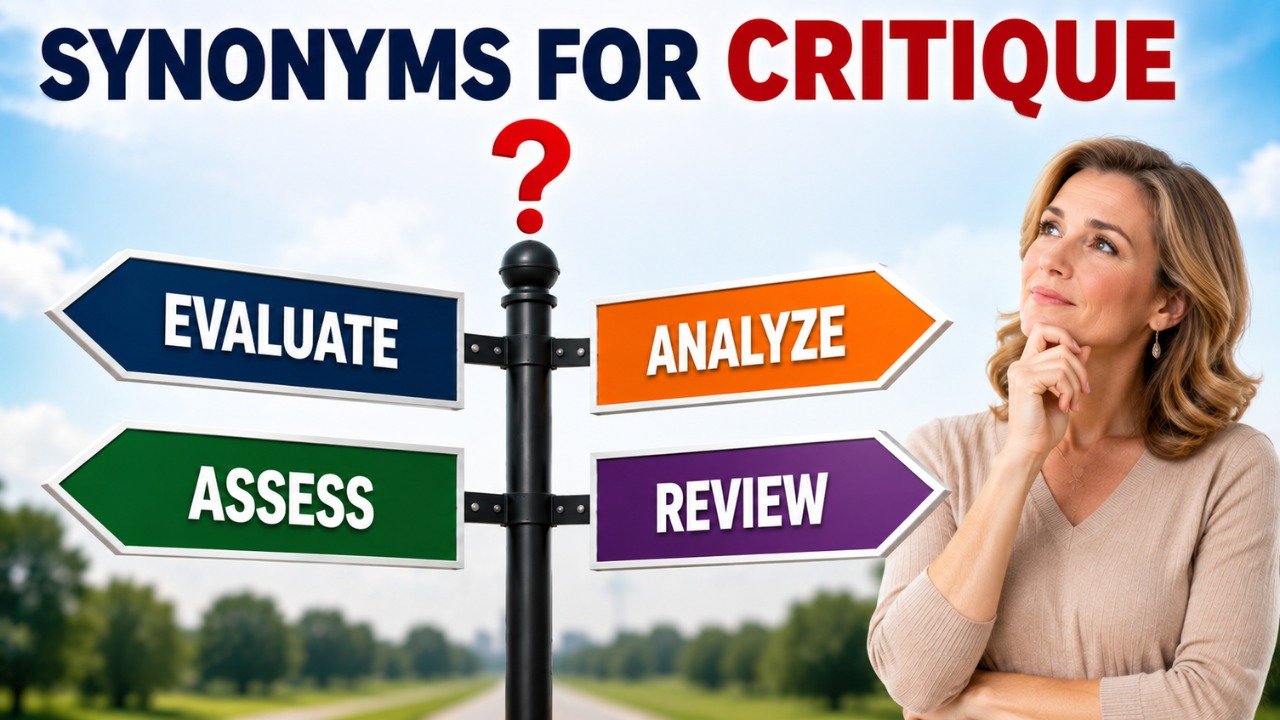
Quick Answer: The best synonyms for critique include evaluation, analysis, review, assessment, appraisal, criticism, commentary, examination, feedback, and judgment. Use evaluation for a balanced formal judgment, analysis for a detailed examination, and review for an organized discussion of quality. Feedback is best for helpful suggestions, while criticism often emphasizes weaknesses or faults. Appraisal suits professional judgments of quality or value, and commentary works well for observations about a creative work, argument, performance, or idea.
Pronunciation and Word Details
Word: Critique.
Pronunciation: /krɪˈtiːk/.
Part of Speech: Noun and verb.
Meaning: A detailed examination and judgment of the strengths, weaknesses, quality, or meaning of something.
US Pronunciation:
UK Pronunciation:
What Does “Critique” Mean?
Critique means a careful analysis and judgment of a work, idea, performance, argument, or result.
As a noun, critique refers to the written or spoken evaluation itself.
Example: The editor provided a detailed critique of the opening chapter.
As a verb, critique means to examine something carefully and explain its strengths, weaknesses, and possible improvements.
Example: The students were asked to critique each other’s essays.
A critique does not always mean negative criticism. A balanced critique may recognize successful features, identify weaknesses, explain their effects, and suggest practical improvements.
The word commonly appears in education, literature, art, research, design, business, performance, and professional development. Its exact meaning depends on whether the speaker is offering analysis, judgment, feedback, or criticism.
Meaning, Tone, and Context of “Critique”
Critique usually has a neutral, formal, and analytical tone. It suggests a thoughtful examination rather than a quick personal reaction.
In academic writing, a critique evaluates the reasoning, evidence, methods, and conclusions of a text or study. It may explain whether an argument is convincing and whether the evidence supports the main claim.
In creative fields, a critique discusses the technique, structure, originality, emotional effect, and overall quality of a work. It may be used for writing, painting, design, music, photography, or performance.
In professional settings, critique can describe structured feedback about a proposal, presentation, product, strategy, or completed project.
The word may sound negative when it focuses mainly on faults. However, a useful critique should normally be fair, specific, evidence based, and constructive.
In casual conversation, review, opinion, or feedback may sound more natural. Critique is usually chosen when the examination is detailed, organized, or informed by clear standards.
When and How to Use “Critique”
For Academic Analysis: Use critique when carefully evaluating an argument, theory, article, or research study.
Example: Her critique examined the reliability of the evidence and the logic of the conclusion.
For Creative Work: Use critique when discussing the strengths, weaknesses, style, and effect of a creative piece.
Example: The class held a critique of the students’ short stories.
For Constructive Feedback: Use critique when giving thoughtful comments intended to improve someone’s work.
Example: His critique included practical suggestions for strengthening the presentation.
For Professional Evaluation: Use critique when assessing the effectiveness or quality of a plan, project, or performance.
Example: The manager requested a critique of the proposed marketing strategy.
For Cultural Discussion: Use critique when examining social ideas, traditions, institutions, or patterns.
Example: The novel presents a critique of social inequality.
For Detailed Judgment: Use critique when a simple opinion is not enough and reasons must support the judgment.
Example: The report offered a balanced critique of the new policy.
Best Synonyms for Critique
Evaluation: A careful judgment of quality, value, effectiveness, or performance.
Example: The evaluation identified both the strengths and limitations of the program.
Analysis: A detailed examination of the parts, meaning, structure, or causes of something.
Example: Her analysis explained how the writer developed the central argument.
Review: An organized examination that gives information and an opinion about something.
Example: The reviewer wrote a thoughtful review of the exhibition.
Assessment: A judgment based on evidence, standards, or measured results.
Example: The assessment revealed several areas that required improvement.
Appraisal: A formal or professional judgment of quality, value, or performance.
Example: The annual appraisal considered his achievements and future goals.
Criticism: The expression of disapproval or the identification of faults and weaknesses.
Example: The proposal received criticism for its lack of supporting evidence.
Commentary: Spoken or written observations that explain, interpret, or evaluate a subject.
Example: Her commentary added useful context to the discussion.
Examination: A careful and detailed consideration of a subject.
Example: The examination of the evidence uncovered several contradictions.
Feedback: Information about someone’s work that may help improve future performance.
Example: The instructor gave specific feedback on the essay’s structure.
Judgment: A conclusion or opinion formed after careful consideration.
Example: His judgment was based on the quality of the final results.
50 Synonyms for Critique with Short Meanings
- Evaluation: A careful judgment of quality or effectiveness.
- Analysis: A detailed examination of meaning, structure, or parts.
- Review: An examination followed by an opinion or conclusion.
- Assessment: A judgment based on evidence or standards.
- Appraisal: A formal estimate of quality, value, or performance.
- Criticism: A statement that identifies faults or weaknesses.
- Commentary: Observations that explain or evaluate a subject.
- Examination: Careful consideration of facts, details, or qualities.
- Feedback: Comments intended to guide improvement.
- Judgment: An opinion formed after careful consideration.
- Study: A detailed investigation of a particular subject.
- Discussion: A reasoned consideration of different features or ideas.
- Interpretation: An explanation of meaning or significance.
- Observation: A comment based on careful attention.
- Response: A considered reaction to a work or idea.
- Opinion: A personal belief or judgment about something.
- Inspection: A close examination for quality, problems, or details.
- Scrutiny: Extremely careful and detailed examination.
- Investigation: A systematic effort to discover or evaluate facts.
- Consideration: Careful thought before reaching a conclusion.
- Reflection: Thoughtful consideration of meaning or experience.
- Report: An organized account of findings and conclusions.
- Account: A description or explanation of a subject.
- Overview: A broad examination of the main features.
- Diagnosis: Identification of the nature or cause of a problem.
- Comment: A brief expression of an opinion or observation.
- Reaction: A response showing an opinion or feeling.
- Dissection: A very detailed examination of individual parts.
- Evaluation Report: A written judgment supported by findings.
- Critical Analysis: A detailed examination that tests strengths and weaknesses.
- Critical Review: A reasoned evaluation of quality and meaning.
- Close Reading: A careful analysis of language, structure, and detail.
- Constructive Feedback: Helpful comments designed to support improvement.
- Professional Assessment: A formal judgment made using expert knowledge.
- Peer Review: Evaluation completed by people with similar knowledge or experience.
- Editorial Review: An editor’s examination of content, structure, and quality.
- Literary Analysis: A detailed examination of a literary work.
- Performance Review: An evaluation of someone’s work or results.
- Evaluate: To judge quality, value, or effectiveness.
- Analyze: To examine something carefully by studying its parts.
- Review: To inspect and form an opinion about something.
- Assess: To judge something using evidence or standards.
- Appraise: To determine quality, value, or performance.
- Criticize: To point out faults, problems, or weaknesses.
- Examine: To inspect something carefully and thoroughly.
- Judge: To form an opinion after considering evidence.
- Inspect: To look at something closely for quality or problems.
- Scrutinize: To examine every detail with great care.
- Interpret: To explain the meaning or importance of something.
- Comment On: To express an observation or opinion about something.
Read Also:
Synonyms for News

Synonyms for Critique by Context
When Critique Means Detailed Analysis
Analysis, examination, study, scrutiny, dissection, close reading, and investigation are useful when the purpose is to understand how something works.
Analysis is the strongest general choice. Examination emphasizes careful attention, while scrutiny suggests an especially intense inspection.
Example: Her analysis explored the structure, evidence, and underlying assumptions of the argument.
Example: The committee’s scrutiny revealed several weaknesses in the original proposal.
When Critique Means Formal Evaluation
Evaluation, assessment, appraisal, judgment, professional assessment, and performance review work well when quality is measured against standards.
Evaluation is broad and neutral. Assessment often involves evidence or criteria, while appraisal commonly appears in professional settings.
Example: The assessment measured the project against its original objectives.
Example: His appraisal considered the employee’s performance throughout the year.
When Critique Means Helpful Feedback
Feedback, constructive feedback, commentary, observations, response, and comments are suitable when the goal is improvement.
Feedback is natural in education and professional communication. Constructive feedback clearly suggests that the comments are practical and supportive.
Example: The instructor’s feedback helped her improve the clarity of the introduction.
Example: His commentary explained what worked and what needed further development.
When Critique Means a Published Review
Review, critical review, editorial review, report, account, and overview can describe a written examination prepared for readers.
Review is the most familiar choice for books, films, performances, exhibitions, and products. A critical review is usually more detailed and analytical.
Example: The review praised the performance but questioned the pacing.
Example: The critical review considered the work’s themes, structure, and cultural importance.
When Critique Means Negative Judgment
Criticism, disapproval, faultfinding, objection, and condemnation may be used when the speaker mainly focuses on problems.
Criticism can be balanced, but it often sounds more negative than critique. Condemnation is much stronger and expresses serious disapproval.
Example: The plan attracted criticism because it ignored several financial risks.
Example: Her objection focused on the proposal’s lack of reliable evidence.
Another Word for Critique
Evaluation is often the best single replacement for critique because it communicates careful judgment without sounding automatically negative. However, the most suitable alternative depends on whether the sentence describes analysis, feedback, a published review, or criticism.
Original: The committee prepared a critique of the training program.
Better Option: The committee prepared an evaluation of the training program.
Original: The teacher gave a critique of my first draft.
Better Option: The teacher gave constructive feedback on my first draft.
Original: She wrote a critique of the novel’s central argument.
Better Option: She wrote a critical analysis of the novel’s central argument.
Original: The newspaper published a critique of the performance.
Better Option: The newspaper published a review of the performance.
When Not to Use “Critique”
Do not use critique when you mean a brief personal opinion without detailed reasoning. Comment, reaction, or opinion will usually sound more natural.
Weak: He gave a critique by saying that he liked the color.
Better: He gave a brief opinion by saying that he liked the color.
Avoid critique when the response consists only of praise. Appreciation, compliment, or praise may communicate the meaning more clearly.
Weak: Her critique described the performance as perfect and offered no analysis.
Better: Her praise described the performance as exceptional.
Do not use critique when describing an angry personal attack. Criticism, insult, or condemnation may be more accurate.
Weak: His cruel critique attacked the writer personally.
Better: His cruel criticism attacked the writer personally.
Avoid using critique when evaluation is based on measurable standards and results. Assessment or evaluation may be clearer.
Weak: The report contains a critique of the system’s technical performance.
Better: The report contains an assessment of the system’s technical performance.
Do not repeat critique several times in one paragraph. Replace it with analysis, review, assessment, or feedback when the meaning remains clear.
Weak: The critique provides a critique of the author’s ideas before critiquing the conclusion.
Better: The review analyzes the author’s ideas before evaluating the conclusion.
Words Commonly Confused With Critique
Critique vs Criticism: A critique is usually a detailed and balanced evaluation. Criticism often emphasizes faults, errors, or disapproval.
Critique vs Review: A critique closely analyzes strengths, weaknesses, meaning, or methods. A review may be shorter and often gives readers an overall opinion.
Critique vs Feedback: A critique evaluates a completed work or idea. Feedback usually provides comments intended to guide improvement.
Critique vs Analysis: A critique includes judgment, while an analysis may explain parts and relationships without deciding whether something is good or bad.
Critique vs Assessment: A critique often uses discussion and interpretation. An assessment usually measures quality or performance against defined standards.
Critique vs Appraisal: A critique may examine ideas, methods, and artistic choices. An appraisal commonly determines professional performance, quality, or monetary value.
Critique vs Commentary: A critique makes a reasoned judgment. Commentary may explain or discuss a subject without reaching a firm conclusion.
Which Synonym Should You Choose?
Choose analysis when you are breaking a subject into parts and explaining how those parts work together.
Choose evaluation when you need a balanced and neutral judgment of quality, value, or effectiveness.
Choose review when discussing a book, performance, exhibition, article, service, or completed work for an audience.
Choose assessment when using evidence, standards, scores, or measurable criteria.
Choose appraisal when making a formal professional judgment about quality, value, or performance.
Choose feedback when offering practical suggestions that can help someone improve.
Choose constructive feedback when you want to make the supportive purpose of your comments clear.
Choose criticism when the sentence mainly focuses on errors, faults, weaknesses, or disapproval.
Choose commentary when offering observations, explanations, and informed opinions.
Choose examination when emphasizing careful attention without necessarily giving a positive or negative judgment.
Choose close reading when analyzing the language, structure, imagery, and details of a text.
Choose peer review when specialists or people with similar experience evaluate academic or professional work.
Real Life Examples of “Critique” in Sentences
Original: The professor gave a detailed critique of the research paper.
Better Option: The professor gave a detailed evaluation of the research paper.
Original: Her critique identified weaknesses in the writer’s argument.
Better Option: Her analysis identified weaknesses in the writer’s argument.
Original: The editor sent a critique of the unfinished manuscript.
Better Option: The editor sent constructive feedback on the unfinished manuscript.
Original: We read a critique of the new stage performance.
Better Option: We read a review of the new stage performance.
Original: The report included a critique of the current safety process.
Better Option: The report included an assessment of the current safety process.
Original: His critique focused on the painting’s composition and use of light.
Better Option: His commentary focused on the painting’s composition and use of light.
Original: The committee will critique each proposal before making a decision.
Better Option: The committee will evaluate each proposal before making a decision.
Original: Students learned how to critique a persuasive essay.
Better Option: Students learned how to analyze a persuasive essay.
Original: She critiqued the presentation in a fair and helpful manner.
Better Option: She reviewed the presentation in a fair and helpful manner.
Original: The supervisor critiqued my performance during the meeting.
Better Option: The supervisor assessed my performance during the meeting.
Synonym Groups and Usage Differences
Analysis Group
Analysis, examination, study, scrutiny, investigation, dissection, and close reading focus on understanding details, structure, meaning, or causes.
Analysis is broad and widely useful. Scrutiny suggests intense attention, while close reading is especially suitable for written texts.
Example: A close reading revealed repeated images that supported the central theme.
Evaluation Group
Evaluation, assessment, appraisal, judgment, and professional assessment focus on deciding how successful, valuable, accurate, or effective something is.
Assessment often uses established criteria. Appraisal sounds formal and may involve professional value or performance.
Example: The evaluation found that the project achieved most of its intended goals.
Feedback Group
Feedback, constructive feedback, comments, observations, response, and commentary are useful when communicating reactions and suggestions.
Feedback is normally practical and improvement focused. Commentary may be broader and more interpretive.
Example: Her constructive feedback helped the writer create a stronger conclusion.
Review Group
Review, critical review, editorial review, report, overview, and account commonly describe organized discussions prepared for readers or decision makers.
A review usually combines description and opinion. An overview gives only the main points and is less detailed than a critique.
Example: The review discussed the book’s strengths, weaknesses, and intended audience.
Negative Judgment Group
Criticism, disapproval, objection, faultfinding, and condemnation communicate negative reactions.
Criticism can still be reasoned and useful. Faultfinding suggests an excessive search for mistakes, while condemnation expresses severe disapproval.
Example: The policy received criticism for failing to protect vulnerable workers.
Antonyms of Critique
The opposite of critique depends on whether critique means careful evaluation or negative criticism. Some antonyms describe approval, while others describe uncritical acceptance.
Praise: An expression of approval or admiration.
Approval: A favorable opinion or acceptance.
Commendation: Formal recognition of good qualities or achievements.
Compliment: A positive statement about someone or something.
Acclaim: Strong and enthusiastic public praise.
Endorsement: Public or formal support for an idea, person, or product.
Acceptance: Willing agreement without opposition.
Agreement: A shared opinion or conclusion.
Support: Approval or assistance given to an idea or action.
Affirmation: A statement confirming value, truth, or approval.
Uncritical Acceptance: Agreement without careful examination or judgment.
Comparison: Critique vs Related Words
Critique vs Evaluation
A critique explains strengths, weaknesses, methods, and meaning through detailed discussion. An evaluation judges quality or effectiveness, often by using specific standards.
Example With Critique: Her critique examined the argument’s logic and use of evidence.
Example With Evaluation: Her evaluation rated the argument against the assignment criteria.
Critique vs Criticism
A critique is normally organized, balanced, and supported by reasons. Criticism often focuses more directly on faults or disapproval.
Example With Critique: The critique praised the structure but questioned the conclusion.
Example With Criticism: The criticism focused on the conclusion’s unsupported claims.
Critique vs Review
A critique usually provides deeper analysis. A review may summarize a work and give a general opinion for potential readers or viewers.
Example With Critique: His critique explored the novel’s themes and narrative structure.
Example With Review: His review recommended the novel to readers of historical fiction.
Critique vs Feedback
A critique judges and analyzes the quality of something. Feedback gives information or advice that can guide revision and improvement.
Example With Critique: The critique explained why the opening scene lacked emotional impact.
Example With Feedback: The feedback suggested adding more detail to the opening scene.
Critique vs Analysis
A critique includes an assessment of value, effectiveness, or quality. An analysis can remain descriptive and explain how something works without judging it.
Example With Critique: The critique argued that the method was unreliable.
Example With Analysis: The analysis described each stage of the method.
Critique vs Appraisal
A critique commonly examines creative, intellectual, or academic work. An appraisal usually judges professional performance, condition, quality, or value.
Example With Critique: The article presented a critique of the author’s theory.
Example With Appraisal: The manager completed an appraisal of the employee’s performance.
Common Phrases and Expressions With Critique
Constructive Critique: A balanced evaluation intended to support improvement.
Detailed Critique: A thorough examination of strengths, weaknesses, and important features.
Critical Critique: A deeply analytical judgment based on careful reasoning.
Written Critique: A formal evaluation presented in written form.
Literary Critique: An analysis and evaluation of a literary work.
Art Critique: A discussion of the technique, meaning, composition, and quality of artwork.
Peer Critique: An evaluation provided by someone with similar experience or status.
Professional Critique: An assessment offered by someone with relevant knowledge or expertise.
Balanced Critique: An evaluation that discusses both strengths and weaknesses.
Honest Critique: A sincere judgment that communicates genuine observations.
Common Mistakes to Avoid
One common mistake is assuming that critique always means negative criticism. A proper critique can praise effective features, explain limitations, and suggest improvements.
Avoid using critique when you only mean a short comment or personal reaction. A critique normally requires explanation, evidence, or careful reasoning.
Do not confuse the noun critique with the verb criticize. Critique can function as both a noun and a verb, but criticize usually places greater emphasis on faults.
Incorrect: She gave several helpful critique about my essay.
Correct: She gave several helpful critiques of my essay.
Use critique of when identifying the subject being evaluated.
Less Natural: He wrote a critique about the theory.
Better: He wrote a critique of the theory.
Avoid choosing criticism when you mean balanced professional feedback. Criticism may sound harsher than intended.
Unclear: The supervisor gave me criticism about my presentation.
Clearer: The supervisor gave me constructive feedback on my presentation.
Do not use evaluation, analysis, and review as though they always have identical meanings. Evaluation judges quality, analysis examines parts, and review combines discussion with an overall opinion.
Avoid vague critiques that do not explain the reasons behind a judgment.
Vague: The article was poorly written.
Specific: The article’s main argument was difficult to follow because the supporting ideas were not arranged logically.
Finally, avoid repeating critique in every sentence. Use analysis, assessment, review, feedback, or commentary where the context allows natural variation.
Conclusion
The most useful synonyms for critique include evaluation, analysis, review, assessment, appraisal, feedback, commentary, and criticism. Evaluation is best for balanced formal judgment, while analysis suits detailed academic examination. Choose review for public discussions of completed works and feedback for practical improvement advice. Criticism is appropriate when faults or disapproval are central. Understanding these differences helps you select a precise alternative that matches the subject, tone, purpose, and level of formality in your sentence.
FAQs About Synonyms for Critique
What Is the Best Synonym for Critique?
Evaluation is the best general synonym because it describes a careful and balanced judgment. Analysis, review, or feedback may be better in specific contexts.
Is Critique the Same as Criticism?
No. A critique usually examines both strengths and weaknesses, while criticism often focuses mainly on faults or disapproval.
Can Review Replace Critique?
Review can replace critique when discussing a book, performance, exhibition, or completed work. Critique usually suggests deeper analysis.
What Is a Positive Word for Critique?
Constructive feedback is a positive alternative. It emphasizes helpful suggestions and improvement rather than faultfinding.
What Is a Formal Synonym for Critique?
Evaluation, assessment, appraisal, and critical analysis are strong formal alternatives.
What Is Another Word for Critiquing Someone’s Work?
Evaluating, reviewing, assessing, analyzing, and giving feedback are natural alternatives.
Can Critique Be Used as a Verb?
Yes. As a verb, critique means to examine and judge a work, idea, argument, or performance carefully.
