
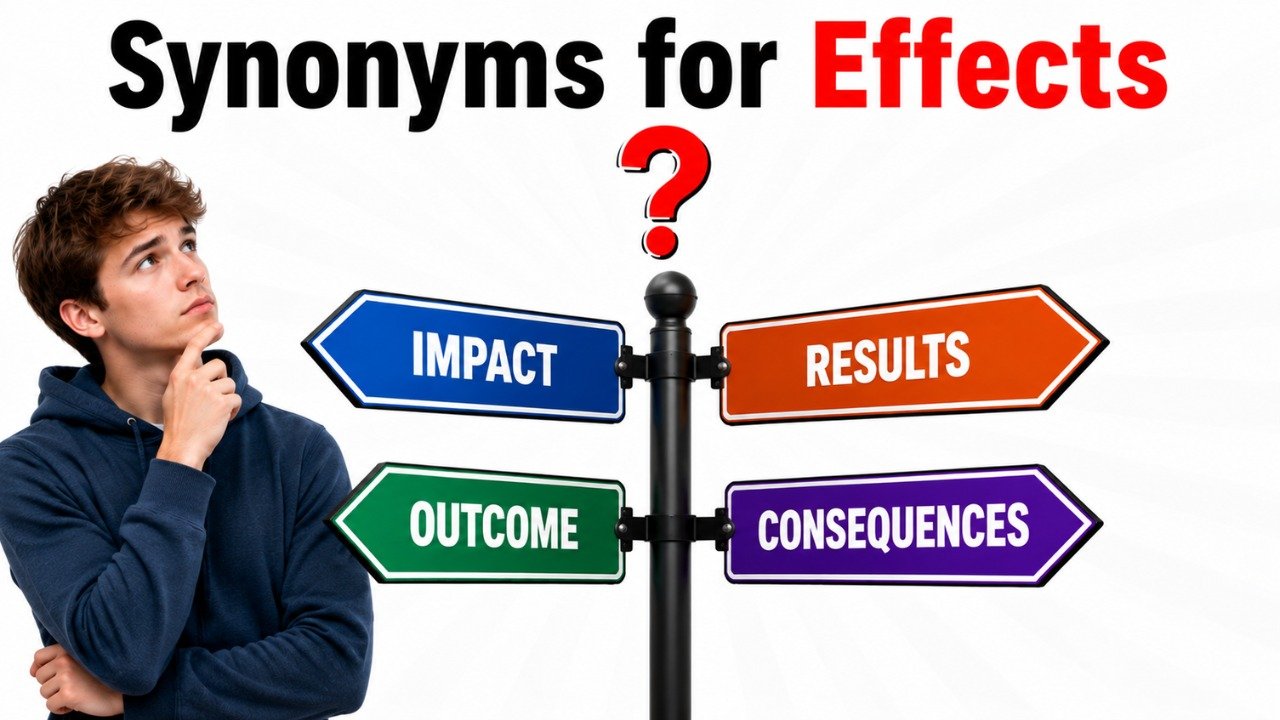
Quick Answer: The best synonyms for effects include results, outcomes, consequences, impacts, influences, repercussions, changes, reactions, visuals, and possessions. Use results or outcomes for general consequences, impacts for strong changes, influences for gradual power over something, and repercussions for serious negative results. Visuals works when discussing special effects, while possessions is suitable when effects means personal belongings. The best replacement depends on whether effects refers to results, influence, created images, property, or the act of causing change.
Pronunciation and Word Details
Word: Effects
Pronunciation: /ɪˈfekts/
Part of Speech: Plural noun and third person singular verb
Meaning: Effects are results, changes, influences, created impressions, or personal belongings, while the verb effects means causes something to happen.
US Pronunciation:
UK Pronunciation:
What Does “Effects” Mean?
Effects most commonly means the results, consequences, or changes produced by an action, event, decision, substance, or condition. It is usually the plural form of the noun effect.
The word can describe positive, negative, direct, indirect, immediate, or lasting results.
Result Context: The effects of regular practice became visible within a few weeks.
Health Context: The medicine produced several unexpected effects.
Environmental Context: The effects of pollution can continue for many years.
Effects can also refer to artificial sounds, images, lighting, or visual techniques used to create a particular impression.
Visual Context: The performance used impressive lighting effects.
The phrase personal effects means a person’s private belongings, such as clothing, documents, jewelry, and everyday items.
Belongings Context: The traveler collected his personal effects before leaving.
As a verb, effects means brings about, causes, or successfully produces something.
Verb Context: The new policy effects meaningful change throughout the organization.
Meaning, Tone, and Context of “Effects”
Effects is a neutral and highly flexible word. It appears in casual conversation, formal reports, scientific explanations, academic essays, health information, business writing, legal discussions, and creative descriptions.
In everyday language, effects usually refers to noticeable results.
Example: The effects of the storm were visible throughout the town.
In academic or scientific writing, effects may describe measurable changes caused by a specific factor.
Example: The study examined the effects of temperature on plant growth.
In health related communication, effects can refer to physical, emotional, or mental reactions.
Example: Lack of sleep can have serious effects on concentration.
In entertainment and design contexts, effects describes sounds, images, lighting, movement, or other techniques that create a particular experience.
Example: The stage effects made the scene feel dramatic.
In formal writing, effects may also refer to personal property.
Example: The employee removed her personal effects from the office.
The word is usually neutral, but its emotional strength depends on the surrounding description. Adverse effects sounds serious and negative, while beneficial effects sounds positive and encouraging.
When and How to Use “Effects”
For Results
Use effects when discussing the results produced by an action, decision, event, or condition.
Example: The effects of the new schedule became clear after one month.
For Consequences
Effects can describe consequences, especially when one event leads to several later developments.
Example: The economic effects of the closure affected the entire area.
For Physical Changes
Use effects for changes in the body, environment, materials, or physical conditions.
Example: The effects of extreme heat were visible on the road surface.
For Emotional Influence
Effects can describe changes in feelings, confidence, motivation, or behavior.
Example: The speech had powerful effects on the audience.
For Health Reactions
Use effects when describing the physical or mental results of medicine, treatment, diet, stress, or illness.
Example: The patient reported mild effects after taking the medicine.
For Visual or Sound Techniques
Effects can refer to artificial images, lighting, sounds, or movement added to a performance or production.
Example: The lighting effects created a mysterious atmosphere.
For Personal Belongings
The expression personal effects refers to belongings owned and used by an individual.
Example: His personal effects were placed in a secure container.
For Causing Change
As a verb, effects means successfully creates, causes, or brings about a result.
Example: Strong leadership effects positive change within a team.
Best Synonyms for Effects
Results
Synonym: Results are the things that happen because of an action, process, or event.
Example: The results of the experiment supported the original prediction.
Outcomes
Synonym: Outcomes are final results or situations that develop after an activity or decision.
Example: Careful planning produced better outcomes for the project.
Consequences
Synonym: Consequences are results that follow an action, often with a serious or negative meaning.
Example: The decision had unexpected consequences for local families.
Impacts
Synonym: Impacts are strong or noticeable effects on a person, situation, system, or environment.
Example: The storm had lasting impacts on the farming community.
Influences
Synonym: Influences are forces that gradually affect thoughts, behavior, development, or decisions.
Example: Family traditions were important influences on her writing.
Repercussions
Synonym: Repercussions are indirect or delayed consequences, usually negative or serious.
Example: The mistake caused financial repercussions for the company.
Changes
Synonym: Changes are differences that appear after an action, experience, or process.
Example: The treatment produced noticeable changes in his energy level.
Reactions
Synonym: Reactions are physical, emotional, or behavioral responses to something.
Example: The announcement caused mixed reactions among the employees.
Visuals
Synonym: Visuals are images, designs, or created scenes used to produce a visual impression.
Example: The presentation included clear visuals to explain the process.
Possessions
Synonym: Possessions are objects or belongings owned by a person.
Example: She packed her possessions before moving to her new home.
50 Synonyms for Effects With Short Meanings
- Results: Things that happen because of an action or process.
- Outcomes: Final situations produced by actions or decisions.
- Consequences: Results that follow a particular action.
- Impacts: Strong or noticeable changes caused by something.
- Influences: Forces that affect behavior, ideas, or development.
- Repercussions: Indirect or delayed negative consequences.
- Ramifications: Complicated results that develop from a decision.
- Aftereffects: Effects that continue after the main event has ended.
- Implications: Possible results or meanings suggested by something.
- Responses: Actions or changes produced by a situation.
- Reactions: Physical, emotional, or behavioral responses.
- Changes: Differences produced over time or through action.
- Alterations: Deliberate or noticeable changes in form or condition.
- Developments: New situations or changes that emerge gradually.
- Products: Things produced by a process, action, or condition.
- Fruits: Valuable results produced by effort or experience.
- End Results: Final consequences of a process or activity.
- Conclusions: Final results reached after thought or examination.
- Findings: Results discovered through study or investigation.
- Impressions: Feelings or ideas created in someone’s mind.
- Manifestations: Visible signs or expressions of something.
- Symptoms: Physical or mental signs of a condition.
- Signs: Indications that show something exists or has happened.
- Indications: Evidence suggesting a particular condition or result.
- Phenomena: Observable events, experiences, or occurrences.
- Visuals: Images or created scenes used for visual impact.
- Sounds: Created or recorded noises used for a particular impression.
- Illusions: Appearances or impressions that differ from reality.
- Enhancements: Additions that improve appearance, quality, or experience.
- Features: Noticeable elements added for function or appearance.
- Techniques: Methods used to produce a particular result.
- Devices: Tools or methods used to create an effect.
- Belongings: Personal objects owned by someone.
- Possessions: Things that belong to a person.
- Property: Objects or assets legally owned by someone.
- Goods: Movable objects or personal items.
- Items: Individual objects or possessions.
- Personal Property: Private belongings owned by an individual.
- Paraphernalia: Equipment, objects, or belongings connected with an activity.
- Causes: Makes something happen or exist.
- Produces: Creates or brings about a result.
- Creates: Makes something new or causes a situation.
- Generates: Produces energy, activity, ideas, or results.
- Induces: Causes a particular condition, response, or action.
- Triggers: Starts a reaction, event, or process.
- Brings About: Causes something to happen.
- Accomplishes: Successfully completes or produces something.
- Achieves: Successfully reaches a desired result.
- Implements: Puts a decision, plan, or system into effect.
- Enacts: Makes a plan, rule, or change active.
Read Also:
Synonyms for Inspired

Synonyms for Effects by Context
When Effects Means Results
Results, outcomes, end results, products, fruits, conclusions, and findings are useful when effects refers to what happens after an action or process.
Results is the most general alternative. Outcomes often emphasizes the final situation. Findings works best for research, testing, or investigation.
Example: The results of the training were visible within a month.
Example: Better communication led to more positive outcomes.
Example: The findings revealed a connection between sleep and concentration.
When Effects Means Consequences
Consequences, repercussions, ramifications, aftereffects, and implications describe results that may be serious, delayed, complicated, or unexpected.
Consequences can be positive or negative, although it often sounds negative. Repercussions usually refers to indirect negative results. Aftereffects are results that remain after the original event.
Example: The careless decision had serious consequences.
Example: The dispute created political repercussions.
Example: The emotional aftereffects continued long after the incident.
When Effects Means Influence
Impacts, influences, impressions, responses, reactions, and changes describe the power something has over people, behavior, systems, or conditions.
Impact suggests a strong influence. Influence may be gradual and less obvious. Impression refers to an idea or feeling created in someone’s mind.
Example: The new program had a positive impact on attendance.
Example: Childhood experiences were important influences on his personality.
Example: Her confident introduction created a strong impression.
When Effects Means Physical or Medical Reactions
Reactions, symptoms, responses, signs, indications, and manifestations work well when discussing physical, emotional, or medical changes.
Symptoms usually indicate a health condition. Reactions often happen after exposure to medicine, food, stress, or an experience.
Example: The patient experienced a mild reaction to the treatment.
Example: Tiredness may be one of the first symptoms.
Example: The body’s response to stress can affect sleep.
When Effects Means Created Images or Sounds
Visuals, sounds, illusions, enhancements, features, techniques, and devices are useful for describing artistic, visual, lighting, or sound effects.
Visuals focuses on what people see. Sounds refers to what they hear. Illusions create an appearance that may not be real.
Example: The lighting visuals transformed the stage.
Example: Carefully created sounds made the scene more realistic.
Example: Mirrors created the illusion of a larger room.
When Effects Means Personal Belongings
Belongings, possessions, property, goods, items, personal property, and paraphernalia can replace effects in the phrase personal effects.
Belongings and possessions are the most natural choices in everyday language. Property is more formal and may have a legal meaning.
Example: He gathered his belongings before leaving the building.
Example: Her possessions were stored safely.
Example: The personal property was returned to its owner.
When Effects Is Used as a Verb
Causes, produces, creates, generates, induces, triggers, brings about, accomplishes, achieves, implements, and enacts may replace effects when it means causes something to happen.
Example: The new approach produces lasting improvement.
Example: Honest communication brings about greater trust.
Example: The organization implements changes gradually.
Another Word for Effects
Results is the best general replacement for effects when the word refers to things produced by an action, event, or process. However, the strongest choice depends on the intended meaning.
Use outcomes for final results, consequences for serious results, impacts for strong influence, reactions for physical or emotional responses, visuals for created images, and possessions for personal belongings.
Original: The effects of the new routine were encouraging.
Better Option: The results of the new routine were encouraging.
Original: The storm had serious effects on the coastal area.
Better Option: The storm had serious impacts on the coastal area.
Original: The medicine caused several effects.
Better Option: The medicine caused several reactions.
Original: He collected his personal effects from the room.
Better Option: He collected his personal belongings from the room.
When Not to Use “Effects”
Avoid effects when the sentence needs a more specific word. The term can refer to results, consequences, influence, symptoms, visuals, belongings, or the act of causing change. A precise synonym helps readers understand the intended meaning immediately.
Weak: The decision had many effects.
Better: The decision had several financial consequences.
Effects can also sound repetitive when it appears several times in the same paragraph.
Weak: The effects of stress include physical effects and emotional effects.
Better: The consequences of stress include physical symptoms and emotional changes.
Do not use effects when you actually mean affects. Effects is usually a noun, while affects is commonly a verb meaning influences.
Weak: The weather effects my mood.
Better: The weather affects my mood.
When effects is used as a verb, it has a formal meaning. It means causes or brings about rather than merely influences.
Weak: The music effects her emotions.
Better: The music affects her emotions.
Correct Formal Use: The policy effects meaningful change.
Words Commonly Confused With Effects
Effects vs Affects: Effects is usually a plural noun meaning results. Affects is usually a verb meaning influences or changes something.
Example With Effects: The effects of the storm lasted for weeks.
Example With Affects: Hot weather affects my concentration.
Effects vs Results: Effects can include any changes caused by something. Results often refers to final, measurable, or expected outcomes.
Effects vs Consequences: Effects is neutral and broad. Consequences often suggests serious, important, or negative results.
Effects vs Impacts: Effects may be weak, strong, direct, or indirect. Impacts usually suggests powerful or noticeable influence.
Effects vs Reactions: Effects are all results caused by something. Reactions are specific physical, emotional, chemical, or behavioral responses.
Effects vs Symptoms: Effects can be any results, while symptoms are signs connected with an illness or condition.
Effects vs Influences: Effects are results that appear after a cause. Influences are forces that shape thoughts, actions, or development.
Effects vs Possessions: Effects can mean belongings only in expressions such as personal effects. Possessions directly means things someone owns.
Which Synonym Should You Choose?
Choose results for a clear and general alternative in everyday writing.
Choose outcomes when discussing final situations produced by plans, decisions, education, treatment, or business activity.
Choose consequences when an action leads to serious, important, or possibly negative results.
Choose impacts when the influence is strong, measurable, or widely noticeable.
Choose influences when something gradually shapes behavior, opinions, development, or choices.
Choose repercussions when negative consequences appear indirectly or after some time.
Choose aftereffects when results continue after the original event has ended.
Choose reactions when discussing physical, emotional, chemical, or public responses.
Choose symptoms for signs connected with health conditions.
Choose findings in reports, research, surveys, experiments, and investigations.
Choose visuals when discussing created images, lighting, design, or appearance.
Choose possessions or belongings when effects means personal property.
Choose causes, produces, or brings about when effects is being used as a verb.
In formal reports and essays, results, outcomes, consequences, impacts, findings, and implications are usually strong choices. In casual conversation, results, changes, reactions, and belongings often sound more natural.
Real Life Examples of “Effects” in Sentences
Original: The effects of the exercise routine appeared gradually.
Better Option: The results of the exercise routine appeared gradually.
Original: The storm had damaging effects on local farms.
Better Option: The storm had damaging impacts on local farms.
Original: The decision may have unexpected effects.
Better Option: The decision may have unexpected consequences.
Original: The medicine produced several mild effects.
Better Option: The medicine produced several mild reactions.
Original: The teacher discussed the effects of regular reading.
Better Option: The teacher discussed the benefits of regular reading.
Original: The lighting effects made the room appear larger.
Better Option: The lighting techniques made the room appear larger.
Original: The report examined the effects of stress on sleep.
Better Option: The report examined the influence of stress on sleep.
Original: She collected her personal effects before leaving.
Better Option: She collected her personal belongings before leaving.
Original: The new system effects a major improvement.
Better Option: The new system produces a major improvement.
Original: The emotional effects continued for several months.
Better Option: The emotional aftereffects continued for several months.
Synonym Groups and Usage Differences
Result Group
Results, outcomes, products, fruits, end results, conclusions, and findings describe what is produced by an action or process.
Results is broad and flexible. Outcomes emphasizes final conditions, while findings relates to discovered information.
Example: The findings confirmed the positive results of the program.
Consequence Group
Consequences, repercussions, ramifications, aftereffects, and implications describe results that may be serious, indirect, delayed, or complicated.
Repercussions and ramifications often have a negative tone. Implications may refer to possible future results.
Example: The decision had long term ramifications for the entire community.
Influence Group
Impacts, influences, impressions, changes, alterations, and developments describe how something shapes or changes another person, object, or situation.
Impact is usually stronger than influence. Alteration suggests a specific change in form or condition.
Example: The experience had a lasting impact on her career choices.
Reaction Group
Responses, reactions, symptoms, signs, indications, and manifestations describe visible, physical, emotional, or behavioral results.
Reaction is suitable for immediate responses, while symptoms and signs commonly relate to health or conditions.
Example: The skin reaction was an early sign of sensitivity.
Creative Effects Group
Visuals, sounds, illusions, enhancements, features, techniques, and devices describe tools or methods used to create an artistic or sensory impression.
Example: The lighting techniques and sound enhancements created a dramatic atmosphere.
Belongings Group
Belongings, possessions, property, goods, items, personal property, and paraphernalia describe objects owned or used by a person.
Belongings sounds natural and personal. Property is more formal and legal.
Example: All personal belongings were returned safely.
Causation Group
Causes, produces, creates, generates, induces, triggers, brings about, accomplishes, achieves, implements, and enacts relate to effects when it is used as a verb.
These words differ in strength and purpose. Causes is general, triggers suggests starting something quickly, and implements means putting a plan into action.
Example: The revised process creates efficiency and brings about lasting improvement.
Antonyms of Effects
The opposites of effects depend on whether the word refers to results, influence, change, created impressions, or possessions.
Causes: Actions or conditions that produce effects.
Origins: Points where events, conditions, or processes begin.
Sources: People, things, or conditions from which results develop.
Reasons: Explanations for why something happens.
Beginnings: Early stages before results appear.
Inputs: Resources, information, or effort added to a process.
Inaction: The absence of activity that could produce results.
Stability: A condition in which little or no change occurs.
Unchangeability: The quality of remaining the same.
Neutrality: The absence of strong influence or effect.
Ineffectiveness: Failure to produce the intended result.
Powerlessness: Lack of ability to influence or change something.
Comparison: Effects vs Related Words
Effects vs Results
Effects includes any changes produced by a cause. Results often refers to final or measurable outcomes.
Example With Effects: The effects of the treatment included better sleep and improved energy.
Example With Results: The test results showed a clear improvement.
Effects vs Consequences
Effects is neutral and can describe positive or negative changes. Consequences often sounds more serious and may imply responsibility.
Example With Effects: The exercise had positive effects on her mood.
Example With Consequences: Ignoring the warning had serious consequences.
Effects vs Impacts
Effects can vary in strength. Impacts usually describes powerful, noticeable, or important influence.
Example With Effects: The change had several effects on the schedule.
Example With Impacts: The closure had major impacts on local employment.
Effects vs Reactions
Effects refers broadly to all results. Reactions describes specific responses caused by an event, substance, or experience.
Example With Effects: The medicine may produce several effects.
Example With Reactions: The patient experienced an allergic reaction.
Effects vs Influences
Effects are changes or results that have already appeared. Influences are forces that shape people or situations over time.
Example With Effects: The effects of the campaign were visible in the final numbers.
Example With Influences: Her early teachers were strong influences on her career.
Effects vs Aftereffects
Effects may occur immediately or later. Aftereffects continue or appear after the main cause or event has ended.
Example With Effects: The storm caused several immediate effects.
Example With Aftereffects: The town experienced economic aftereffects for months.
Effects vs Affects
Effects is commonly a noun meaning results. Affects is commonly a verb meaning influences.
Example With Effects: Noise can have harmful effects on sleep.
Example With Affects: Noise affects the quality of sleep.
Common Phrases and Expressions With “Effects”
Positive Effects: Helpful or beneficial results.
Negative Effects: Harmful or undesirable results.
Side Effects: Additional and often unwanted results of medicine or treatment.
Long Term Effects: Results that continue for an extended period.
Short Term Effects: Results that last for a limited period.
Lasting Effects: Results that remain for a long time.
Special Effects: Created visual or sound techniques used to produce an impression.
Visual Effects: Artificial or enhanced images used to create a scene.
Sound Effects: Created or recorded sounds used to support an experience.
Personal Effects: Private belongings owned or carried by a person.
Common Mistakes to Avoid
A common mistake is confusing effects with affects. Effects is usually a noun, while affects is normally a verb.
Incorrect: The weather effects her energy level.
Correct: The weather affects her energy level.
Another mistake is assuming effects always means negative consequences. Effects can be positive, negative, neutral, direct, or indirect.
Incorrect: Exercise has dangerous effects on everyone.
Better: Exercise can have different effects depending on a person’s health and routine.
Avoid using effects repeatedly when a more precise synonym would improve clarity.
Repetitive: The effects of stress include physical effects, emotional effects, and social effects.
Improved: The consequences of stress may include physical symptoms, emotional changes, and social difficulties.
Do not use effects as a verb when you simply mean influences. The verb effects means causes or brings about.
Incorrect: Her opinion effects my decision.
Correct: Her opinion affects my decision.
Correct Formal Use: The agreement effects a permanent change in policy.
Writers should also avoid vague sentences such as the change had many effects. Explain what kind of results appeared.
Vague: The new system had several effects.
Clear: The new system reduced delays, improved accuracy, and increased productivity.
Conclusion
Synonyms for effects vary according to meaning and context. Results and outcomes are strong general replacements, while consequences, repercussions, and ramifications describe serious results. Impacts and influences work well for changes in people, systems, or environments. Reactions and symptoms suit physical or emotional responses, while visuals and sounds describe creative techniques. When effects means personal property, belongings and possessions are clearer. Selecting the most precise alternative makes writing easier to understand, more natural, and better suited to the subject.
FAQs About Synonyms for Effects
What Is the Best Synonym for Effects?
Results is the best general synonym. Outcomes, consequences, impacts, and changes may be more precise in specific contexts.
What Is a Formal Synonym for Effects?
Consequences, outcomes, implications, ramifications, repercussions, and findings are suitable formal alternatives.
What Is Another Word for Positive Effects?
Benefits, improvements, advantages, gains, positive results, and favorable outcomes can replace positive effects.
What Is Another Word for Negative Effects?
Consequences, harmful results, adverse reactions, repercussions, drawbacks, and damaging impacts are useful alternatives.
What Is the Difference Between Effects and Affects?
Effects is usually a noun meaning results. Affects is usually a verb meaning influences or changes something.
What Does Personal Effects Mean?
Personal effects means private belongings, such as clothing, documents, jewelry, and other items owned or carried by a person.
Can Effects Be Used as a Verb?
Yes. As a verb, effects means causes, produces, or brings about something, as in the policy effects meaningful change.
