
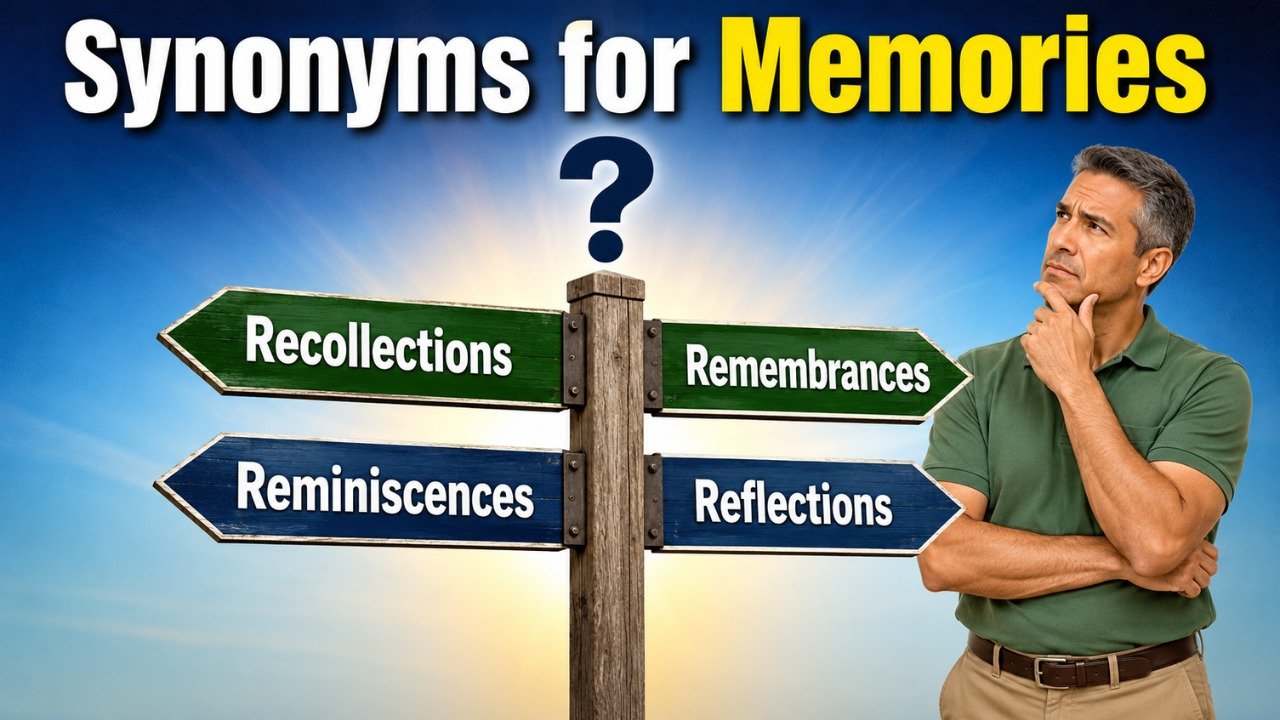
Quick Answer: Common synonyms for memories include recollections, remembrances, reminiscences, experiences, reflections, impressions, flashbacks, thoughts, images, and echoes. Use recollections for remembered events, remembrances for respectful or emotional memories, reminiscences for pleasant stories about the past, experiences for events someone personally lived through, and flashbacks for sudden vivid returns of past moments. The best choice depends on whether the context is emotional, formal, personal, historical, literary, or psychological.
Pronunciation and Word Details
Word: Memories
Pronunciation: /ˈmeməriz/
Part of Speech: Plural noun
Meaning: Memories are thoughts, images, feelings, or experiences remembered from the past.
US Pronunciation:
UK Pronunciation:
What Does “Memories” Mean?
Memories are mental records of past experiences, people, places, feelings, and events. The word memories is the plural form of memory and functions as a noun.
A memory may be a clear image of a particular moment, a general feeling connected with the past, or knowledge stored in the mind. Memories can be joyful, painful, distant, vivid, personal, shared, or incomplete.
The word can refer to specific remembered events.
Example: Her childhood memories include long summer afternoons in the garden.
It can also describe the mental ability to remember.
Example: Age can affect how clearly people retain memories.
In emotional writing, memories often represent meaningful moments that continue to influence a person.
Example: The old house was filled with warm family memories.
In formal or psychological contexts, memories may refer to information stored and recalled by the brain.
Example: Strong emotions can make certain memories easier to recall.
Meaning, Tone, and Context of “Memories”
Memories is a neutral word, but its emotional tone changes according to context. It can sound warm and sentimental when discussing family, childhood, friendship, or celebrations. It can sound painful when referring to loss, regret, conflict, or trauma.
The word is common in everyday conversation, personal writing, literature, psychology, history, education, and storytelling.
Emotional context: Memories can express affection, sadness, longing, gratitude, or regret.
Casual context: People use memories when talking about past trips, school days, family gatherings, and personal experiences.
Formal context: Researchers and educators may discuss memory formation, stored memories, and recall.
Literary context: Writers use memories to connect past events with present emotions.
Historical context: Shared memories can describe how communities remember important events.
Memories is broader than recollections because it can include feelings, images, knowledge, and experiences. Recollections usually refer more specifically to details that someone consciously remembers.
When and How to Use “Memories”
For Personal Experiences
Use memories when describing events that someone remembers from their own life.
Example: She has many happy memories of living near the sea.
For Childhood Events
Use memories to describe people, places, routines, and emotions remembered from early life.
Example: His earliest memories involve playing with his cousins.
For Emotional Reflection
Use memories when discussing how the past continues to affect present feelings.
Example: The song brought back memories of her late grandmother.
For Shared Moments
Use memories for events remembered by friends, families, teams, or communities.
Example: The reunion gave everyone an opportunity to share old memories.
For Important People
Use memories when describing remembered moments connected with someone meaningful.
Example: She treasures the memories she created with her father.
For Past Places
Use memories when a location is strongly connected with earlier experiences.
Example: The village holds special memories for our family.
For Difficult Experiences
Use memories when referring to events that remain painful or uncomfortable.
Example: He found it difficult to discuss memories of the accident.
For Psychological Discussion
Use memories when explaining how the mind stores, changes, or recalls information.
Example: Sleep plays an important role in forming lasting memories.
Best Synonyms for Memories
Recollections
Synonym: Recollections are details or events that someone consciously remembers.
Example: Her recollections of the journey were clear and detailed.
Remembrances
Synonym: Remembrances are memories kept with affection, respect, or emotional importance.
Example: The letters were precious remembrances of their friendship.
Reminiscences
Synonym: Reminiscences are spoken or written accounts of pleasant past experiences.
Example: His reminiscences of village life entertained the entire family.
Experiences
Synonym: Experiences are events and situations that a person has personally lived through.
Example: Their shared experiences created a lasting connection.
Reflections
Synonym: Reflections are thoughtful memories or careful thoughts about past events.
Example: Her reflections on childhood revealed how much she had changed.
Impressions
Synonym: Impressions are remembered feelings, ideas, or mental images created by an experience.
Example: His first impressions of the city remained strong for years.
Flashbacks
Synonym: Flashbacks are sudden and vivid returns of past scenes or emotions.
Example: The familiar smell caused flashbacks to her school days.
Reminders
Synonym: Reminders are things that cause someone to remember a person, event, or experience.
Example: The photographs served as reminders of happier times.
Images
Synonym: Images are mental pictures of people, places, or events from the past.
Example: Clear images of the celebration remained in his mind.
Echoes
Synonym: Echoes are lingering traces or emotional impressions of past experiences.
Example: The empty hall still carried echoes of former celebrations.
50 Synonyms for Memories with Short Meanings
- Recollections: Details or events remembered from the past.
- Remembrances: Affectionate or respectful memories of people and events.
- Reminiscences: Pleasant spoken or written accounts of past experiences.
- Experiences: Events and situations personally lived through.
- Reflections: Thoughtful considerations of past moments.
- Impressions: Lasting feelings or ideas created by experiences.
- Flashbacks: Sudden vivid returns of past events or feelings.
- Reminders: Things that cause someone to remember.
- Images: Mental pictures stored in the mind.
- Thoughts: Ideas or mental activity connected with the past.
- Echoes: Lingering traces or feelings from earlier times.
- Associations: Mental connections between one thing and another.
- Recollections of the past: Consciously remembered earlier events.
- Past experiences: Events someone encountered earlier in life.
- Mental pictures: Images of past people, places, or events.
- Remembered moments: Particular occasions retained in the mind.
- Stored experiences: Past events preserved mentally.
- Past impressions: Feelings or ideas remaining from earlier encounters.
- Personal history: The collection of events that shaped a person.
- Life experiences: Important events encountered throughout life.
- Old times: A casual expression for a remembered period.
- Bygone days: A literary expression for earlier times.
- Former days: A neutral phrase for a past period.
- Yesterday: A figurative term for the recent or distant past.
- The past: Everything that happened before the present.
- Nostalgia: Emotional longing for an earlier time.
- Sentiments: Feelings connected with remembered people or events.
- Keepsakes: Objects preserved because they hold memories.
- Mementos: Objects that remind someone of a person or event.
- Souvenirs: Items kept as reminders of places or experiences.
- Records: Preserved accounts of past events.
- Accounts: Spoken or written descriptions of experiences.
- Stories: Narratives based on remembered events.
- Anecdotes: Short and often interesting accounts of past incidents.
- Memoirs: Written accounts of personal experiences and memories.
- Testimonies: Personal statements about witnessed or experienced events.
- Mental records: Information about past events stored in the mind.
- Retained knowledge: Information remembered over time.
- Recall: The act or ability of bringing information back to mind.
- Recognition: Awareness caused by remembering something familiar.
- Conscious recollections: Memories deliberately brought to mind.
- Distant recollections: Memories from long ago.
- Vivid recollections: Clear and detailed remembered experiences.
- Fond recollections: Warm and affectionate memories.
- Painful recollections: Memories connected with sadness or distress.
- Shared recollections: Events remembered by more than one person.
- Childhood recollections: Memories formed during early life.
- Mental traces: Remaining impressions left by past experiences.
- Afterimages: Lingering mental pictures of previous sights or events.
- Traces of the past: Remaining signs or feelings from earlier times.
Read Also:
Synonyms for Stubborn

Synonyms for Memories by Context
When Memories Means Personal Recollections
Recollections, remembered moments, mental pictures, and past experiences work well when describing events from someone’s own life.
Example: Her recollections of school were mostly positive.
Example: He wrote down several remembered moments from his childhood.
Recollections is useful when the speaker can describe particular details. Past experiences is broader and includes everything someone lived through, even when not every detail is remembered clearly.
When Memories Means Pleasant Past Experiences
Reminiscences, fond recollections, nostalgia, old times, and bygone days are suitable for warm or sentimental contexts.
Example: The friends spent the evening sharing reminiscences of their youth.
Example: The familiar melody filled her with nostalgia.
Reminiscences often refers to stories people tell about their past. Nostalgia refers more to the emotional longing created by those memories.
When Memories Means Mental Images
Images, mental pictures, impressions, afterimages, and mental traces describe how past scenes remain in the mind.
Example: Images of the mountain village remained with him.
Example: Her first impression of the teacher stayed with her for years.
Use images when the memory is visual. Use impressions when it is a feeling, opinion, or general idea rather than a detailed picture.
When Memories Means Emotional Remembrance
Remembrances, sentiments, echoes, reminders, and associations work well when memories carry emotional importance.
Example: The room contained many remembrances of her mother.
Example: The scent created powerful associations with home.
Remembrances often sounds affectionate or respectful. Associations describe the mental link between a present object and a past person, place, feeling, or event.
When Memories Means Recorded Experiences
Memoirs, accounts, records, stories, testimonies, and anecdotes are useful when memories are expressed in spoken or written form.
Example: Her memoirs describe life during a period of great change.
Example: His account of the journey included several unusual incidents.
Memoirs usually cover a meaningful period of someone’s life. Anecdotes are shorter and focus on one interesting event.
When Memories Means Painful Recall
Flashbacks, painful recollections, mental traces, and disturbing reminders may describe unwanted or difficult memories.
Example: The loud noise triggered painful recollections of the accident.
Example: Certain places acted as disturbing reminders of the conflict.
Flashbacks are usually sudden and vivid. Painful recollections may be brought to mind more gradually or deliberately.
Another Word for Memories
Recollections is often the best single replacement for memories when referring to events or details remembered from the past. However, the strongest alternative depends on the sentence.
Use reminiscences for pleasant stories about earlier times, remembrances for emotional or respectful memories, experiences for events someone lived through, and nostalgia for a longing connected with the past.
Original: She shared memories of her childhood.
Better Option: She shared recollections of her childhood.
Original: They spent the afternoon discussing old memories.
Better Option: They spent the afternoon sharing reminiscences.
Original: The necklace held precious memories of her grandmother.
Better Option: The necklace was a precious remembrance of her grandmother.
Original: His memories of traveling shaped his writing.
Better Option: His travel experiences shaped his writing.
When Not to Use “Memories”
Memories is a broad word and may sound vague when the sentence requires a more exact meaning. A clearer synonym can show whether the writer means stories, emotions, images, facts, or personal experiences.
When Describing Written Life Stories
Use memoirs or accounts when referring to written descriptions of someone’s life.
Weak: She published her memories of working abroad.
Better: She published her memoirs about working abroad.
When Referring to Physical Objects
Objects are not memories themselves. They are keepsakes, mementos, souvenirs, or reminders connected with memories.
Weak: The old watch was one of his favorite memories.
Better: The old watch was one of his favorite keepsakes.
When Discussing a Specific Remembered Detail
Recollection may be more precise than memory when describing conscious recall.
Weak: His memory of the conversation included several exact details.
Better: His recollection of the conversation included several exact details.
When Describing Emotional Longing
Use nostalgia when the focus is a warm or bittersweet desire for the past.
Weak: The old photographs filled her with memories.
Better: The old photographs filled her with nostalgia.
When Referring to Lived Events
Experiences may be more accurate when discussing what happened rather than what is currently remembered.
Weak: His memories as a volunteer taught him patience.
Better: His experiences as a volunteer taught him patience.
When the Word Becomes Repetitive
Repeating memories in every sentence can make a paragraph sound flat.
Weak: Her memories of the house were happy. Those memories included family meals. The memories remained important.
Better: Her recollections of the house were happy. They included family meals and other experiences that remained important.
Words Commonly Confused With Memories
Memories vs Recollections: Memories can include feelings, knowledge, images, and experiences. Recollections usually refer to specific details consciously brought back to mind.
Memories vs Reminiscences: Memories are thoughts or experiences retained in the mind. Reminiscences are usually stories or reflections about pleasant past events.
Memories vs Nostalgia: Memories are remembered events or information. Nostalgia is the emotional longing or affection created by thoughts of the past.
Memories vs Experiences: Experiences are events someone lives through. Memories are the mental impressions that remain after those events.
Memories vs Memoirs: Memories exist in the mind. Memoirs are written accounts based on a person’s memories and experiences.
Memories vs History: Memories are personal or collective recollections. History is a studied or recorded account of past events.
Memories vs Remembrance: Memories is a general plural noun. Remembrance often refers to the act of remembering or honoring someone.
Memories vs Flashbacks: Memories may be recalled deliberately. Flashbacks usually return suddenly and vividly, sometimes without conscious control.
Which Synonym Should You Choose?
Choose recollections when writing about specific details or events someone consciously remembers.
Choose remembrances when discussing memories kept with affection, respect, or emotional significance.
Choose reminiscences when describing pleasant stories and conversations about earlier times.
Choose experiences when the focus is on events someone personally lived through.
Choose reflections when writing thoughtfully about the meaning of the past.
Choose impressions when discussing feelings, opinions, or mental effects left by an experience.
Choose flashbacks when a past scene or emotion returns suddenly and vividly.
Choose nostalgia when the main meaning is emotional longing for an earlier time.
Choose memoirs when referring to written personal accounts of important life experiences.
Choose mementos or keepsakes when describing physical objects preserved because of their emotional meaning.
Choose records or accounts for formal, historical, or factual descriptions of previous events.
Choose associations when one object, smell, sound, or place causes someone to remember something else.
Real Life Examples of “Memories” in Sentences
Original: She has wonderful memories of her school years.
Better Option: She has wonderful recollections of her school years.
Original: They shared memories of growing up together.
Better Option: They shared reminiscences of growing up together.
Original: The photograph brought back memories of the holiday.
Better Option: The photograph brought back vivid images of the holiday.
Original: His memories of working on the farm shaped his character.
Better Option: His experiences of working on the farm shaped his character.
Original: The song filled her with memories of home.
Better Option: The song filled her with nostalgia for home.
Original: She recorded her memories in a book.
Better Option: She recorded her recollections in a memoir.
Original: The medal carried memories of his years of service.
Better Option: The medal was a valued remembrance of his years of service.
Original: Certain sounds caused memories of the accident to return.
Better Option: Certain sounds caused flashbacks to the accident.
Original: The house contained many memories of family life.
Better Option: The house contained many reminders of family life.
Original: His memories of the meeting were unclear.
Better Option: His recollection of the meeting was unclear.
Synonym Groups and Usage Differences
Recollection Group
Recollections, recall, remembered moments, conscious recollections, and mental records relate to the act of bringing past details back to mind.
Recollection is usually more deliberate than memory. Recall often refers to the ability or process of remembering information.
Example: Her recollection of the event became clearer after reading the letter.
Emotional Remembrance Group
Remembrances, sentiments, fond recollections, echoes, and reminders express emotional connections with people, places, and events.
These words are useful in personal, reflective, and literary writing.
Example: The garden remained a loving remembrance of her parents.
Nostalgia Group
Nostalgia, old times, bygone days, former days, and yesterday describe emotional or reflective connections with earlier periods.
Nostalgia is the strongest choice when a person misses or idealizes the past.
Example: The smell of fresh bread filled him with nostalgia for his childhood.
Experience Group
Experiences, life experiences, past experiences, personal history, and stored experiences describe events that shaped a person.
These alternatives focus more on what happened than on the mental act of remembering.
Example: Her life experiences helped her understand other people.
Mental Image Group
Images, mental pictures, impressions, afterimages, and mental traces describe the visual or psychological form of memories.
Images are often clear and visual. Impressions may be less detailed but still emotionally powerful.
Example: Mental pictures of the old neighborhood remained vivid.
Written Memory Group
Memoirs, accounts, stories, anecdotes, testimonies, and records describe memories preserved through language.
Memoirs are extended personal accounts. Anecdotes are brief stories about individual events.
Example: His memoirs offer a detailed account of his early career.
Antonyms of Memories
The opposites of memories depend on whether the word refers to remembering, retained information, or awareness of the past.
Forgetfulness: The condition of frequently failing to remember.
Forgetting: The process of losing a memory or failing to recall something.
Oblivion: A state in which something is completely forgotten.
Amnesia: Loss of memory caused by illness, injury, or psychological factors.
Unawareness: Lack of knowledge or recognition.
Ignorance: Absence of knowledge about facts or events.
Blankness: An inability to remember or think of anything.
Inattention: Failure to notice or remember because of limited focus.
Erasure: The removal or destruction of stored information.
Loss of recall: An inability to bring information back to mind.
Present experience: An event occurring now rather than being remembered from the past.
Future expectation: A thought about what may happen rather than what has already happened.
Comparison: Memories vs Related Words
Memories vs Recollections
Memories is the broader term. Recollections usually describe particular details or events someone consciously remembers.
Example With Memories: She has many memories of her childhood.
Example With Recollections: Her recollections of the old school are surprisingly detailed.
Memories vs Reminiscences
Memories exist in the mind, while reminiscences are often stories or reflections shared about pleasant past experiences.
Example With Memories: His memories of college remained vivid.
Example With Reminiscences: His reminiscences of college amused his children.
Memories vs Nostalgia
Memories are thoughts of the past. Nostalgia is the emotional longing that those thoughts may create.
Example With Memories: The photograph brought back memories of home.
Example With Nostalgia: The photograph filled her with nostalgia for home.
Memories vs Experiences
Experiences are events someone lives through. Memories are what remains mentally after those events.
Example With Memories: She treasures her memories of the journey.
Example With Experiences: Her travel experiences increased her confidence.
Memories vs Flashbacks
Memories may be recalled calmly or deliberately. Flashbacks are usually sudden, intense, and vivid.
Example With Memories: He often thinks about memories of the competition.
Example With Flashbacks: The sound caused a sudden flashback to the competition.
Memories vs Memoirs
Memories are mental impressions of the past. Memoirs are written narratives created from personal memories and experiences.
Example With Memories: Her memories of the village were warm and detailed.
Example With Memoirs: Her memoirs describe daily life in the village.
Common Phrases and Expressions With “Memories”
Fond Memories: Warm and pleasant thoughts about the past.
Happy Memories: Recollections connected with joy and positive experiences.
Childhood Memories: Events, people, and feelings remembered from early life.
Precious Memories: Past moments valued because of their emotional importance.
Lasting Memories: Experiences that remain in the mind for a long time.
Vivid Memories: Clear and detailed recollections.
Distant Memories: Recollections from long ago or memories that have become unclear.
Painful Memories: Thoughts of past events connected with sadness or distress.
Shared Memories: Events remembered by two or more people.
Create Memories: Experience meaningful moments that may be remembered later.
Common Mistakes to Avoid
Using Memory When the Plural Is Needed
Memory is singular, while memories refers to more than one remembered event or mental impression.
Incorrect: She shared many happy memory from childhood.
Correct: She shared many happy memories from childhood.
Using Memories for Physical Objects
Photographs, letters, jewelry, and gifts are reminders or keepsakes. They are not literally memories.
Unclear: These photographs are my favorite memories.
Clear: These photographs are reminders of my favorite memories.
Confusing Memories With Memoirs
Memories are thoughts retained in the mind. Memoirs are written accounts based on those memories.
Incorrect: The author published her memories in three volumes.
Better: The author published her memoirs in three volumes.
Using Nostalgia as an Exact Synonym
Nostalgia describes an emotion, not the remembered event itself.
Incorrect: His nostalgia of the trip was clear.
Correct: His memories of the trip were clear.
Correct: He felt nostalgia for the days he spent traveling.
Choosing Recollections for Every Context
Recollections works well for specific remembered details, but it may sound unnatural when referring to physical objects or emotional longing.
Unnatural: The necklace was a recollection of her mother.
Better: The necklace was a remembrance of her mother.
Repeating Memories Too Often
Vary the wording when several sentences discuss the past.
Repetitive: Her memories were joyful. These memories included family meals. The memories remained important.
Improved: Her recollections were joyful. They included family meals and other experiences that remained important throughout her life.
Using an Unclear Modifier
Words such as good, bad, old, and nice may be too general. More specific adjectives improve meaning.
Vague: He had bad memories of the event.
Better: He had painful memories of the event.
Vague: She had nice memories of the summer.
Better: She had warm and joyful memories of the summer.
Conclusion
Synonyms for memories allow writers to describe the past with greater accuracy and emotion. Recollections works best for specific remembered details, while reminiscences suits pleasant stories about earlier times. Use remembrances for emotional connections, experiences for events someone lived through, nostalgia for longing, and flashbacks for sudden vivid recall. Memoirs describes written personal accounts, while mementos and keepsakes name objects connected with meaningful moments. Choosing the right alternative makes personal stories, essays, conversations, and reflective writing clearer and more expressive.
FAQs About Synonyms for Memories
What Is the Best Synonym for Memories?
Recollections is the best general synonym when referring to past events or details that someone consciously remembers.
What Is a Formal Word for Memories?
Recollections, remembrances, reminiscences, and retained experiences are suitable formal alternatives, depending on the context.
What Is Another Word for Happy Memories?
Fond recollections, pleasant reminiscences, cherished moments, and joyful experiences are useful alternatives for happy memories.
What Is Another Word for Old Memories?
Distant recollections, bygone moments, past experiences, and memories of former days can describe old memories.
What Is the Difference Between Memories and Nostalgia?
Memories are thoughts or images of past events. Nostalgia is the emotional longing or affection a person feels for the past.
Can Experiences Replace Memories?
Experiences can replace memories when the focus is on events someone lived through. It cannot always replace memories when the focus is on mental recall.
What Word Describes a Physical Object Connected With Memories?
Memento, keepsake, souvenir, and reminder describe physical objects preserved because they are connected with meaningful people, places, or events.
The title, tone, or section wording can be adjusted to match the style of your other synonym articles.
