
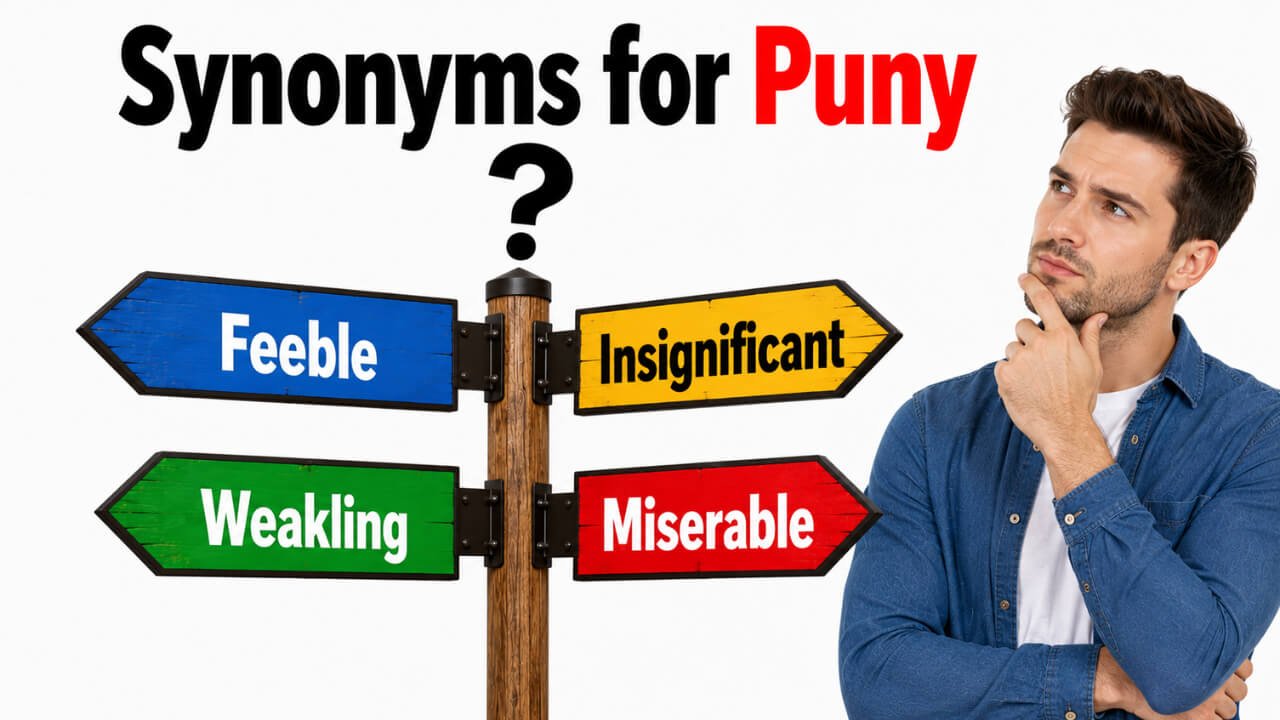
Quick Answer: The best synonyms for puny include tiny, small, little, weak, feeble, frail, scrawny, undersized, insignificant, and meager. The keyword synonyms for puny can describe something very small, physically weak, unimpressive, or not important. Use tiny for very small size, weak for lack of strength, feeble for weak force, insignificant for low importance, meager for a poor amount, and scrawny for a thin and weak looking person or animal.
Pronunciation and Word Details
Word: Puny.
Pronunciation: /ˈpjuː.ni/.
Part of Speech: Adjective.
Meaning: Puny means very small, weak, unimpressive, or lacking size, strength, value, or importance.
US Pronunciation:
UK Pronunciation:
What Does “Puny” Mean?
Puny means small, weak, thin, or unimpressive. It is an adjective used to describe people, animals, objects, efforts, amounts, excuses, or results that seem too small or too weak.
A puny plant may be small and underdeveloped. A puny excuse may sound weak and unconvincing. A puny amount of money may not be enough for a real need. The word can describe physical size, body strength, emotional force, importance, or quality depending on the sentence.
Meaning, Tone, and Context of “Puny”
Puny usually has a negative, critical, or dismissive tone. It is more conversational than formal, but it can still appear in stories, reviews, descriptions, and opinion writing.
Tone: Critical, casual, sometimes humorous, and often slightly insulting.
Context: Small size, weak body, poor effort, low value, little importance, or small amount.
Careful Use: Avoid using puny to describe a real person directly unless the tone is playful or clearly not offensive. It can sound rude when used for someone’s body or strength.
When and How to Use “Puny”
For Small Size: Use puny when something looks much smaller than expected.
Example: A puny tree stood alone in the dry field.
For Weak Strength: Use puny when someone or something lacks power or force.
Example: His puny arms could not lift the heavy box.
For Poor Effort: Use puny when an attempt feels too weak to matter.
Example: That was a puny effort for such an important task.
For Low Importance: Use puny when something seems too small to be meaningful.
Example: A puny complaint should not delay the whole project.
For Small Amount: Use puny when an amount is too little or not enough.
Example: They received a puny share of the reward.
Best Synonyms for Puny
Tiny: Very small in size.
Example: The tiny bird rested on the branch.
Small: Not large in size, amount, or degree.
Example: They lived in a small house near the river.
Little: Small in size, age, amount, or importance.
Example: A little mistake changed the answer.
Weak: Lacking strength, power, or force.
Example: His weak voice was hard to hear.
Feeble: Very weak or lacking energy.
Example: She made a feeble attempt to explain the delay.
Frail: Physically weak or delicate.
Example: The frail man walked slowly across the room.
Scrawny: Very thin and weak looking.
Example: The scrawny cat searched for food.
Undersized: Smaller than normal or expected.
Example: The undersized chair looked strange beside the large table.
Insignificant: Too small or unimportant to matter much.
Example: The error was insignificant in the final report.
Meager: Small in amount, quality, or value.
Example: They survived on a meager supply of food.
50 Synonyms for Puny with Short Meanings
- Tiny: Very small in size.
- Small: Not large or big.
- Little: Small in size, amount, or importance.
- Miniature: Much smaller than normal.
- Diminutive: Very small and delicate.
- Petite: Small and graceful.
- Slight: Thin, small, or not strong.
- Thin: Having little body size or thickness.
- Slim: Narrow or thin in shape.
- Skinny: Very thin in body shape.
- Scrawny: Thin and weak looking.
- Bony: Very thin with visible bones.
- Lean: Thin, with little extra flesh.
- Undersized: Smaller than normal or expected.
- Stunted: Prevented from growing properly.
- Shrunken: Made smaller or reduced in size.
- Smallish: Somewhat small.
- Microscopic: Extremely tiny.
- Minute: Extremely small.
- Teeny: Very tiny in a casual sense.
- Weak: Lacking strength or power.
- Feeble: Very weak or lacking force.
- Frail: Weak, delicate, or easily hurt.
- Delicate: Easily damaged or physically weak.
- Fragile: Easily broken or harmed.
- Weakly: Often ill, weak, or lacking strength.
- Powerless: Without strength or control.
- Helpless: Unable to act strongly or independently.
- Ineffective: Not producing a strong result.
- Flimsy: Weak, thin, or poorly made.
- Insignificant: Not important or meaningful.
- Minor: Small in importance or effect.
- Trivial: Too unimportant to worry about.
- Petty: Small and unimportant.
- Negligible: So small it hardly matters.
- Unimportant: Not important.
- Inconsequential: Having little or no effect.
- Paltry: Small, poor, or worthless.
- Meager: Too small in amount or quality.
- Scant: Barely enough.
- Sparse: Thinly spread or limited.
- Limited: Small in amount, range, or power.
- Poor: Low in quality or amount.
- Weakening: Losing strength or force.
- Lackluster: Unimpressive or lacking energy.
- Unimpressive: Not strong, special, or notable.
- Inferior: Lower in quality or value.
- Wimpy: Weak in a casual or critical way.
- Limp: Lacking strength, firmness, or energy.
- Soft: Lacking toughness or force in some contexts.
Read Also:
Synonyms for Quick

Synonyms for Puny by Context
When Puny Means Small in Size
Use these synonyms when puny describes something physically small.
Tiny: Very small.
Example: The tiny seed grew into a healthy plant.
Diminutive: Small and delicate.
Example: The diminutive bird moved quickly through the grass.
Undersized: Smaller than normal.
Example: The undersized table did not fit the large room.
Miniature: Made or appearing in a very small form.
Example: The miniature house looked carefully designed.
When Puny Means Weak in Strength
Use these synonyms when puny describes low power, weak force, or poor physical strength.
Weak: Lacking strength.
Example: His weak grip could not hold the rope.
Feeble: Very weak or lacking energy.
Example: The old lamp gave a feeble light.
Frail: Physically weak or delicate.
Example: The frail patient needed careful support.
Powerless: Without force or control.
Example: They felt powerless against the strong storm.
When Puny Means Thin or Scrawny
Use these synonyms when puny describes a thin, weak looking person or animal.
Scrawny: Thin and weak looking.
Example: A scrawny dog waited outside the gate.
Skinny: Very thin.
Example: The skinny child wore an oversized jacket.
Bony: Very thin with visible bones.
Example: The bony horse needed food and care.
Slight: Small and thin.
Example: She had a slight frame but strong confidence.
When Puny Means Unimportant
Use these synonyms when puny means minor, low value, or not worth much attention.
Insignificant: Not important.
Example: The mistake was insignificant in the final score.
Minor: Small in importance.
Example: It was only a minor issue.
Trivial: Too small to matter.
Example: They argued over a trivial detail.
Negligible: So small it has little effect.
Example: The cost difference was negligible.
When Puny Means Small in Amount
Use these synonyms when puny describes a poor amount, weak supply, or limited quantity.
Meager: Not enough in amount or quality.
Example: The workers received a meager meal.
Scant: Barely enough.
Example: They had scant evidence to support the claim.
Sparse: Thin or limited in number.
Example: The sparse crowd left many seats empty.
Paltry: Too small to be acceptable.
Example: The team received a paltry reward for its effort.
Another Word for Puny
Another word for puny is tiny when you mean very small in size. However, the best replacement depends on context. Use weak for strength, feeble for force, insignificant for importance, and meager for amount.
Original: The puny candle barely lit the room.
Better Option: The feeble candle barely lit the room.
Original: He gave a puny excuse for being late.
Better Option: He gave a weak excuse for being late.
Original: The company offered a puny raise.
Better Option: The company offered a meager raise.
Original: The puny detail did not affect the result.
Better Option: The insignificant detail did not affect the result.
When Not to Use “Puny”
Do not use puny when a softer, more respectful, or more exact word would work better. It can sound rude when describing a person’s body. It can also sound too casual in formal writing.
Weak: The puny old woman needed help crossing the street.
Better: The frail old woman needed help crossing the street.
Weak: The report showed a puny change in sales.
Better: The report showed a negligible change in sales.
Weak: His puny argument failed.
Better: His weak argument failed.
Weak: They received puny food portions at the event.
Better: They received meager food portions at the event.
Words Commonly Confused With Puny
Puny vs Tiny: Puny can mean small and weak, while tiny mainly means very small.
Puny vs Weak: Puny can describe size, strength, amount, or importance, while weak mainly describes lack of strength or force.
Puny vs Feeble: Puny is broader and more casual, while feeble often means very weak in body, sound, effort, or force.
Puny vs Frail: Puny may sound insulting, while frail is more polite and often describes physical weakness or delicate health.
Puny vs Meager: Puny can describe a small amount, but meager is better for poor supply, small payment, or limited resources.
Puny vs Insignificant: Puny can describe size or strength, while insignificant focuses on low importance or little effect.
Which Synonym Should You Choose?
Choose tiny when writing about very small physical size.
Choose small when you need a simple and neutral word.
Choose little for casual speech or softer description.
Choose weak when describing lack of strength, force, or confidence.
Choose feeble when something has very little power, energy, or effect.
Choose frail when describing delicate physical weakness in a respectful way.
Choose scrawny when describing a thin and weak looking person or animal.
Choose undersized when something is smaller than normal or expected.
Choose meager when writing about a poor amount, low payment, or limited supply.
Choose insignificant when something is too unimportant to matter much.
Real Life Examples of “Puny” in Sentences
Original: The puny plant needed more sunlight.
Better Option: The tiny plant needed more sunlight.
Original: He gave a puny excuse for missing the meeting.
Better Option: He gave a weak excuse for missing the meeting.
Original: The puny candle did not brighten the room.
Better Option: The feeble candle did not brighten the room.
Original: Their puny savings could not cover the repair cost.
Better Option: Their meager savings could not cover the repair cost.
Original: The puny dog hid behind the chair.
Better Option: The scrawny dog hid behind the chair.
Original: That puny complaint did not change the decision.
Better Option: That insignificant complaint did not change the decision.
Original: The puny chair looked strange beside the large table.
Better Option: The undersized chair looked strange beside the large table.
Original: His puny voice disappeared in the noisy hall.
Better Option: His weak voice disappeared in the noisy hall.
Original: The puny reward disappointed the workers.
Better Option: The paltry reward disappointed the workers.
Original: A puny effort will not solve a serious problem.
Better Option: A feeble effort will not solve a serious problem.
Synonym Groups and Usage Differences
Size Group
This group includes words that describe something physically small. Use these when puny refers to height, length, shape, or physical size.
Synonyms: Tiny, small, little, miniature, diminutive, undersized.
Example: The tiny box was easy to carry.
Strength Group
This group includes words that describe low power, weak force, or poor energy.
Synonyms: Weak, feeble, frail, fragile, powerless, limp.
Example: His feeble push did not move the door.
Body Description Group
This group includes words for a person or animal that looks thin, small, or weak. Use them carefully because some can sound rude.
Synonyms: Scrawny, skinny, bony, slight, thin, lean.
Example: The scrawny kitten needed food and warmth.
Importance Group
This group includes words that describe something with little value or little effect.
Synonyms: Insignificant, minor, trivial, negligible, inconsequential, unimportant.
Example: The change was negligible and did not affect the result.
Amount Group
This group includes words for small supplies, low payments, limited resources, or poor quantities.
Synonyms: Meager, scant, sparse, paltry, limited, poor.
Example: The family survived on a meager income.
Antonyms of Puny
Huge: Very large in size.
Large: Big in size, amount, or scale.
Strong: Having power, force, or physical ability.
Powerful: Having great strength or influence.
Muscular: Having strong and developed muscles.
Sturdy: Strong, solid, and well built.
Robust: Strong, healthy, and full of energy.
Significant: Important or meaningful.
Substantial: Large enough to be important.
Abundant: More than enough in amount or supply.
Comparison: Puny vs Related Words
Puny vs Tiny
Difference: Puny often suggests smallness with weakness or lack of impressiveness. Tiny only means very small and is usually neutral.
Example With Puny: The puny plant looked weak in the dry soil.
Example With Tiny: The tiny plant grew in a small pot.
Puny vs Weak
Difference: Puny can describe size, strength, amount, or importance. Weak mainly describes lack of strength, force, or power.
Example With Puny: His puny effort did not help the team.
Example With Weak: His weak effort did not help the team.
Puny vs Feeble
Difference: Puny is casual and can describe smallness or weakness. Feeble is more exact for weak force, weak sound, or weak effort.
Example With Puny: The puny light barely reached the wall.
Example With Feeble: The feeble light barely reached the wall.
Puny vs Frail
Difference: Puny may sound insulting when used for a person. Frail sounds more respectful and often refers to delicate health or physical weakness.
Example With Puny: The puny man struggled with the heavy bag.
Example With Frail: The frail man struggled with the heavy bag.
Puny vs Meager
Difference: Puny can describe a poor amount, but meager is stronger and clearer for limited money, food, resources, or supply.
Example With Puny: They received a puny share of the profit.
Example With Meager: They received a meager share of the profit.
Common Phrases and Expressions With Puny
Puny Effort: A weak or unimpressive attempt.
Puny Excuse: A weak reason that does not sound convincing.
Puny Amount: A very small or poor quantity.
Puny Body: A small or weak physical frame.
Puny Voice: A weak or soft voice.
Puny Reward: A small and disappointing prize or payment.
Puny Result: A weak or unimpressive outcome.
Puny Little Thing: A casual phrase for something very small or unimpressive.
Puny Strength: Very little physical power.
Puny Detail: A detail that seems too small to matter.
Common Mistakes to Avoid
One common mistake is using puny for every small thing. If the tone should be neutral, use small or tiny instead. Another mistake is using puny in formal writing when insignificant, meager, or negligible would sound more precise.
Avoid using puny to describe people unless the sentence needs a critical or humorous tone. It can sound insulting. Also avoid confusing puny with tiny. Tiny means very small, but puny often adds the idea of weakness or poor quality.
Conclusion
The keyword synonyms for puny includes words for small size, weak strength, poor amount, and low importance. Use tiny, small, or diminutive for size. Use weak, feeble, or frail for strength. Use meager, scant, or paltry for amount. Use insignificant, minor, or trivial for importance. The best synonym depends on what you want to describe and how polite, formal, or critical your sentence should sound.
FAQs About Synonyms for Puny
What are the best synonyms for puny?
The best synonyms for puny are tiny, small, weak, feeble, frail, scrawny, undersized, meager, and insignificant.
What does puny mean in simple words?
Puny means very small, weak, unimpressive, or not important. It can describe size, strength, amount, effort, or value.
Is puny a rude word?
Puny can sound rude when used to describe a person’s body or strength. Use frail, slight, or small if you want a softer tone.
What is another word for puny in formal writing?
In formal writing, use insignificant, negligible, meager, limited, or weak, depending on the meaning.
What is a better word than puny for weak effort?
A better word for weak effort is feeble. You can also use weak, ineffective, or lackluster.
What is a synonym for puny amount?
Good synonyms for a puny amount include meager, scant, paltry, limited, and sparse.
What is the opposite of puny?
The opposite of puny can be huge, large, strong, powerful, sturdy, robust, significant, or substantial, depending on context.
