
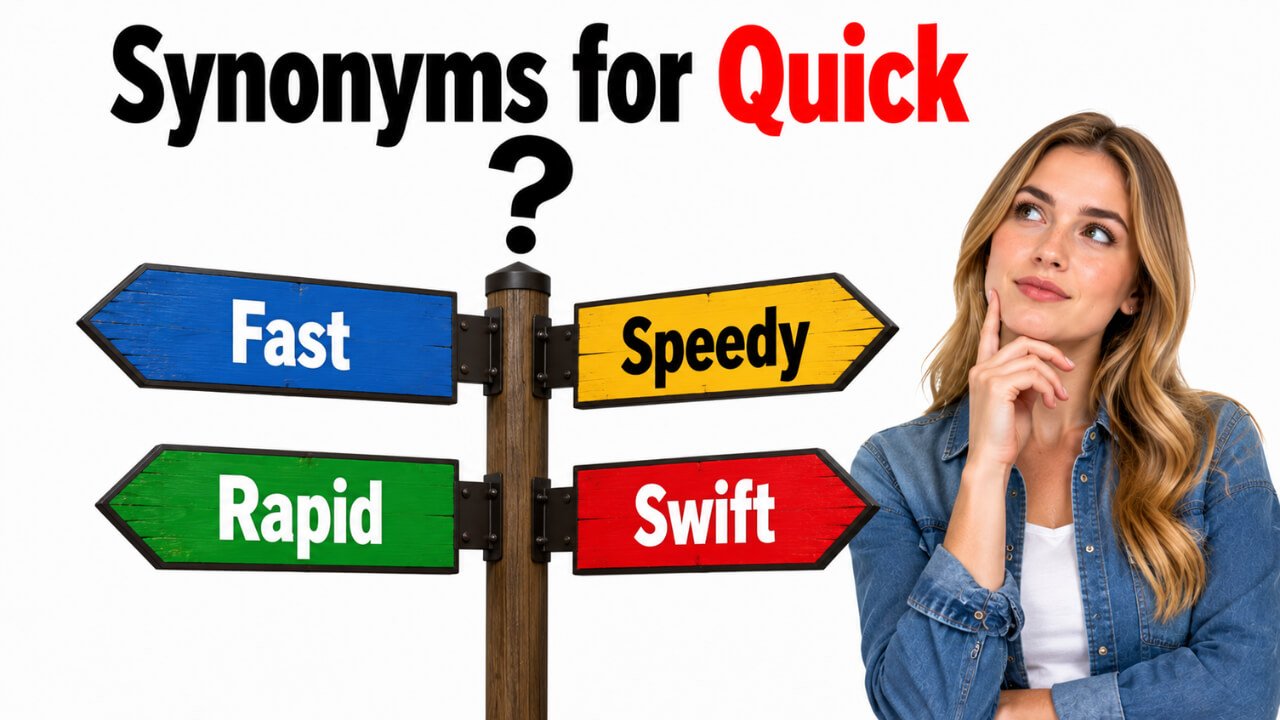
Quick Answer: Synonyms for quick include fast, rapid, swift, speedy, prompt, immediate, instant, brisk, sudden, and brief. Use fast for general speed, rapid for formal or measurable speed, swift for smooth movement or action, prompt for timely response, immediate for something happening without delay, brisk for energetic speed, sudden for something unexpected, and brief when quick means short in time or length.
Pronunciation and Word Details
Word: Quick.
Pronunciation: /kwɪk/.
Part of Speech: Adjective. It can also work informally as an adverb in some expressions and as a noun in special uses.
Meaning: Quick means moving, happening, or done fast, or lasting only a short time.
US Pronunciation:
UK Pronunciation:
What Does “Quick” Mean?
Direct Answer: Quick means fast, prompt, short, or able to respond without delay.
Explanation: Quick is most often an adjective. It can describe speed, time, reaction, movement, thinking, speech, work, or duration. A quick runner moves fast. A quick reply comes soon. A quick meeting does not last long. A quick thinker understands or reacts rapidly.
Grammar Use: Quick usually appears before a noun, as in quick answer, quick trip, or quick decision. It can also appear after a linking verb, as in the response was quick.
Example: She gave a quick reply before leaving the room.
Meaning, Tone, and Context of “Quick”
Tone: Quick is simple, neutral, and common in both spoken and written English.
Casual Use: I need a quick break.
Formal Use: The team made a prompt decision.
Business Use: Thank you for your quick response.
Academic Use: The experiment produced a rapid change in temperature.
Main Contexts: Quick can mean fast in speed, short in duration, prompt in response, sharp in thinking, or sudden in action. Because it has several meanings, the best synonym depends on the exact sentence.
When and How to Use “Quick”
For Speed: Use quick when something moves or happens fast.
Example: The athlete made a quick move toward the finish line.
For Response: Use quick when someone answers or reacts without delay.
Example: She gave a quick answer to the question.
For Short Duration: Use quick when something takes little time.
Example: We had a quick meeting after lunch.
For Thinking: Use quick when someone understands or reacts mentally fast.
Example: He is quick at solving problems.
For Sudden Action: Use quick when something happens suddenly or unexpectedly.
Example: A quick change in weather surprised everyone.
For Simple Tasks: Use quick when a task is easy and not time consuming.
Example: I made a quick note before the call.
Best Synonyms for Quick
Fast: Moving or happening at high speed.
Example: She is a fast learner.
Rapid: Happening very quickly, often in a formal or measurable way.
Example: The city saw rapid growth.
Swift: Fast, smooth, and efficient.
Example: The manager took swift action.
Speedy: Done or happening quickly.
Example: We hope for a speedy recovery.
Prompt: Done without delay.
Example: Thank you for your prompt reply.
Immediate: Happening at once.
Example: The issue needs immediate attention.
Instant: Happening right away.
Example: The app gave an instant result.
Brisk: Quick and energetic.
Example: They took a brisk walk in the morning.
Brief: Short in time or length.
Example: The speaker gave a brief explanation.
Sudden: Happening quickly and unexpectedly.
Example: A sudden noise came from outside.
50 Synonyms for Quick with Short Meanings
- Fast: Moving or happening at high speed.
- Rapid: Very quick in movement, change, or progress.
- Swift: Fast, smooth, and efficient.
- Speedy: Done or happening quickly.
- Prompt: Done without delay.
- Immediate: Happening at once.
- Instant: Happening right away.
- Sudden: Happening quickly and unexpectedly.
- Brisk: Quick, active, and energetic.
- Hasty: Done too quickly, often without enough care.
- Hurried: Done in a rush.
- Rushed: Done quickly because of pressure.
- Expeditious: Fast and efficient, especially in formal use.
- Fleet: Very fast, especially in movement.
- Nimble: Quick and light in movement.
- Agile: Able to move or think quickly.
- Spry: Energetic and quick in movement.
- Lively: Active, energetic, and quick.
- Sharp: Quick in thought or response.
- Alert: Ready to notice and react quickly.
- Ready: Prepared to act quickly.
- Responsive: Able to react quickly.
- Efficient: Done quickly with little waste.
- Accelerated: Made faster than usual.
- High speed: Moving or operating very fast.
- Fast moving: Changing or moving quickly.
- Swift moving: Moving smoothly and quickly.
- Snappy: Quick, lively, and energetic.
- Zippy: Fast, lively, and full of energy.
- Brief: Short in time or length.
- Short: Not lasting long.
- Concise: Short and clear.
- Compact: Short, tight, and not too detailed.
- Condensed: Made shorter while keeping the main idea.
- Fleeting: Lasting only a very short time.
- Momentary: Lasting for a moment.
- Passing: Brief and not lasting long.
- Temporary: Lasting for a short time.
- Transient: Short lived or not permanent.
- Abrupt: Sudden and unexpected.
- Curt: Very brief, sometimes sounding rude.
- Short lived: Lasting only a little while.
- Lightning fast: Extremely fast.
- Soon: After a short time.
- Promptly: Without delay.
- At once: Immediately.
- Readily: Quickly and willingly.
- Rash: Too quick and careless.
- Impulsive: Done suddenly without much thought.
- Precipitate: Done suddenly or too quickly.
Read Also:
Synonyms for Limited
Synonyms for Quick by Context
When Quick Means Fast
Useful Synonyms: Fast, rapid, swift, speedy, fleet, high speed, lightning fast.
Explanation: Use these words when quick describes speed, movement, progress, or action.
Example: The runner made a quick start.
Better Option: The runner made a fast start.
When Quick Means Prompt
Useful Synonyms: Prompt, immediate, instant, at once, soon, promptly.
Explanation: Use these words when quick means without delay.
Example: She gave a quick reply.
Better Option: She gave a prompt reply.
When Quick Means Brief
Useful Synonyms: Brief, short, concise, compact, condensed.
Explanation: Use these words when quick means short in time, length, or detail.
Example: We had a quick discussion.
Better Option: We had a brief discussion.
When Quick Means Alert or Sharp
Useful Synonyms: Sharp, alert, ready, responsive, agile, nimble.
Explanation: Use these words when quick describes mental speed, awareness, or reaction.
Example: He has a quick mind.
Better Option: He has a sharp mind.
When Quick Means Rushed or Careless
Useful Synonyms: Hasty, hurried, rushed, rash, impulsive, precipitate.
Explanation: Use these words when quick suggests speed without enough care.
Example: She made a quick decision without reading the details.
Better Option: She made a hasty decision without reading the details.
Another Word for Quick
Direct Answer: Another word for quick is fast, but the best single replacement depends on meaning.
Best General Choice: Fast works well when quick means high speed.
Best Formal Choice: Rapid works well in reports, studies, and professional writing.
Best Response Choice: Prompt works well when talking about replies, service, or action.
Best Short Duration Choice: Brief works well when quick means not lasting long.
Original: He gave a quick answer.
Better Option: He gave a prompt answer.
Original: The company showed quick growth.
Better Option: The company showed rapid growth.
Original: We took a quick walk.
Better Option: We took a brisk walk.
Original: The teacher gave a quick explanation.
Better Option: The teacher gave a brief explanation.
When Not to Use “Quick”
Avoid Vague Use: Quick can be too general when the sentence needs a more exact meaning.
Weak: The process was quick.
Better: The process was rapid and efficient.
Avoid Wrong Tone: Quick is fine in everyday writing, but prompt or immediate may sound better in formal writing.
Weak: Thank you for your quick attention.
Better: Thank you for your prompt attention.
Avoid Wrong Meaning: Do not use quick when you mean careless unless the context is clear.
Weak: He made a quick decision and caused a problem.
Better: He made a hasty decision and caused a problem.
Avoid Repetition: Do not repeat quick too many times in one paragraph.
Weak: We had a quick call, a quick review, and a quick update.
Better: We had a brief call, a short review, and a prompt update.
Avoid Confusing Speed With Length: Quick can mean fast or short. Choose rapid for speed and brief for length.
Weak: The report was quick.
Better: The report was brief.
Words Commonly Confused With Quick
Quick vs Fast: Quick can mean fast, prompt, or brief. Fast usually means high speed.
Quick vs Rapid: Quick is more common and general. Rapid sounds more formal and often describes change, growth, movement, or progress.
Quick vs Prompt: Quick can describe speed or short time. Prompt mainly means done without delay.
Quick vs Brief: Quick can mean fast or short. Brief means short in duration, length, or detail.
Quick vs Hasty: Quick is usually neutral or positive. Hasty means too quick and often careless.
Quick vs Sudden: Quick means fast. Sudden means unexpected and happening without warning.
Quick vs Immediate: Quick means fast or soon. Immediate means right away with no delay.
Which Synonym Should You Choose?
Choose fast: When describing general speed, movement, or action.
Choose rapid: When writing about growth, change, progress, results, or measurable speed.
Choose swift: When you want a polished word for smooth and effective action.
Choose prompt: When writing about replies, responses, service, or action without delay.
Choose immediate: When something must happen right away.
Choose brief: When quick means short in time or length.
Choose concise: When quick means short but clear in writing or speech.
Choose hasty: When quick action lacks care or thought.
Choose sudden: When something happens unexpectedly.
Choose alert: When quick describes awareness or reaction.
Real Life Examples of “Quick” in Sentences
Original: She gave a quick reply to my message.
Better Option: She gave a prompt reply to my message.
Original: The team made a quick decision.
Better Option: The team made a swift decision.
Original: The company experienced quick growth.
Better Option: The company experienced rapid growth.
Original: He took a quick look at the notes.
Better Option: He took a brief look at the notes.
Original: The child made a quick movement.
Better Option: The child made a sudden movement.
Original: We had a quick meeting before work.
Better Option: We had a short meeting before work.
Original: She is quick at solving puzzles.
Better Option: She is sharp at solving puzzles.
Original: The doctor asked for quick action.
Better Option: The doctor asked for immediate action.
Original: He gave a quick explanation.
Better Option: He gave a concise explanation.
Original: The player made a quick turn.
Better Option: The player made a swift turn.
Synonym Groups and Usage Differences
Speed Group
Words: Fast, rapid, swift, speedy, fleet, high speed.
Use: These words describe movement, action, progress, or change.
Example: The train made a rapid climb through the hills.
Response Group
Words: Prompt, immediate, instant, responsive, ready.
Use: These words describe fast replies, reactions, service, or attention.
Example: The office gave a prompt response.
Short Time Group
Words: Brief, short, momentary, fleeting, passing.
Use: These words describe something that does not last long.
Example: We had a brief conversation after class.
Sharp Thinking Group
Words: Sharp, alert, agile, nimble, responsive.
Use: These words describe quick thinking, awareness, or mental reaction.
Example: Her sharp mind helped solve the issue.
Careless Speed Group
Words: Hasty, hurried, rushed, rash, impulsive.
Use: These words describe action done too quickly or without enough thought.
Example: A hasty choice can create bigger problems later.
Antonyms of Quick
Slow: Moving or happening at low speed.
Delayed: Happening later than expected.
Late: Not happening on time.
Gradual: Happening slowly over time.
Lengthy: Taking a long time.
Long: Lasting for much time or space.
Leisurely: Done slowly and without hurry.
Sluggish: Slow and lacking energy.
Careful: Done with attention rather than speed.
Steady: Slow, even, and controlled.
Dull: Not quick in thought or reaction.
Inactive: Not moving or acting quickly.
Comparison Between Quick and Related Words
Quick vs Fast
Difference: Quick can mean fast, prompt, or short. Fast mainly describes high speed.
Example With Quick: She made a quick decision.
Example With Fast: She drives a fast car.
Quick vs Rapid
Difference: Quick is common in everyday English. Rapid sounds more formal and is often used for change, growth, or movement.
Example With Quick: The update was quick.
Example With Rapid: The update caused rapid improvement.
Quick vs Prompt
Difference: Quick is general. Prompt means done at the right time without delay.
Example With Quick: He gave a quick answer.
Example With Prompt: He gave a prompt answer.
Quick vs Brief
Difference: Quick may describe speed or time. Brief only means short in time, length, or detail.
Example With Quick: We need a quick answer.
Example With Brief: We need a brief answer.
Quick vs Hasty
Difference: Quick is usually neutral. Hasty suggests careless speed.
Example With Quick: She made a quick choice.
Example With Hasty: She made a hasty choice and regretted it.
Common Phrases and Expressions With Quick
Quick Answer: A fast or direct reply.
Quick Look: A brief glance or short check.
Quick Trip: A short journey.
Quick Call: A short phone conversation.
Quick Decision: A decision made fast.
Quick Response: A reply or reaction without delay.
Quick Fix: A fast solution, often temporary.
Quick Thinking: Fast and useful mental reaction.
Quick Change: A fast shift or adjustment.
Quick Review: A short check or examination.
Common Mistakes to Avoid
Mistake One: Using quick when a more exact synonym is better.
Weak: The results changed quick.
Better: The results changed rapidly.
Mistake Two: Using quick as an adverb in formal writing.
Weak: Please reply quick.
Better: Please reply quickly.
Mistake Three: Confusing quick with brief.
Weak: The article is quick.
Better: The article is brief.
Mistake Four: Using hasty when the meaning is positive.
Weak: Thank you for your hasty reply.
Better: Thank you for your prompt reply.
Mistake Five: Repeating quick too often.
Weak: We need a quick plan, a quick call, and a quick update.
Better: We need a fast plan, a brief call, and a prompt update.
Mistake Six: Using rapid for every casual sentence.
Weak: I need a rapid snack.
Better: I need a quick snack.
Conclusion
Summary: Synonyms for quick help you choose a clearer word for speed, timing, short duration, sharp reaction, or sudden action. Use fast for general speed, rapid for formal change, prompt for timely replies, immediate for urgent action, brief for short length, and hasty when speed suggests carelessness. The best synonym depends on whether quick describes movement, response, time, thinking, or tone.
FAQs About Synonyms for Quick
What is the best synonym for quick?
Answer: Fast is the best general synonym for quick, but prompt, rapid, swift, and brief may be better in specific contexts.
What is a formal synonym for quick?
Answer: Rapid, prompt, immediate, expeditious, and swift are formal synonyms for quick.
What is another word for quick response?
Answer: Prompt response, immediate response, fast reply, and timely reply are good alternatives.
What is another word for quick movement?
Answer: Fast movement, swift movement, rapid movement, sudden movement, and brisk movement are useful options.
Is quick the same as fast?
Answer: Not always. Quick can mean fast, short, or prompt. Fast mainly means moving or happening at high speed.
What is the opposite of quick?
Answer: The opposite of quick can be slow, delayed, late, gradual, lengthy, or sluggish, depending on the meaning.
What is a better word than quick in writing?
Answer: Use rapid for formal speed, prompt for replies, brief for short length, swift for smooth action, and hasty for careless speed.
