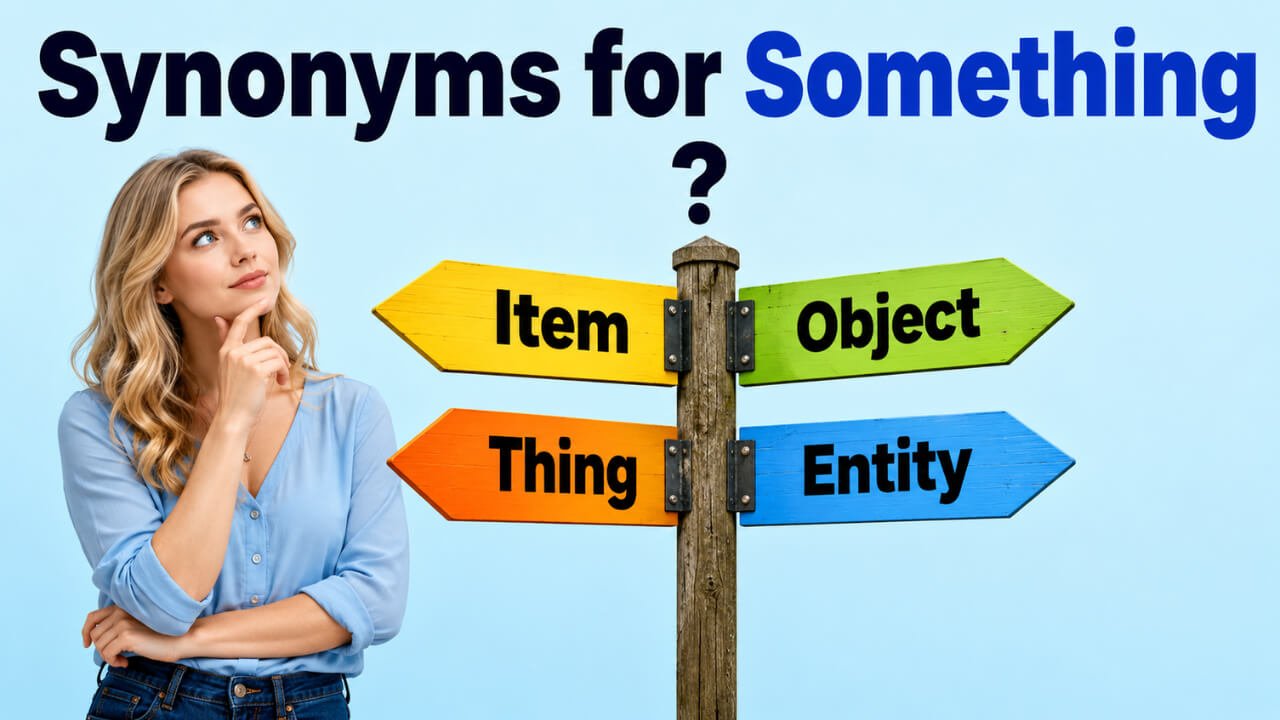
Quick Answer: The best synonyms for something include thing, item, object, matter, issue, point, detail, element, factor, and subject. Use thing in casual speech, item for lists or objects, object for physical things, matter for a topic or concern, issue for a problem, point for an idea, detail for specific information, element for a part, and factor for something that affects a result.
Pronunciation and Word Details
Word: Something
Pronunciation: ˈsʌmθɪŋ
Part of Speech: Pronoun and noun
Meaning: An unspecified thing, idea, event, matter, amount, or quality.
US Pronunciation:
UK Pronunciation:
What Does “Something” Mean?
Direct Answer: Something means an unspecified or unnamed thing, idea, event, amount, quality, or matter. It is commonly used when the speaker does not know, does not name, or does not need to identify the exact thing.
As a Pronoun: Something can replace an unknown or unnamed noun.
Example: I heard something outside.
As a Noun: Something can mean a thing, quality, or important feature.
Example: There is something special about this place.
In Everyday Speech: Something is useful when the exact word is unknown, unnecessary, or not important.
Meaning, Tone, and Context of “Something”
Tone: Something is neutral, simple, and conversational. It is one of the most common words for referring to an unnamed thing.
Formality: Something is acceptable in everyday speech, casual writing, and many professional sentences. In formal writing, a more specific word such as factor, issue, element, detail, or matter may sound clearer.
Common Contexts: Something is used for objects, ideas, feelings, events, problems, plans, changes, amounts, and unknown details.
Emotional Use: Something can create mystery, uncertainty, curiosity, or emphasis.
Example: Something about his voice made everyone listen.
When and How to Use “Something”
For an Unknown Thing: Use something when you do not know the exact object, fact, or idea.
Example: Something is missing from the drawer.
For a General Matter: Use something when referring to an issue or topic without naming it.
Example: We need to discuss something important.
For a Quality: Use something when describing an unnamed quality or feeling.
Example: There is something peaceful about this room.
For an Offer: Use something when offering food, help, information, or action.
Example: Would you like something to drink?
For a Problem: Use something when a situation feels wrong but the cause is unclear.
Example: Something is not right with this report.
For an Amount: Use something when referring to an approximate amount.
Example: The repair cost something around fifty dollars.
Best Synonyms for Something
Thing: A general word for an object, idea, action, or matter.
Example: I need to ask you one thing.
Item: A single object, product, or entry in a list.
Example: Please remove one item from the basket.
Object: A physical thing that can be seen or touched.
Example: A small object was lying near the door.
Matter: A subject, issue, or situation being discussed.
Example: This matter needs careful attention.
Issue: A problem, topic, or point of concern.
Example: We found an issue in the document.
Point: A specific idea, detail, or argument.
Example: She raised an important point during the meeting.
Detail: A small piece of information.
Example: One detail in the story seemed unusual.
Element: One part of a larger whole.
Example: Trust is an important element of friendship.
Factor: Something that affects a result or decision.
Example: Price was a major factor in their choice.
Subject: A topic, theme, or area of discussion.
Example: The subject came up during class.
50 Synonyms for Something with Short Meanings
- Thing: A general object, idea, or matter.
- Item: One separate object or entry.
- Object: A physical thing that can be seen or touched.
- Article: A particular object or item.
- Entity: A thing that exists as a separate unit.
- Matter: A subject, issue, or concern.
- Issue: A problem, question, or topic.
- Subject: A topic being discussed or studied.
- Topic: A matter of conversation or writing.
- Point: A specific idea or detail.
- Detail: A small part of information.
- Element: One part of a larger whole.
- Factor: Something that affects a result.
- Part: A piece or section of something.
- Component: A part of a system or whole.
- Feature: A noticeable quality or part.
- Aspect: One side or part of a subject.
- Piece: A part, object, or bit of information.
- Bit: A small amount or small part.
- Unit: One separate thing in a group.
- Case: A situation, example, or instance.
- Instance: A specific example or occurrence.
- Example: A thing that shows or represents an idea.
- Incident: An event, often unusual or notable.
- Event: Something that happens.
- Occurrence: An event or happening.
- Situation: A set of conditions or circumstances.
- Circumstance: A fact or condition connected with a situation.
- Concern: A matter that needs attention.
- Affair: A matter, event, or situation.
- Business: A matter or concern to deal with.
- Question: A matter needing an answer or decision.
- Problem: A difficulty or issue.
- Possibility: Something that may happen or be true.
- Idea: A thought, plan, or concept.
- Thought: Something formed in the mind.
- Concept: A general idea or principle.
- Notion: An idea, belief, or impression.
- Proposal: An idea or plan offered for consideration.
- Plan: An intended action or arrangement.
- Quality: A feature, nature, or characteristic.
- Trait: A particular quality or characteristic.
- Characteristic: A typical feature or quality.
- Sign: An indication that something exists or may happen.
- Hint: A small clue or suggestion.
- Clue: Information that helps explain something.
- Reason: A cause or explanation.
- Cause: Something that makes an event happen.
- Result: Something produced by an action or cause.
- Substance: A material, matter, or meaningful content.
Read Also:
Synonyms for Legacy

Synonyms for Something by Context
When Something Means a Thing or Object
Useful Synonyms: Thing, item, object, article, entity, piece, unit.
Use: Choose these words when something refers to a physical object or a general item.
Example: I found something under the table.
Better Option: I found an object under the table.
When Something Means a Matter or Topic
Useful Synonyms: Matter, issue, subject, topic, point, question, concern.
Use: Choose these words when something refers to a discussion, problem, or subject.
Example: We need to talk about something.
Better Option: We need to talk about an important matter.
When Something Means a Part or Detail
Useful Synonyms: Detail, element, aspect, feature, factor, component, part.
Use: Choose these words when something refers to one part of a larger situation or idea.
Example: Something in the plan needs attention.
Better Option: One detail in the plan needs attention.
When Something Means an Event
Useful Synonyms: Event, occurrence, incident, case, instance, situation.
Use: Choose these words when something refers to something that happened.
Example: Something strange happened last night.
Better Option: A strange incident happened last night.
When Something Means an Idea
Useful Synonyms: Idea, thought, concept, notion, proposal, plan.
Use: Choose these words when something refers to a thought, suggestion, or mental image.
Example: I have something in mind.
Better Option: I have an idea in mind.
When Something Means a Quality
Useful Synonyms: Quality, trait, characteristic, feature, sign, hint.
Use: Choose these words when something refers to an unnamed quality or feeling.
Example: There is something kind in her expression.
Better Option: There is a gentle quality in her expression.
Another Word for Something
Direct Answer: Another word for something is thing in casual speech. However, the best replacement depends on the sentence. Use item for a list, object for a physical thing, matter for a concern, issue for a problem, detail for specific information, and idea for a thought.
Original: I need to tell you something.
Better Option: I need to tell you an important detail.
Original: Something is wrong with the file.
Better Option: An issue is affecting the file.
Original: She noticed something on the floor.
Better Option: She noticed an object on the floor.
Original: There is something beautiful about this song.
Better Option: There is a beautiful quality in this song.
When Not to Use “Something”
Avoid Vague Writing: Something can sound unclear when the reader needs specific information.
Weak: Something caused the delay.
Better: A system error caused the delay.
Avoid Repetition: Repeating something too often makes writing sound weak.
Weak: Something happened, and something changed after something went wrong.
Better: An incident happened, and the situation changed after an error occurred.
Avoid Formal Vagueness: In formal writing, use a more precise synonym when possible.
Weak: The study shows something important.
Better: The study shows an important factor.
Avoid Unclear Problems: Use issue, problem, cause, or reason when the sentence is about a difficulty.
Weak: There is something with the machine.
Better: There is a problem with the machine.
Avoid Weak Details: Use detail, point, or aspect when referring to information.
Weak: I noticed something in your answer.
Better: I noticed one detail in your answer.
Words Commonly Confused With Something
Something vs Anything: Something usually refers to an unspecified thing that exists or is expected. Anything often means any possible thing, especially in questions or negative sentences.
Something vs Everything: Something means one unnamed thing or part. Everything means all things.
Something vs Nothing: Something means a thing exists. Nothing means no thing exists.
Something vs Someone: Something refers to a thing, idea, event, or matter. Someone refers to a person.
Something vs Somewhat: Something is a pronoun or noun. Somewhat is an adverb meaning to some degree.
Something vs Thing: Something is less specific and often unknown. Thing is a general noun that can be named, counted, or described.
Something vs Matter: Something is broad and informal. Matter is clearer when referring to a topic, concern, or issue.
Which Synonym Should You Choose?
Choose thing when speaking casually about an unnamed object, idea, or matter.
Choose item when writing about a list, product, object, or entry.
Choose object when the sentence refers to a physical thing.
Choose matter when writing about a subject, concern, or serious topic.
Choose issue when writing about a problem, difficulty, or point of concern.
Choose point when writing about an idea, argument, or statement.
Choose detail when writing about a small piece of information.
Choose element when writing about one part of a larger whole.
Choose factor when writing about a cause or influence in a result.
Choose idea when writing about a thought, plan, or suggestion.
Real Life Examples of “Something” in Sentences
Original: I heard something near the window.
Better Option: I heard a sound near the window.
Original: Something is missing from this paragraph.
Better Option: A detail is missing from this paragraph.
Original: She wants to discuss something with you.
Better Option: She wants to discuss a matter with you.
Original: Something changed after the meeting.
Better Option: The situation changed after the meeting.
Original: There is something unusual about his answer.
Better Option: There is an unusual point in his answer.
Original: I found something in the garden.
Better Option: I found an object in the garden.
Original: Something about this plan feels risky.
Better Option: One aspect of this plan feels risky.
Original: He said something helpful during the lesson.
Better Option: He shared a helpful idea during the lesson.
Original: Something caused the lights to fail.
Better Option: A fault caused the lights to fail.
Original: There is something special about her writing.
Better Option: There is a special quality in her writing.
Synonym Groups and Usage Differences
Object Group
Use: This group works when something means a physical thing.
Synonyms: Thing, item, object, article, entity, piece, unit.
Example: The item on the shelf belongs in the kitchen.
Topic Group
Use: This group works when something means a subject, concern, or discussion point.
Synonyms: Matter, issue, subject, topic, concern, question, affair.
Example: This matter needs a clear answer.
Detail Group
Use: This group works when something means one part of a larger idea, plan, or explanation.
Synonyms: Detail, point, element, aspect, feature, component, factor.
Example: One element of the design needs improvement.
Event Group
Use: This group works when something means a happening or situation.
Synonyms: Event, incident, occurrence, case, instance, situation.
Example: The incident changed the mood of the room.
Idea Group
Use: This group works when something means a thought, plan, or suggestion.
Synonyms: Idea, thought, concept, notion, proposal, plan.
Example: Her proposal solved the main problem.
Quality Group
Use: This group works when something means an unnamed feature, sign, or feeling.
Synonyms: Quality, trait, characteristic, feature, sign, hint, clue.
Example: A quiet confidence is the strongest quality in his speech.
Antonyms of Something
Nothing: No thing or not anything.
Everything: All things rather than one unnamed thing.
Anything: Any possible thing, often used in questions or negatives.
No One: No person, when the meaning refers to a person instead of a thing.
Nowhere: No place, when the meaning refers to location.
None: Not one thing or not any amount.
Zero: No amount or no number.
Absence: The state of something not being present.
Void: An empty space or lack of something.
Lack: The condition of not having something needed.
Comparison: Something vs Related Words
Something vs Anything
Difference: Something often suggests that a thing exists or is expected. Anything is broader and means any possible thing.
Example With Something: I need something to write with.
Example With Anything: Do you need anything from the store?
Something vs Everything
Difference: Something means one unspecified thing or part. Everything means all things.
Example With Something: Something in the room felt different.
Example With Everything: Everything in the room felt different.
Something vs Nothing
Difference: Something means a thing exists. Nothing means no thing exists.
Example With Something: Something made a noise outside.
Example With Nothing: Nothing made a noise outside.
Something vs Thing
Difference: Something is used when the thing is unknown, unnamed, or general. Thing is a common noun for an object, idea, action, or matter.
Example With Something: I saw something near the door.
Example With Thing: The thing near the door was a small box.
Something vs Matter
Difference: Something is broad and general. Matter is clearer when referring to a concern, topic, or issue.
Example With Something: We need to solve something today.
Example With Matter: We need to solve this matter today.
Something vs Item
Difference: Something is general. Item is more specific and usually refers to one object in a list, group, order, or collection.
Example With Something: She bought something from the shop.
Example With Item: She bought one item from the shop.
Common Phrases and Expressions With Something
Something Else: A different thing or an impressive person or thing.
Something Special: A thing, person, or quality that feels important or unusual.
Something New: A new thing, idea, experience, or change.
Something Important: A matter or detail that needs attention.
Something Like: Approximately or similar to.
Something About: An unnamed quality or feature.
Say Something: To speak or give a response.
Do Something: To take action.
Something Wrong: A problem or unusual condition.
Something to Remember: A point, fact, or experience worth keeping in mind.
Common Mistakes to Avoid
Mistake With Vagueness: Do not use something when the reader needs a clear noun. Replace it with issue, reason, detail, object, or factor.
Mistake With Formal Writing: In essays, reports, and professional writing, something can sound too general. Use a precise word when possible.
Mistake With Negative Sentences: Use anything more often than something after negative words.
Weak: I do not need something else.
Better: I do not need anything else.
Mistake With Questions: Anything is often more natural in open questions.
Weak: Do you want something from the store?
Better: Do you want anything from the store?
Mistake With People: Use someone for people and something for things.
Weak: Something called me yesterday.
Better: Someone called me yesterday.
Mistake With Repetition: Replace repeated uses of something with more accurate synonyms.
Weak: Something in the plan shows something is missing.
Better: One detail in the plan shows a key point is missing.
Conclusion
Summary: Understanding synonyms for something helps you write with more clarity and precision. Use thing for casual speech, item for lists, object for physical things, matter for concerns, issue for problems, point for ideas, detail for information, element for parts, and factor for causes or influences. Something is useful when the exact word is unknown, but stronger synonyms make your writing clearer, more specific, and more professional.
FAQs About Synonyms for Something
What are the best synonyms for something?
Answer: The best synonyms for something are thing, item, object, matter, issue, point, detail, element, factor, and subject.
What is another word for something in casual speech?
Answer: Another word for something in casual speech is thing. It is simple, natural, and widely used.
What is a formal synonym for something?
Answer: Formal synonyms for something include matter, issue, subject, element, factor, detail, and entity.
What is another word for something physical?
Answer: Another word for something physical is object. Item, article, thing, and piece can also work.
What is another word for something important?
Answer: Another word for something important is matter, issue, point, concern, or key detail.
Is something the same as anything?
Answer: No. Something usually suggests that a thing exists or is expected. Anything means any possible thing, especially in questions and negative sentences.
Can something be used in formal writing?
Answer: Yes, but it can sound vague. In formal writing, use a clearer word such as factor, issue, detail, matter, or element when the meaning is specific.
